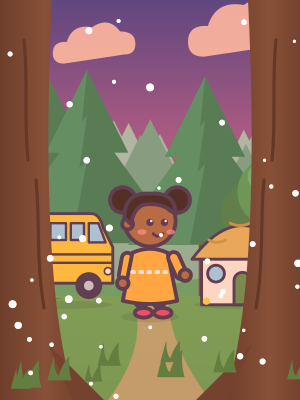
The Thirteenth Stop: the full story
Part One
By the last week of February, Zoya Petrenko had gone thirty-one days without seeing the sun, and she had stopped being polite about it. Cleveland lay beneath the same gray lid it had worn since New Year's, the snow along the curbs had turned the color of old dishwater, and every morning her brother Danyl asked whether it was spring yet, in a voice so patient that she wanted to lie down in a drift and be done. They were riding the Route 13 bus home from their grandmother's, Danyl in his mismatched mittens, Zoya with her phone at eleven percent and her hood drawn up like a curtain, and she was counting the stops, because in this weather counting was the only entertainment available. The bus stopped twelve times, and then, to her considerable astonishment, it stopped again.
There was no shelter at the thirteenth stop, and no street either, only a sign on a pole that read 13 in a handwriting that belonged to no city, and a stand of birches glowing faintly blue in the dusk, and a great deal of snow that did not appear to have been informed it was February. The driver turned round with a face as pale and fixed as a plate. "End of the line," he said, in a voice like a heavy door being closed very slowly. The doors folded open, and cold poured in that smelled of pine and woodsmoke and of something far older than either. "Everybody off." "I have a transfer," Zoya said, which was perfectly true and which, she knew even as she said it, was of no use whatever.
When the bus had gone, its taillights dwindling between the trees, something came up the track toward them that she took, at first, for a small house. It had a steep roof and a crooked chimney and a lit window like a squinting eye, and it was walking, on a pair of immense yellow chicken legs, with the creaking, self-important gait of a very old hen. It lowered itself in front of them with a thump that shook the snow from the birches, and a hatch opened in the door, and a woman looked out, so wrinkled that she appeared to have been folded for storage. "Another bus," she said wearily, "and they never read the schedule. Come in before you freeze. I am Lidka, this is a depot, and I will not be giving refunds."
Inside, the depot was low and warm and smelled of baking, and a long table was crowded with lost property: umbrellas, a violin, a hundred single gloves, and a clock that ran backwards with great dignity. In the corner, on four little iron feet, a squat black stove paced up and down, talking to itself. "Oh, children, oh dear, they are so small and the cold is so enormous, and nobody has had hot tea since the first of January, and I only say, as a stove, that this was not what I was made for." "That is Pech," said Lidka, "and he never stops, and I have given up asking." Zoya checked her phone, which had sunk to three percent, and as she watched it blinked once, politely, and died.
Part Two
It was Lidka who explained, over black bread and a tea so strong that it stood up straight in the cup. The depot was where lost buses came to rest, and it lay in the thirteenth stop that appeared on no calendar, at the very edge of the year. Father Frost, the old man of winter in the tales, had grown tired of the way the seasons always ended, and so he had locked the thaw away in his ice-house at the head of the river, so that now February could not finish. "It will go on and on," said Lidka, "for you, and for Cleveland, and for every place that has ever put up with him. The stove and I are bound to this depot, so it must be somebody who can walk out and come back."
"No," said Zoya, "I am taking my brother home." "On what?" said Lidka, not unkindly. "The bus runs once, when the year is turning, and the year will not turn until the thaw comes down that river." Danyl, who had been listening with his mouth open, put down his bread. "I will go," he said, "because I am not even cold." Zoya looked at him, small and stubborn in the lamplight, then at the stove, which was pacing again, then at the dead black rectangle of her phone, and she said a word that she was not allowed to say at home. "Fine," she said, "but where is this river?"
The river was called the Studena, and at first it did not seem to be a river at all. It looked like a road of blue ice winding between the birches, and Pech the stove, who had insisted on coming for the sake of the warmth, clanked ahead of them explaining at every step that he was not a brave stove. At the bank the ice rippled, and a mouth opened in it, slow and silver. "Toll," said the Studena, in a voice like a spoon in a glass. "I take no coin and no bread, only answers. What can you keep only by giving it away?"
Danyl said, "A cold?" and Pech said, "A cough?" and the ice began to close, and the dark beneath it widened, and the river's voice returned, patient and dreadful. Zoya, who hated to be hurried, thought of every promise she had ever made to her grandmother and resented keeping. "A word," she said slowly, "your word, because you give it, and then you have to keep it." The mouth smiled, and with a long groan, the ice rolled itself into a bridge of white planks, and the Studena said, "That one will cross, and that one will come back, as she has said." And Zoya understood, a moment too late, exactly what she had promised.
Part Three
The ice-house stood at the head of the river, a shining palace of drifts and pillars, and in its doorway, on a throne cut from a single block of blue, sat a very tall old man in a coat the color of frost. His beard fell to his knees and crackled when he breathed, and his eyes were like two lamps seen through a window in a storm. "Children," said Father Frost, and the word came out in a little cloud and hung there. "You have come a long way. Are you warm?" Danyl opened his mouth, but Zoya gripped his shoulder, hard, because she had remembered a story that her grandmother used to read, in which one sister said yes, and one said no, and only one of them ever went home.
"No," said Zoya, "I am freezing, and I have been freezing since the second week of January, and I hate it, and I hate that you took the thaw, and I would like it back." The ice-house went so silent that she could hear the snow settling. Pech the stove whispered, "Oh no, oh no, oh no." Then Father Frost began to laugh, a rumbling, crackling laugh that shook icicles from the ceiling, and he went on for a good while. "In nine hundred years," he said, wiping his eyes, "everyone has told me they were warm. Every single one. They say it very sweetly, and they would sooner freeze than say otherwise, so that I had almost forgotten what it is like to be spoken to straight."
"Then why take the thaw at all?" said Zoya, who by now saw no point in stopping, and his beard stopped crackling. "Because it leaves," said Father Frost quietly. "Every spring the entire world is glad to see the back of me, and I sit up here with the drifts for company, and I thought, if I held it a little longer, only one winter, somebody might come to say goodbye." He lifted a brass key as long as her forearm from a string around his neck. "The thaw is in the kettle behind the throne," he said. "This opens it. Only remember what you promised the river, child. Come again, next February, and tell me something true."
So the thaw went down the Studena that night in one long shining roar, and the birches shook off their snow, and the ice cracked from end to end, and a smell of wet earth came up that nearly knocked Danyl over. Lidka's depot danced on its chicken legs, and Pech said, "I knew it, I never doubted for a moment," and fell off a step. At dawn a tired yellow bus came wheezing up the track, and the driver, whose face was now an ordinary tired face, said, "Route 13, mind the gap." Zoya climbed on, and Danyl took the window seat, and they counted the stops back, one, two, three, all the way down to twelve.
At the twelfth stop the doors folded open on Cleveland, on a street that was dripping and sparkling and running with water toward every drain. A single gold bar of sunlight lay across the pavement. Zoya took out her phone, which, impossibly, had woken itself with three percent, and the date on the screen said March 1. Danyl was holding up one bare hand. "I lost a mitten," he said. "No, you did not," said Zoya, and she looked back at the empty seat behind them, where a small red mitten lay on the cushion, and beside it, folded as small as a stamp, a pale blue note that said, in a handwriting that belonged to no city: See you in February.