The Time Machine: the full story
Part One · The Machine
"Time travel is impossible," said one of the inventor's five dinner guests, and he laughed out loud. So the inventor set a little machine on the table, no bigger than a clock, made of shining brass and ivory. He touched a tiny white lever. The machine shimmered, blurred, and vanished. It had not fallen. It had not been hidden. It had simply gone, forward through time. "Next week," said the inventor, "I will ride the big one."
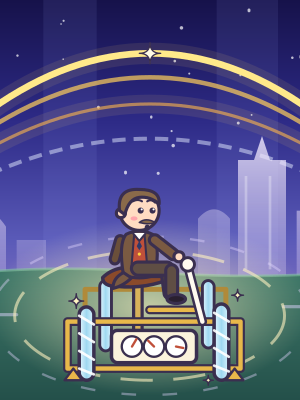
He took the lever in both hands and pushed. At once the world went mad. Daylight and darkness flickered like a bat's wings, the sun leapt across the sky, and buildings rose and melted like sand. Faster, faster! Then he yanked the lever back, hard, and the machine crashed into thick grass. Years had slid by in seconds. He climbed down, shaking, and looked around at a world nobody in his time had ever seen.
Tall, beautiful buildings stood among the flowers, though half of them were cracked and covered in vines. Small, bright people ran out to meet him. They had curly hair, frail arms, and big shining eyes, and they laughed at everything, even when he tripped over a flower. They called themselves the Eloi. They ate fruit, they played in the sun, and they did no work at all. It seemed like paradise. Then he turned around, and the machine was gone.
It had been dragged away. Deep marks in the grass led to a huge white statue with bronze doors, shut tight. The inventor pounded and shouted, and the little people only shook with fear. They would not go near the statue, and they would not say why. He asked about the night, and their faces went blank. That evening, he understood. The Eloi hurried into their houses, and they locked every door.
A small woman named Weena had become his friend. She followed him everywhere, picking flowers and giggling at his boots, but at sunset she began to cling to his sleeve. In the dark, something moved in the grass. He lit a match, and two round, glowing eyes stared back at him, and then they were gone. Something pale and quick and soft-footed brushed his hair. He swung his fist and hit empty air.
By morning, he had found the round dark wells scattered across the hills, and each one breathed warm, oily air. Iron rungs ran down the inside of one. Far below, he could hear a steady thump, thump, like great machines. At last he saw the truth. The Eloi were the rich people of his own time, grown weak and pretty in the sun. And the workers had gone underground and become something else. These were the Morlocks, and they came out at night.
Part Two · The Dark
He climbed down into the tunnels, and he did not like what he found. The air was hot, wet, and strange. Pale shapes slid away from his match, whispering and chittering, and a cold hand grabbed his ankle. He kicked it loose. They could not bear light, so he held the matches high, but the box was nearly empty. Far up the shaft, a faint circle of sky glowed. He scrambled toward it as little hands plucked at his clothes.
The Morlocks had stolen his machine, but they had not found the tiny lever that made it go. He had kept it in his pocket all along. So he made a plan. He and Weena would cross a forest at dusk to reach the white statue. The Morlocks stalked them through the trees. He lit a fire to keep them back, but the wind caught the flames, and soon the whole wood was a roaring red wall.
Smoke filled the wood, and the fire roared like a train. In the heat and the noise, Weena's small hand slipped out of his. He shouted her name. He swung a blazing branch at the pale shapes and plunged back into the smoke, again and again, but he could not find her anywhere. At dawn he stumbled out of the burning trees alone, black with ash, and saw the white statue gleaming on the hill.
This time, the bronze doors stood open, and he knew it was a trap. Inside, the machine waited in a room of dark stone, like cheese in a mousetrap. He walked straight in. The doors slammed shut behind him, and in the pitch dark, soft hands reached for him from every side. He jammed the little lever home with a trembling hand and shoved the big one forward. Then the hands were gone.
Part Three · The End of the World
He shoved so hard that the machine flew on and on, millions of years, and the world grew old and cold around him. When at last he stopped, the sun was a huge red ball that hardly moved. The sea lay still and dark. Strange giant crabs crawled over black rocks, waving their long feelers. Then, at the edge of the water, something round and black flopped about. He shivered, gripped the lever, and hauled it back.
He appeared in his own laboratory at dinnertime, filthy and limping. His friends were at the table, arguing about the soup. He told them everything, and most of them laughed. "A good story," said one, "but where is your proof?" The inventor reached into his pocket and drew out two strange white flowers. Weena had tucked them there in the forest. Nobody at that table had ever seen flowers like them, and nobody laughed again.
The next day, the inventor packed a camera and a little bag. He climbed onto his machine, gave his friends a wave, and pushed the lever. The machine shimmered, blurred, and vanished, exactly as the little model had on that first evening. That was three years ago, and he has not come back. Where is he now? Perhaps he went back to find Weena. His oldest friend still keeps the two dry white flowers in a book, and on quiet nights he hopes so.
 The Boxcar Children
 The Cat That Walked by Himself
 A Day on the Space Station
 Anansi and the Pot of Wisdom