Town Mouse visits his cousin in the country and thinks the food is too plain. So Country Mouse visits the town, where the food is fancy and the cat is very big.
The whole story on one page
The Town Mouse and the Country Mouse: the full story
Part One · In the Country
Country Mouse lived in a little hole under a hedge. Beside the hedge was a field of wheat.
One day, his cousin came to visit. Town Mouse wore a fancy coat and a shiny hat.
"Welcome!" said Country Mouse. He gave his cousin the best food he had. There were beans, barley, and a dry crust of bread.
Town Mouse nibbled one bean. He wrinkled up his nose. "Is this really all you eat, cousin?"
"Come to the town with me," said Town Mouse. "I will show you what good food is!"
Part Two · In the Town
So off they went together. They walked all day long. They reached the town at night.
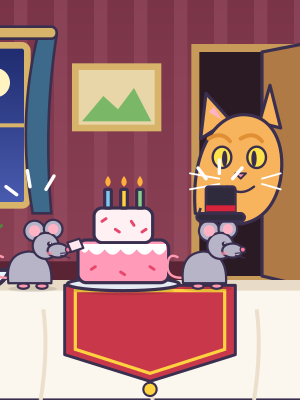
Town Mouse lived in a grand house. They tiptoed into the dining room. The table was covered with food!
There was cake and cheese. There were cherries and jelly and sweet little cookies.
"Help yourself!" said Town Mouse. Country Mouse had never seen a feast like it. He took a big bite of cake.
Just then, the door creaked open. In came a huge cat with yellow eyes!
"Run!" squeaked Town Mouse. The two mice jumped off the table. They raced into a tiny hole in the wall.
They waited and waited. Their hearts went thump, thump, thump. At last the cat walked away.
The mice crept back to the table. Country Mouse picked up a cookie. Then he heard barking!
Two big dogs came bounding into the room. Back into the hole the mice ran again.
Country Mouse sat in the dark hole. He was shaking from his ears to his tail.
"Goodbye, cousin," he said. "You may keep your cake and cheese. I am going home."
Then Country Mouse said something very wise. "Plain food in peace is better than cake in fear."
Away he scampered, back to his cozy hole. That evening he ate beans. Then he slept wonderfully well.
A free Grade 2 story from the Peabody library, Level 7. For about ages 7 to 8. It has 18 short pages and about 311 words, so it reads in a few minutes. It is also called “The Country Mouse and the City Mouse” or “The City Mouse and Country Mouse”.
Words this story teaches
cousin: family member
barley: a grain
crust: hard bread edge
feast: big fancy meal
peace: calm and quiet
bounding: leaping along
At reading level 7, Peabody's practice works on phonics (sounding words out), sight words, spelling; the level page says what is in each.
The short version
Town Mouse visits his cousin Country Mouse and turns up his nose at the plain food of the country. Country Mouse goes to town, where there is a feast, but a cat and two big dogs chase the mice into a hole. Country Mouse goes home, saying that plain food in peace is better than cake in fear.
Quick facts
One of Aesop's fables. The Greek writer Babrius told it, and so did the Roman poet Horace, in his Satires (book 2, poem 6).
Horace called it “an old wives' tale.”
The Scottish poet Robert Henryson told it in a long poem called “The Taill of the Uponlandis Mous and the Burges Mous.”
The French poet La Fontaine told it as Le rat de ville et le rat des champs. Beatrix Potter turned it around in The Tale of Johnny Town-Mouse in 1918.
What it teaches
A calm, safe home is worth more than fancy things.
Where this story comes from
Aesop, a storyteller in Greece, told this about 2,600 years ago.
What is the moral of The Town Mouse and the Country Mouse?
A plain, safe life is worth more than a rich one full of danger. A 13th-century preacher, Odo of Cheriton, said he would rather gnaw a bean than be gnawed by constant fear, and Henryson's moral is to limit your wants. In this telling, Country Mouse says plain food in peace is better than cake in fear.
Who wrote The Town Mouse and the Country Mouse?
It is one of Aesop's fables, and no one knows who first told it. Babrius and Horace both told it long ago, and it spread across medieval Europe in the Latin version of Walter of England, a 12th-century writer. This page is a retelling in Peabody's own words.
Is it the City Mouse or the Town Mouse?
Both names are used for the same fable. English retellings have gone by titles such as “The Country Mouse and the City Mouse” and “The City Mouse and Country Mouse,” and Henryson's Scottish poem calls the cousins the “Uponlandis Mous” and the “Burges Mous.”
For teachers: read it to the class, questions and key
📺 Read this to the class: one page at a time on the board, big arrows, and Peabody reads a page when you ask. Sound is off until you tap.
📚 More books at level 7 for a guided-reading group. This is Peabody's own level, not a Lexile or a guided-reading letter. Pick a group's books from their level, and one level up to stretch them.
 Belling the Cat
 Hercules and the Wagoner
 The Ant and the Grasshopper
 The Boy Who Cried Wolf