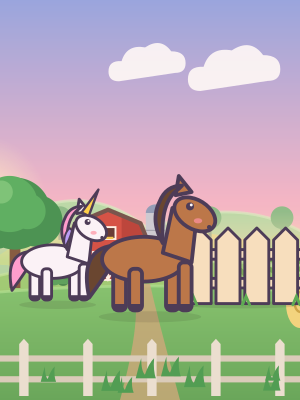
Unicorns and Real Horses: the full story
Part One · The question
Are unicorns real? No. Nobody has ever found a horse with a horn on its head. But real animals are behind the old unicorn stories. First, meet a foal. She was born this morning on a farm. Her mother is a Shetland pony.
A foal is a young horse or pony. This one tries to stand and falls. She tries again and again. Within an hour of her birth, she stands. Soon after, she walks, and then she runs. A horse is a prey animal, which means other animals hunt it, so its best safety is speed. A foal is born ready to run.
Part Two · Hands and inches
Her mother is a pony, and ponies have a rule. Horse people measure height in hands. One hand is four inches. They measure from the ground to the withers, the high spot where the mane ends. Three hands make one foot, the length of a school ruler.
Here is the 2026 rule from US Equestrian, a group that sets the rules for many horse shows in this country. A pony is an animal that does not grow taller than fourteen hands and two inches. That is fifty-eight inches. It is a little less than five feet.
Ponies are not just short. Many are stocky, with short legs and a thick mane and tail. Shetland ponies come from islands off Scotland, and some worked in mines. A miniature horse is smaller than a Shetland, but it is still called a horse. A pony is not a baby horse. A foal grows up to be a pony or a horse.
Part Three · A horse's day
Soon the foal takes her first nap. Grown horses sleep for only a few hours a day, and most of that is on their feet. But they must lie down for a short time to get one kind of sleep they need. In that sleep, a horse's muscles go limp, so it cannot stand up.
A horse's eyes sit on the sides of its head. So it sees a very wide view. But there is a blind spot, where it cannot see, right behind it. Horse guides say there is another right in front of its face. A horse turns its head from side to side to see more.
A horse's ears can turn about halfway around. So it can point them right at a sound, even a small one. Horses also watch each other's ears and eyes. These show what another horse is paying attention to. In one test, horses used these signs to choose where to eat.
A horse cannot see right behind it, so people are careful around horses. Ask a grown-up before you go near one. People who work with horses go up slowly, toward the shoulder, never from behind. Anyone sitting on a horse, even a grown-up, should wear a riding helmet, say doctors at children's hospitals.
Part Four · The real animals behind the stories
The foal's forehead is smooth. There is no horn. So where did people get unicorn horns? Many came from the cold Arctic Ocean. The narwhal is a whale. Most males have one long, twisted tusk. The tusk is a tooth, not a horn. It averages six to eight feet long. That is as long as a very tall grown-up, or longer.
Hundreds of years ago, traders in Europe sold narwhal tusks as unicorn horns. Some hid where the tusks came from. Kings and queens paid a lot of money for them. People believed a unicorn horn could keep them safe from poison. It cannot. A narwhal tusk is only a tooth.
The oldest Greek writing about a one-horned animal is about 2,400 years old. A Greek doctor named Ctesias wrote it. He said that in India there were wild animals as big as horses, with white bodies and one horn. But Ctesias never went to India. He wrote what travelers told him.
Some people think those travelers saw a rhino. The Indian rhino has one horn, like the animal in the story. But a rhino is no horse. It has thick, folded skin. Its horn is made of keratin, the same stuff as your fingernails and hair.
More than seven hundred years ago, a traveler named Marco Polo wrote about animals he called unicorns. They were nearly as big as elephants, with a thick black horn and a love of mud. He called the beast ugly. It was nothing like the stories. People who study his book say he saw a rhino.
One real animal even has the name Siberian unicorn. It was a giant rhino that ate grass on wide plains in Russia and Kazakhstan. It could weigh as much as five big horses. No one has found its horn, but a big bump on its skull may have held one. Some were still alive 39,000 years ago, long before anyone wrote about unicorns.
Part Five · Real enough
So, are unicorns real? A horse with a horn, no. But the whale's tooth was real, and so were the rhinos. Old stories and old traders turned them into a white horse with one horn. The giant of Siberia had died out long before. The foal on the farm has no horn. She has fast legs and ears that turn.