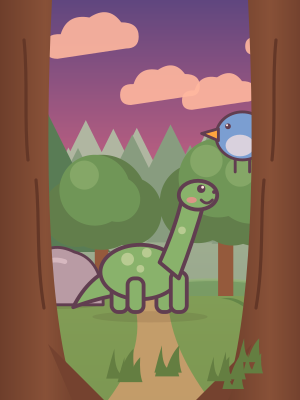
When Did the Dinosaurs Go Extinct?: the full story
Part One · One ordinary day
Picture an ordinary day, 66 million years ago, in a forest in what is now western North America. A Triceratops is feeding among the trees. Somewhere under the roots, a furry animal about the size of a rat is curled up asleep in its burrow. Neither of them can know that a mountain of rock is falling toward Earth from space. That day is the answer to a question people ask all the time: when did the dinosaurs go extinct? It is also the start of a harder question: how?
The rock was an asteroid, a chunk of stone that travels around the Sun. This one was several miles wide. If you could set it down on a beach, it would stand taller than Mount Everest. It was moving so fast that when its front edge struck the ground, its back edge was still up near the top of the sky. It hit a shallow sea off the coast of what is now Mexico, at a place called Chicxulub. The crater it made is still there, buried under younger rock, mostly beneath the seafloor.
Part Two · The first hours
Close to the crash, everything was wrecked at once. Farther away, the danger came down from the sky. Rock that had been blasted upward fell back through the air and heated it for hours, and fires broke out across the land. In the sea, the crash raised waves more than 100 meters high, about the length of a football field, because the rock had landed in shallow water. The waves washed over the coasts of the Americas, and the flood reached as far inland as what is now Illinois.
Still, the waves and the fires were not what ended the age of dinosaurs. The real trouble was in the air. The rock at Chicxulub was full of sulfur, and the crash turned much of it into tiny droplets that floated high above the clouds. Along with dust and soot from the fires, they dimmed the sunlight all over the planet. The world grew cold, and freezing weather probably lasted at least three years. Many dinosaurs died on the first day, but not all of them. The rest had to live on in the cold and the gloom.
Part Three · The long cold
Think about what dim light means for a forest. Plants need sunlight to make their food, so in the gloom many of them withered and stopped growing. In the oceans, the tiny floating plants that feed everything else were in trouble too. The plant-eaters, like Triceratops, had less and less to eat. Then the meat-eaters, like Tyrannosaurus, ran short of plant-eaters to hunt. It was like pulling a block out of the bottom of a tower: every level above it came tumbling down.
Why did the dinosaurs do so badly, when other animals did not? One clue is that there is no sign they could burrow, swim or dive, so they had nowhere to hide from the worst of it. Another clue is size. Almost no land animal heavier than about 25 kilograms, or 55 pounds, survived. Many scientists also think dinosaurs were warm-blooded, and a warm-blooded animal needs far more food than a cold-blooded one of the same size. In a hungry world, a big body was a heavy burden.
Part Four · Who made it
Small animals had a better chance. The mammals that survived were mostly about the size of rats, small enough to shelter in burrows and other protected spots. Their food chain did not start with fresh green leaves. They ate insects, worms and snails, and those creatures lived on dead plants and animals, which were everywhere. Picture our little burrower again, digging out a beetle in the dark. It did not need the sun to find its dinner, and that may have saved its life.
Some crocodiles made it through as well. A crocodile can live for months without a meal, and young crocodiles eat small creatures and dead things. Turtles did remarkably well, too: more than four out of every five kinds came through. Seeds lay in the soil, waiting. And one group of dinosaurs survived: the birds, though only a small fraction of the kinds alive then. They were small, they could eat many different foods and they could fly, and those three things probably saved them.
When the sky finally cleared, ferns, which grow from tiny spores instead of seeds, were the first plants to spread back over the bare ground. Mushrooms and other fungi, which need no sunlight at all, flourished on the rotting wood. The surviving mammals began to grow bigger, slowly. After about 700,000 years, some weighed about as much as a large dog, a hundred times more than the little survivors. Truly huge mammals, the size of a rhinoceros, took millions of years longer. For a long time, the world belonged to small animals.
Part Five · How we know
Nobody was there to see any of this, so how do we know? In 1980, a physicist named Luis Alvarez and his son Walter, a geologist, reported something odd about a thin layer of clay in rock in Italy. It held a lot of iridium, one of the rarest metals on Earth but a more common one in rocks from space. Soon the same layer, from the same moment in time, turned up at site after site around the world. The Alvarezes said a huge asteroid had sprinkled it there. At first, many scientists thought they were wrong.
If an asteroid that big had hit Earth, where was the crater? Part of the answer had already been found by people looking for oil. In the late 1970s, Glen Penfield and Antonio Camargo, who worked for Mexico's national oil company, were mapping the rocks under the Gulf of Mexico from an airplane. Penfield noticed a giant buried bullseye. He was sure it was a crater. His company decided it was the remains of volcanoes. It took until 1991 for rock samples from old drill holes to prove that Penfield had been right.
Part Six · Still arguing
Even now, not everyone agrees on the whole story. While the last dinosaurs were alive, enormous volcanoes in what is now India were erupting again and again, pouring out lava and gases that changed the climate. A few scientists, such as Gerta Keller, think those volcanoes did much of the damage. Most now think the asteroid was the main cause. One recent study even suggests that the volcanoes helped in the end, warming the planet faster after the long winter so that life could recover sooner.
There is one more question scientists like to wonder about. The asteroid hit a shallow sea. If it had arrived just a few minutes later, it would have landed in deeper water and thrown up less rock to darken the sky. A dinosaur expert at the Natural History Museum in London suspects that, if the asteroid had missed, some dinosaurs besides birds would still be alive today. Find Chicxulub on a map. Then look at the next bird you see, and remember which dinosaurs are still here.
 When the Wolf Was Real
 A Fox and His Pride
 Aladdin
 Alice in Wonderland