Which sound makes salt dance on a drum from the farthest away?
- 🧽 A bit messy
My hypothesis
If I change what you bang with the spoon, then how far away it can be and still make the salt jump will ______, because ______.
You fill in the blanks. Think about which one sounds loudest and rings the longest when you bang it. A guess is a good because: the test finds out.
Change, measure, keep the same
CHANGE
what you bang with the spoon: Baking tray, Shoebox, Hardback book
MEASURE
how far away it can be and still make the salt jump, in cm
KEEP THE SAME
- the same drum and the same pinch of salt
- the same spoon and the same hard bang
- a quiet room
Scientists call the thing you change the independent variable and the thing you measure the dependent variable. The things you keep the same are the controls: if one of them changed too, you wouldn't know which change made the difference. Try each of the 3 levels 3 times.
What you need
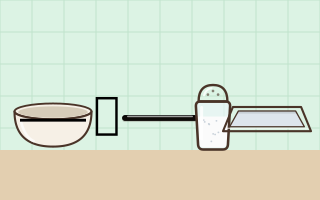
- A big bowl: 1, for the drum
- Clear plastic wrap: a piece bigger than the bowl
- Rubber bands: 1 big one
- Salt: a pinch
- A baking tray or big plate: a metal baking tray
- A shoebox
- Some books: 1 hardback
- A spoon: a wooden spoon
- A tape measure, or a long ruler
Steps
- Stretch plastic wrap tight over the bowl and hold it on with the rubber band.
- Sprinkle a pinch of salt in the middle of the drum.
- Hold the baking tray right next to the drum and bang it once with the spoon.
- Watch the salt. Did it jump? Never bang it next to anyone's ears.
- Step back 20 cm and bang it again. Keep stepping back until the salt stops jumping.
- Measure how far the tray was at the last bang that made the salt jump.
- Do it two more times with the tray, putting the salt back in the middle each time.
- Test the shoebox three times and the book three times, with the same bang.
- Draw a bar for each one. Which sound moved the salt from farthest away?
Every step is one you can do yourself, with a grown-up nearby. Write each number down straight away, in the table below, so nothing is lost.
Your results table
Name ______________________ Fair day ____________
Question: Which sound makes salt dance on a drum from the farthest away?
I changed: What I banged I measured: how far away it can be and still make the salt jump (cm)
| What I banged | Try 1 (cm) | Try 2 (cm) | Try 3 (cm) | Mean |
|---|---|---|---|---|
| Baking tray | ||||
| Shoebox | ||||
| Hardback book |
MY GRAPH (a bar graph: what i banged along the bottom, cm up the side)
What I noticed: ______________________________________________
From 4th grade, add the tries for each level and divide by how many there were: that's the mean, and it goes in the last column. Then draw a bar graph, one bar for each thing you tried.
Name ______________________ Fair day ____________
Question: Which sound makes salt dance on a drum from the farthest away?
If I change what you bang with the spoon, then how far away it can be and still make the salt jump will ________________, because _____________________________________________
| I CHANGE | I MEASURE | I KEEP THE SAME |
|---|---|---|
| What I banged: Baking tray, Shoebox, Hardback book | how far away it can be and still make the salt jump (cm) |
|
What I think will happen, in my own words:
Name ______________________ Fair day ____________
Question: Which sound makes salt dance on a drum from the farthest away?
| Date | What I did | What I saw | What I think |
|---|---|---|---|
Name ______________________ Fair day ____________
Question: Which sound makes salt dance on a drum from the farthest away?
| Date | What I did | What I saw | What I think |
|---|---|---|---|
Name ______________________ Fair day ____________
Question: Which sound makes salt dance on a drum from the farthest away?
| Date | What I did | What I saw | What I think |
|---|---|---|---|
Name ______________________ Fair day ____________
Question: Which sound makes salt dance on a drum from the farthest away?
My hypothesis was ☐ right ☐ partly right ☐ not right.
I know because my numbers show:
What surprised me, or what might have gone wrong (7th and up):
Next time I would test:
Idea: Change a second thing: bang each one softly and hard, and measure all six.
Why it works
Sound is the air shaking back and forth very fast. The banged tray shakes the air, the air shakes the plastic wrap, and the wrap bounces the salt. A metal tray rings loudly and keeps shaking, so its sound is still strong enough to move the salt farther away than a dull thump.
Going further (7th and up): Change a second thing: bang each one softly and hard, and measure all six.
Board layout
- ❓ Question (10 × 8 in): Which sound makes salt dance on a drum from the farthest away?
- 💭 Hypothesis (10 × 9 in): If I change what you bang with the spoon, then how far away it can be and still make the salt jump will ______, because ______.
- 🧺 Materials (10 × 12 in): 9 things: see your list.
- 🪜 Steps (22 × 9 in): 9 steps, three tries at each level.
- 📊 Results (22 × 16 in): Your table (What I banged down the side, tries across) and your bar graph.
- ✅ Conclusion (10 × 14 in): My hypothesis was right / partly right / not right. I know because…
Materials to list: A big bowl; Clear plastic wrap; Rubber bands; Salt; A baking tray or big plate; A shoebox; Some books; A spoon; A tape measure, or a long ruler.
Bring photos or drawings of your test. Nothing wet, hot, powered or alive on the table.
This project at your grade
| 1st–3rd grade | Tries: three at each level (one is fine at a first fair). The table: levels and tries, numbers or pictures. The graph: a picture, or a simple bar graph. The conclusion: what happened, in their words. |
|---|---|
| 4th–6th grade | Tries: three at each level. The table: units in the header and a mean column. The graph: a bar graph, or a line for a number that grows. The conclusion: right, partly or not, and the numbers that show it. |
From 4th grade up, the table gets a mean column. See every project for 2nd grade, or print a blank results table.
What a judge will ask
- What did you change, and what did you measure? I changed what you bang with the spoon and measured how far away it can be and still make the salt jump, in cm.
- What did you keep the same, and why does that matter? I kept the same drum and the same pinch of salt and the same spoon and the same hard bang the same, so the only difference was what you bang with the spoon.
- How many times did you test it? 3 times at each of my 3 levels.
- If you did it again, what would you change or test next? I'd bang each one softly and hard, and measure all six.
Make it yours
Keep this project on this device and Peabody counts down to your fair day, with a plan for each day. Nothing is sent anywhere.
Try next
👨👩👧 For grown-ups and teachers: how much to help, the safety rules, and running a school fair. Science fair v0.16.1 · Checked .