Annular solar eclipse, 6 February 2027
86 nights to go
Saturday 6 February 2027 · In the daytime
The Moon that night: 0% lit. If the sky is clear.
On 6 February 2027 the Moon passes in front of the Sun but is too far from Earth to cover it, leaving a ring of sunlight. The ring is seen along a path across southern South America, the South Atlantic and West Africa; no part of the United States sees any of it. Never look at the Sun.
In February 2027, the Moon covers the middle of the Sun in some faraway places. People there see a ring of light. Never look at the Sun yourself.
An annular eclipse happens when the Moon is near the far point of its orbit, so it looks a little smaller than the Sun and can't cover it all. People on a narrow path see a bright ring. This one crosses South America and the Atlantic and ends in West Africa.
Astronomy-engine puts the eclipse's greatest point in the South Atlantic at about 15:59 UTC on 6 February 2027. Annular eclipses are never safe to look at without proper filters, even at the ring: NASA's guidance is eclipse glasses or a handheld solar viewer meeting ISO 12312-2.
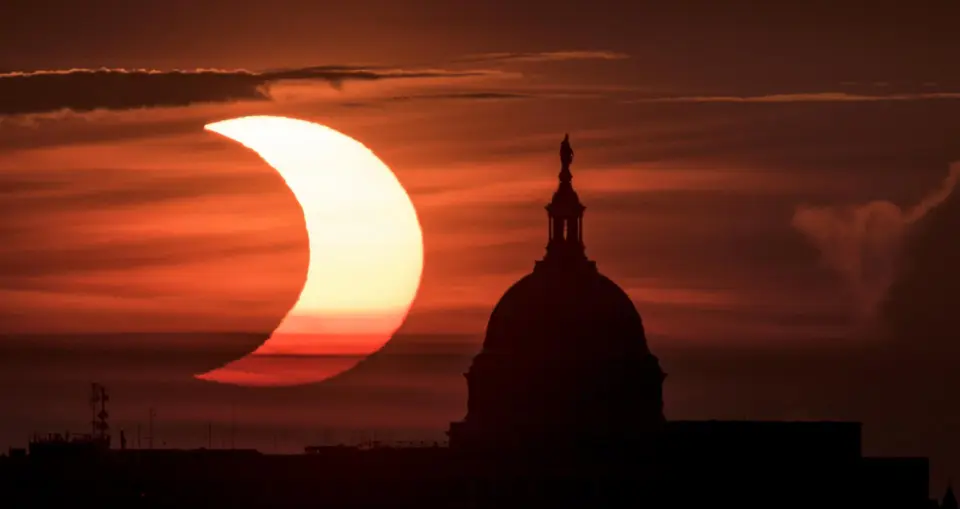
Where to look
Not from the United States. From southern Chile and Argentina in the middle of the day, and from Côte d'Ivoire and Ghana near sunset.
What to do
- Read why eclipses happen: the Moon lines up between Earth and the Sun.
- If you are travelling to the path, follow NASA's eclipse safety guidance and use eclipse glasses that meet ISO 12312-2.
- At home, make a pinhole projector and try it on any sunny day.
More sky events
- Geminids 2026
- Leonids 2026
- Full Moon, November 2026
- New Moon, December 2026
- Planets before dawn, November 2026
- Moon calendar
“If it's cloudy, don't worry. The planets will still be there tomorrow night.”