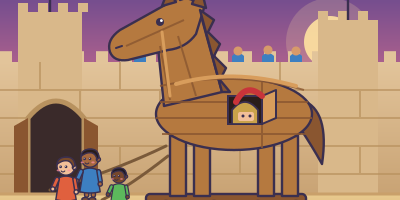
A Horse at the Gates
For ten years, the Greeks camped outside Troy. They could not climb its walls. The walls were too high and too thick.
One evening, Odysseus of Ithaca thought of a plan. "We will not break the gates," he said. "We will let the Trojans open them for us."
A carpenter named Epeius built an enormous wooden horse. They said the goddess Athena helped him. It had a secret door in its side.
Odysseus and some brave men climbed inside. They sat close together in the dark. Nobody even dared to cough.
The rest of the Greeks packed up their camp. They boarded their ships and sailed off. By morning the beach was empty but for the horse.
The Trojans could hardly believe their eyes. "The war is over!" they cried. They opened the gates and hurried down to the beach.
They stood around the great horse. "A gift!" said some. "Let us take it inside the city."
A priest named Laocoon came running. "Are you out of your minds?" he shouted. "Be careful of Greeks with gifts!"
He knocked on its side. It gave a hollow sound. But the Trojans were too happy to listen.
They tied ropes to the horse and pulled. It would not fit through the gate. So they made the gate wider.
They dragged the horse inside. The happy Trojans cheered all the way.
That night, Troy had a great party. Music and lanterns filled every street. At last the people went to sleep.
In the quiet, a door in the horse slid open. A rope ladder dropped down. One by one, the Greeks climbed out into the moonlight.
They crept to the gates and opened them wide. The Greek ships came back across the dark water. The Greeks were at the gates.
By the next morning, the long war was over. Odysseus had won it with a plan, not a sword.
"Beware of a gift that seems too good," people say. Laocoon was right all along.
Questions
- A tall tower
- A bridge
- A huge wooden horse
- In the ships
- Inside the horse
- In a cave
- Laocoon
- Epeius
- Athena
- They thought the war was over and it was a gift
- They were afraid of it
- Laocoon told them to
- Run to something
- Laugh at something
- Be careful of something
- Never build a horse
- Be careful of a gift that seems too good
- Always sail away
Words to know
- gift: a present
- carpenter: wood builder
- priest: temple leader
- beware: be careful
Answer key: A Horse at the Gates
- C. A huge wooden horse
- B. Inside the horse
- A. Laocoon
- A. They thought the war was over and it was a gift
- C. Be careful of something
- B. Be careful of a gift that seems too good
The story in pictures
- Part One · The Plan
- Part Two · The Gift
- Part Three · The Night
For the teacher: how this passage is levelled
“A Horse at the Gates” is a reading level 7 story. Every Peabody story at this level is written and checked to keep sentences to 10 words or fewer, to aim at an average of 6 words a sentence, and to show 12 to 30 words on a screen. At most 8% of its words may be off the familiar-word list. Children in 3rd grade start at this level.
| This passage | 331 words, 16 screens, 6 multiple-choice questions with an answer key, and 4 vocabulary words with kid-sized meanings |
|---|---|
| Longest sentence at this level | 10 words |
| Words on a screen | 12 to 30 |
| Skills practised at this level | phonics (sounding words out), sight words, spelling |
Reading level 7: the limits, a real sample and the free games. Peabody is a learning app, not an assessment: use the questions to talk about the story, not to grade a child.