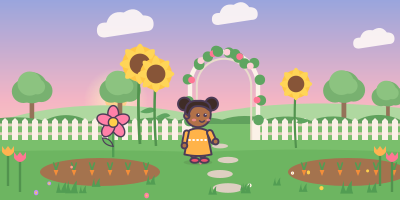
A Seed for Lee
Lee got a seed.
"I will plant it," said Lee.
Lee digs a hole.
The seed went in the hole.
Lee feeds it. Lee waits and waits.
Each day, Lee peeks.
No green yet.
Then a bee lands on the hole.
"Buzz! Is it a tree?" said the bee.
"Not yet," said Lee. "It is a seed."
In a week, Lee can see a leaf!
"A seed can be a tree," said Lee.
"Buzz," said the bee. "I will wait."
Questions
- A seed
- A bone
- A shell
- If it is a tree
- If it is wet
- If Lee is home
- A bug
- A green leaf
- A big tree
- It wants to see the tree
- It is lost
- It is wet
Words to know
- seed: a tiny start of a plant
- peeks: takes a quick look
- week: seven days
- leaf: a green part of a plant
Answer key: A Seed for Lee
- A. A seed
- A. If it is a tree
- B. A green leaf
- A. It wants to see the tree
For the teacher: how this passage is levelled
“A Seed for Lee” is a reading level 4 story. Every Peabody story at this level is written and checked to keep sentences to 8 words or fewer, to aim at an average of 5 words a sentence, and to show 1 to 8 words on a screen. At most 6% of its words may be off the familiar-word list. Readers reach this level by climbing, not by grade.
| This passage | 80 words, 13 screens, 4 multiple-choice questions with an answer key, and 4 vocabulary words with kid-sized meanings |
|---|---|
| Longest sentence at this level | 8 words |
| Words on a screen | 1 to 8 |
| Skills practised at this level | phonics (sounding words out), first sounds, sight words |
Reading level 4: the limits, a real sample and the free games. Peabody is a learning app, not an assessment: use the questions to talk about the story, not to grade a child.