Circe and the Sirens
Odysseus had been sailing for ten years when his ships came to an unfamiliar island, and for two days and nights the sailors saw no sign of a house, a road or a person. On the third morning, from a hilltop, Odysseus noticed smoke curling out of a forest far below. He drew lots to decide who should go and investigate, and the lot fell to his friend Eurylochus, who set off with twenty-two men while Odysseus waited with the ships. Hours passed. At last Eurylochus came running back alone, gasping, with an expression that Odysseus had never witnessed before, and for a long while he could not utter a single word.
Eventually he explained. In a clearing in the forest, the men had discovered a house of polished stone, and all around it lions and wolves were roaming. They should have been terrifying, but they only rubbed affectionately against the men like friendly dogs. From inside came the voice of a woman singing at her loom, and the men called out, and she came cheerfully to the door and invited them inside. Eurylochus, a cautious man, stayed outside to watch through a window. He saw the woman serve his friends wine and food, and he saw her secretly sprinkle a drug into both, and he saw her touch each man with a wand, and then he witnessed something he could hardly describe. His friends had been transformed into pigs.
Odysseus immediately took his sword and went into the forest himself, ordering Eurylochus to stay behind, although the poor man was far too frightened to follow anyway. On the way he met a young man with a golden staff, who announced that he was the god Hermes, and who presented him with a small white flower with a black root. "Carry this," he said. "It will protect you from her drugs." Odysseus thanked him and walked on until he reached the stone house. The woman, whose name was Circe, an enchantress who ruled the island, opened her doors with a gracious smile, and led him to a silver chair, and brought him a golden cup of wine, which he accepted, because he understood what the flower could do.
But when she tapped him with her wand and told him to go to the pigsty with his friends, nothing happened. Odysseus pulled out his sword and leaped toward her, and Circe cried out and stepped backward, astonished. "Who are you," she demanded, "that my magic does not touch you? You can only be Odysseus, the clever one, whom Hermes told me would come. Put away your sword and let us be friends." Odysseus did not trust her yet. "How can I be friends with someone who has turned my companions into animals?" he asked. "Swear a solemn oath that you will never harm me." Circe swore by all the gods, and only then did he lower the sword.
She prepared a bath, and fresh clothing, and a table covered with delicious food, but Odysseus sat in front of the feast without touching anything. "Is something wrong?" asked Circe. "No drug in this food. I have sworn." "What man could eat and drink," said Odysseus, "while his companions are shut up in a pigsty? If you want me to feast with you, let me see my friends as men." Circe went out to the pen, rubbed an ointment on every pig, and one by one the bristles fell away and the faces of Odysseus's sailors reappeared. They looked around them, bewildered, and burst into tears of relief. They were taller and more handsome than ever, as though the enchantment had somehow improved them.
After that the sailors lived in Circe's house for an entire year, eating magnificent meals, sleeping in comfortable beds and gradually forgetting how exhausted they had been. But at the end of the year they took Odysseus aside. "Captain," they said gently, "it is time to remember our own country." He found Circe in her garden and requested permission to leave. She did not argue. "But the road home is not simple," she said, "and I must tell you what lies on it before you go." That evening, while his crew slept by the ship, she sat beside him and told him of the dangers ahead, and the first of them was an island of flowers.
"The Sirens live there," said Circe. "They sing so sweetly that any man who hears them forgets his wife and his home, and sails straight toward them, and breaks his ship on the rocks. The meadow where they sit is white with the bones of sailors. Here is what you must do. Soften some beeswax in your hands and press it carefully into your crew's ears, so that they cannot hear anything. If you want to hear for yourself, because you are a man who wants to know everything, have your crew tie you to the mast with strong rope. If you beg to be freed, they must tie you tighter. When the song is behind you, they can let you go."
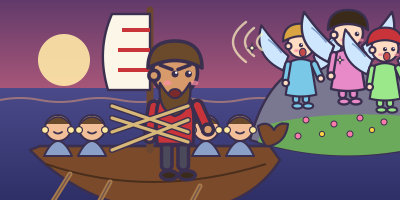
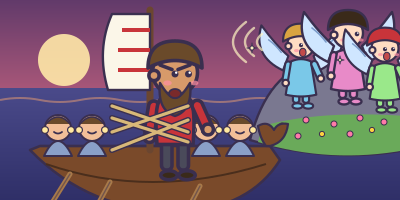
Odysseus remembered every word. When the island came in sight, the wind suddenly died, and the sea became perfectly still, as if the whole world were holding its breath. He kneaded a great ball of wax and pressed it into each man's ears, and the crew bound him upright against the mast with knot after knot, and then picked up their oars and rowed in silence. They had come within a shout of the shore when the Sirens saw the ship and began to sing, and the music that drifted across the water was more beautiful than anything Odysseus had ever heard in his entire life.
"Come closer, Odysseus," they sang, "great Odysseus, and listen. No one has ever passed this island without stopping to hear us, and everyone leaves wiser. We know what the Greeks suffered at Troy. We know everything that is happening on the whole earth. Come to our meadow, and we will sing you the whole story." Odysseus felt his heart break open. He strained against the ropes, he shouted, he nodded and frowned and signaled desperately with his eyebrows for his men to release him. But the rowers, who could hear nothing, saw the signals and bent over their oars and tied him tighter, just as he had commanded.
Slowly the island disappeared behind them, and the voices grew fainter, and then there was only the sound of oars and the lapping of the waves. The crew pulled the wax out of their ears and untied their captain, who was trembling and pale, and bruised by the ropes. He had heard every note of the extraordinary song and survived, which no sailor had ever done before. There were other dangers waiting beyond the horizon, a whirlpool, a six-headed monster and a hungry sea, and not all of the crew would see Ithaca. But Odysseus never forgot that the safest road was not to refuse to listen, but to know your own weakness, and to ask your friends to hold you fast.
Questions
- He was suspicious by nature and stayed outside
- He was not invited
- He was sick
- A flower given to him by Hermes
- His sword
- A magic ring
- He loved his companions and would not feast while they suffered
- He was not hungry
- He didn't trust the cook
- He knew the Sirens' song would make him lose his judgment
- He liked being tied up
- He wanted to go faster
- Confused and puzzled
- Very hungry
- Happy and calm
- Know your own weakness and ask friends to hold you to your word
- Never listen to music
- Avoid islands
Words to know
- enchantress: woman with magic
- bewildered: confused
- ointment: healing cream
- beeswax: wax from bees
- bristles: stiff hairs
Answer key: Circe and the Sirens
- A. He was suspicious by nature and stayed outside
- A. A flower given to him by Hermes
- A. He loved his companions and would not feast while they suffered
- A. He knew the Sirens' song would make him lose his judgment
- A. Confused and puzzled
- A. Know your own weakness and ask friends to hold you to your word
The story in pictures
- Part One · The House in the Forest
- Part Two · The Enchantress
- Part Three · The Singing Island


For the teacher: how this passage is levelled
“Circe and the Sirens” is a reading level 12 story. Every Peabody story at this level is written and checked to keep sentences to 48 words or fewer, to aim at an average of 14 words a sentence, and to show 90 to 130 words on a screen. At most 17% of its words may be off the familiar-word list. Children in 8th grade start at this level.
| This passage | 1185 words, 10 screens, 6 multiple-choice questions with an answer key, and 5 vocabulary words with kid-sized meanings |
|---|---|
| Longest sentence at this level | 48 words |
| Words on a screen | 90 to 130 |
| Skills practised at this level | vocabulary, spelling |
Reading level 12: the limits, a real sample and the free games. Peabody is a learning app, not an assessment: use the questions to talk about the story, not to grade a child.