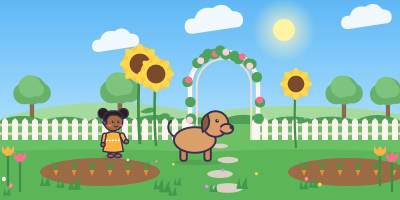
Duke Hides a Bone
Duke is a dog.
Duke can see a bone.
"I will hide it," said Duke.
Duke digs a pit.
The bone is in the pit.
Duke naps. It is nap time.
"My bone!" said Duke.
Duke digs a pit. No bone.
Duke digs and digs.
"Pits, pits, pits!" said Kate.
Kate can see a bone.
"Is this the bone, Duke?"
"Yes!" said Duke.
Duke hides it in a pit.
"I see it!" said Kate.
Questions
- A ball
- A bone
- A hat
- He naps a long time
- A cat took it
- It is in his bed
- A cat
- A pig
- Kate
- Kate sees where Duke hides it
- Duke can fly
- The bone is a cake
Words to know
- hide: put out of sight
- pit: a hole in the dirt
- bone: a hard thing dogs chew
- digs: makes a hole
Answer key: Duke Hides a Bone
- B. A bone
- A. He naps a long time
- C. Kate
- A. Kate sees where Duke hides it
For the teacher: how this passage is levelled
“Duke Hides a Bone” is a reading level 3 story. Every Peabody story at this level is written and checked to keep sentences to 6 words or fewer, to aim at an average of 4 words a sentence, and to show 1 to 6 words on a screen. At most 6% of its words may be off the familiar-word list. Children in 1st grade start at this level.
| This passage | 74 words, 15 screens, 4 multiple-choice questions with an answer key, and 4 vocabulary words with kid-sized meanings |
|---|---|
| Longest sentence at this level | 6 words |
| Words on a screen | 1 to 6 |
| Skills practised at this level | first sounds, rhymes |
Reading level 3: the limits, a real sample and the free games. Peabody is a learning app, not an assessment: use the questions to talk about the story, not to grade a child.