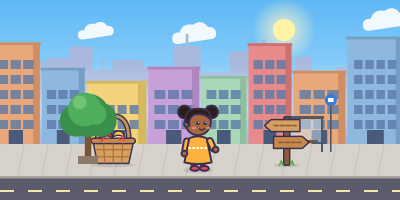
From Paycheck to Bank
Jo is fourteen, and she wants money of her own. A friend at school has a job. Jo asks a plain question. How does a person get paid? And where does the money go next? This book follows one first paycheck, from the job to the bank. Jo is made up. The rules are real.
When Jo was twelve, a neighbor paid her to watch a baby. The rules call that casual baby-sitting. Under fourteen, a child may do only small jobs like that. A few kinds of work are allowed too, such as delivering newspapers or acting. Federal law sets these rules. They are meant to keep work from getting in the way of school or health.
At fourteen, more jobs open up. The Labor Department lists some. They are bagging groceries, office work, stocking shelves and running a cash register. Jo gets a job bagging groceries at a store near home. On day one, she learns that her hours have limits.
A fourteen-year-old may work only outside school hours. That means no more than three hours on a school day. The week has a limit too. Many states add rules of their own, and many ask for a work permit. If the state rule is stricter, the stricter rule wins.
Now for pay. The law sets a lowest wage. For most workers it is $7.25 an hour, That is the federal number in November 2026, and it has not changed since 2009. A change in the law would move it. Many states set a higher one. A few states have no wage law of their own, so the federal number is the one that counts.
Say Jo's store pays ten dollars an hour. In her first two weeks, Jo works ten hours. Ten hours at ten dollars is 100 dollars. That is her gross pay. Gross pay is all the money she earned, before anything comes out. But the check will say less than 100 dollars.
What is taken out? Taxes. A tax is money that people pay to the government, to cover things that everyone shares. Two taxes come out of almost every paycheck. They are Social Security and Medicare. Together they take about eight cents of each dollar. Jo's boss pays the same amount again from the store's own money.
Eight cents of each dollar, on 100 dollars, is about eight dollars. So if only those taxes come out, Jo takes home about 92 dollars. That is her net pay. Net pay is what is left after taxes. A third tax, income tax, comes out of many paychecks. Jo's boss will ask her to fill in a form for it.
Jo needs a place to keep her money, so her mother takes her to a bank. A bank is a business that holds people's money. Jo is under eighteen, so she opens the account with her mother. No federal law sets an age for a savings account. State law and each bank's rules decide. Some banks want a parent on a young customer's account.
At the counter, Jo asks where her money will be kept. The clerk says it will not sit in a box with her name on it. A bank uses the money its customers put in to make loans. A family may borrow to buy a house. A store may borrow to buy a freezer. Jo can still take her money out when she wants it.
Jo asks how the bank earns money. A borrower pays extra for a loan. The extra is called interest. The bank pays part of that extra to people with accounts. In October 2026, the average savings account paid less than half of one percent a year. For Jo, that works out to about 35 cents in a year. Some banks pay more and some pay less.
Jo asks the clerk one more question. What if a bank fails? The FDIC is a government agency that insures money in banks that belong to it. It insures deposits of at least $250,000 at each insured bank. A deposit is money put into an account. Jo's 92 dollars is far below that. Credit unions have their own insurance of the same size.
Jo gets a debit card from the bank. She asks how it is different from a credit card. A debit card spends the money already in her account. A credit card lets a person borrow money and pay it back later. The card company charges interest if the bill is not paid in full. A person under twenty-one usually needs help to get one.
A month passes. Jo opens the list of what happened in her account. The first line says deposit. The new line says interest, and it is only about three cents. Three cents is not much. Jo looks at it anyway. It is the first money that her money ever earned.
Questions
- The money left after taxes
- All the money she earned before taxes
- The extra a bank pays her
- No more than three
- No more than eight
- As many as the store wants
- Because the government asks banks to be kind
- Because the bank uses their money to make loans
- Because interest keeps the account safe
- The pay after taxes come out
- The pay before taxes
- A fishing job
- It sets the lowest wage
- It makes credit cards
- It protects money in insured banks
Words to know
- gross: before taxes
- net: after taxes
- interest: extra money paid
- deposit: money put in
- wage: pay per hour
Answer key: From Paycheck to Bank
- B. All the money she earned before taxes
- A. No more than three
- B. Because the bank uses their money to make loans
- A. The pay after taxes come out
- C. It protects money in insured banks
Teaching a mixed class? Your first paycheck and bank account at three reading levels
Three true passages from the same facts, a basic, a middle and an advanced one, so every group reads about the same thing and the class can talk about it together. Print one PDF: a sheet for each group, marked with a shape instead of a level, and a page for you that says which is which.
- ● From Paycheck to Bank (this passage)Basic, for about 7 to 11 · reading level 8 · 816 words · Flesch-Kincaid grade 3.1 · 5 questions
- ▲ How Does a Paycheck Work?Middle, for about 10 to 13 · reading level 10 · 1222 words · Flesch-Kincaid grade 5.1 · 6 questions
- ■ How Credit Scores Are BuiltAdvanced, for about 13 to 16 · reading level 13 · 1339 words · Flesch-Kincaid grade 7.8 · 6 questions
The story in pictures
- Part One · The job
- Part Two · The pay
- Part Three · The bank
For the teacher: how this passage is levelled
“From Paycheck to Bank” is a reading level 8 story. Every Peabody story at this level is written and checked to keep sentences to 26 words or fewer, to aim at an average of 10 words a sentence, and to show 40 to 65 words on a screen. At most 9% of its words may be off the familiar-word list. Children in 4th grade start at this level.
| This passage | 816 words, 14 screens, 5 multiple-choice questions with an answer key, and 5 vocabulary words with kid-sized meanings |
|---|---|
| Longest sentence at this level | 26 words |
| Words on a screen | 40 to 65 |
| Skills practised at this level | vocabulary, spelling |
Reading level 8: the limits, a real sample and the free games. Peabody is a learning app, not an assessment: use the questions to talk about the story, not to grade a child.