How Does a Betta Breathe Air?
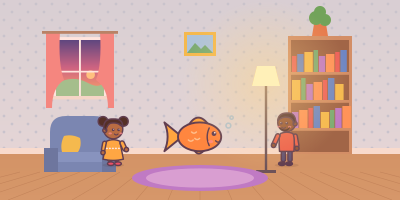
Every evening, when Lena finished her homework, she sat down next to Ember's tank. Ember was a betta with fins the color of a sunset. Most of the time he drifted near the plants, but now and then he swam straight up to the top, poked his mouth through the surface and gulped air. Then he sank back down as if nothing had happened. Lena frowned. Fish breathe underwater, so why would a fish need a gulp of air? She asked her dad, and together they went looking for the answer.
The answer is a body part most fish do not have. Bettas belong to a group called the labyrinth fishes. Besides gills, they have a breathing organ inside their heads, called the labyrinth organ. It lets a betta breathe air by poking its mouth above the water. Lena's dad pointed out something about gulping. Most fish that gasp at the top of a tank are in trouble, because the water has too little oxygen. For a betta, a gulp now and then is simply how it breathes.
Why would a fish ever need such a trick? The clue is where bettas come from. In the wild they live in still, shallow water: ponds, rice paddy fields and even puddles. The water is thick with plants, and it can run low on oxygen. Scientists think life in low-oxygen water helped shape the labyrinth fishes. A betta can reach up and take a breath of air. Some wild homes even dry up a little, and as long as a labyrinth fish stays wet, it can wait until the water comes back.
That explains why Ember's tank is wide and not tall. A betta needs lots of surface, the space where air touches the water, so the shape of the tank matters even more than its size. A betta in a wide tank breathes more easily than one in a vase or in a bowl with a small opening. Lena measured Ember's tank with a ruler. Her dad explained that a vet from a university hospital recommends a tank that holds five gallons or more, and says bettas should not live in bowls.
The wild also explains the heater. The word "tropical" means that bettas come from warm places, and in a house that is kept cooler, the water would be too cold for Ember. One vet says a betta tank needs to stay between 76 and 81 degrees Fahrenheit. Another fish vet says the ideal is 78. The two sources are close, and both agree on the thermometer, which Lena checks each evening. A betta that is cold often becomes lethargic, which means slow and tired.
Lena also learned that bettas do not like a strong current. Their homes in the wild are still, and they are not strong swimmers. A filter that churns the water can annoy them, and a low-flow filter protects their delicate fins from the suction. Here the experts disagree a little. Some say a gentle filter is vital, and others say a betta can do well without one if the water is changed often. Lena's dad said that this was a question for a vet, so he would ask one before choosing.
The water itself needs care. Tap water holds chemicals such as chlorine and chloramine that can make a fish very sick, so Lena's dad uses a dechlorinating product when he fills the tank. Distilled water is not a good substitute, because it lacks the minerals a fish needs. Lena is not allowed to do this job alone, and she does not mind. She would rather hand him the bucket and watch. The tank is Ember's whole world, and everything in it counts.
Feeding is Lena's job, with her dad nearby. In the wild, bettas eat insects and mosquito larvae, so Ember gets a balanced pellet or flake food once a day. Lena gives him the amount he can finish in about three to five minutes, with nothing left over. Extra food sinks and spoils the water, and bettas can be overfed, just like cats and dogs. Now and then Ember gets a treat of bloodworms or brine shrimp, which are high in protein and are given in moderation.
The tank furniture matters too. Lena and her dad chose smooth decorations, since many have sharp edges that can tear a betta's fins. They did not fill the tank with objects, because decorations should never push the fish to the edges. Live plants give Ember shade and places to hide and explore, but he does not eat them, however many websites say so. A vet has said plainly that plants are not a food source, and Lena trusts a vet more than a website.
Ember has no tank mates, and that is on purpose. Bettas are territorial, and a male who sees another betta will spread his fins and flare his gill covers. Two bettas in one tank will fight and injure each other. Alone, Ember is unlikely to be lonely, though in a small tank he could get bored. So Lena gives him new things to look at and talks to him. A vet at Washington State University says bettas do like to have one friend: you.
Lena knows the signs of a happy fish. Ember swims around, comes to the glass when she walks up, and eats eagerly. His fins are held away from his body, not drooping or folded. An unhappy betta lies around and shows no interest in anything. If Ember ever did that, Lena would tell her dad right away, and they would call a vet who treats fish. She would not try to fix it herself, because the vet will know what to do.
There is a health rule too. Tank water and the things in a fish tank can carry germs, so Lena washes her hands with soap and running water after she feeds Ember, and before she eats. Her little cousin is not allowed to clean or handle aquarium items, because children younger than five should not. When the tank is cleaned, Dad dumps the water in the bathtub or a laundry sink, not the kitchen sink. Lena said that the rules made sense once she knew the reasons.
A week later, Lena was watching again when Ember swam up to the surface, took his gulp and sank back down. She smiled. Now it looked like a fish using a built-in tool, one that his ancestors needed in small shallow waters. Lena's dad said that a family decides about a pet together, with a grown-up in charge, and that shelters sometimes have fish needing homes. Ask a grown-up to look at Peabody Pets with you. You will find it at pet.peabody.kids.
Questions
- Its tail
- The labyrinth organ in its head
- A tiny lung in its fin
- It has more surface where air touches the water
- It is easier to carry
- It looks like a pond
- Because puddles have no plants
- Because the water can be low in oxygen
- Because puddles are cold
- Hungry
- Slow and tired
- Friendly
- Bettas are territorial and fight each other
- Bettas hate plants
- Bettas cannot swim in a group of fish
- Tell her dad so a fish vet can help
- Add more food
- Change the heater herself
Words to know
- labyrinth: air-breathing part
- tropical: from warm places
- lethargic: slow and tired
- territorial: guarding its space
- dechlorinating: removing chlorine
- surface: top layer
Answer key: How Does a Betta Breathe Air?
- B. The labyrinth organ in its head
- A. It has more surface where air touches the water
- B. Because the water can be low in oxygen
- B. Slow and tired
- A. Bettas are territorial and fight each other
- A. Tell her dad so a fish vet can help
The story in pictures
- Part One · The gulp
- Part Two · Built for puddles
- Part Three · The daily jobs
- Part Four · Signs and safety
For the teacher: how this passage is levelled
“How Does a Betta Breathe Air?” is a reading level 11 story. Every Peabody story at this level is written and checked to keep sentences to 40 words or fewer, to aim at an average of 13 words a sentence, and to show 80 to 115 words on a screen. At most 15% of its words may be off the familiar-word list. Children in 7th grade start at this level.
| This passage | 1123 words, 13 screens, 6 multiple-choice questions with an answer key, and 6 vocabulary words with kid-sized meanings |
|---|---|
| Longest sentence at this level | 40 words |
| Words on a screen | 80 to 115 |
| Skills practised at this level | vocabulary, spelling |
Reading level 11: the limits, a real sample and the free games. Peabody is a learning app, not an assessment: use the questions to talk about the story, not to grade a child.