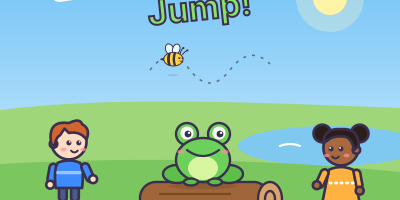
Jump, Jump, Jump!
Ben can jump.
Meg can jump.
"Jump, jump, jump!" said Ben.
Look! A frog on a log.
"Can the frog jump?" said Meg.
"Jump!" said Ben. The frog sat.
"Jump!" said Meg. The frog sat.
Look! A bug on the log!
Jump! The frog can jump!
The frog is on Ben!
Up, up! The bug is up!
Ben and Meg clap. Clap, clap!
Questions
- On a rock
- On a log
- On a bed
- It sits
- It swims
- It sings
- Meg claps
- It wants the bug
- It is wet
- In the pond
- On Meg
- On Ben
- No, the bug gets away
- Yes, a big bite
- There is no bug
Words to know
- jump: spring up
- frog: a green hopper
- log: a fallen tree
- clap: hit hands
Answer key: Jump, Jump, Jump!
- B. On a log
- A. It sits
- B. It wants the bug
- C. On Ben
- A. No, the bug gets away
For the teacher: how this passage is levelled
“Jump, Jump, Jump!” is a reading level 2 story. Every Peabody story at this level is written and checked to keep sentences to 6 words or fewer, to aim at an average of 4 words a sentence, and to show 1 to 6 words on a screen. At most 6% of its words may be off the familiar-word list. Readers reach this level by climbing, not by grade.
| This passage | 63 words, 12 screens, 5 multiple-choice questions with an answer key, and 4 vocabulary words with kid-sized meanings |
|---|---|
| Longest sentence at this level | 6 words |
| Words on a screen | 1 to 6 |
| Skills practised at this level | first sounds, rhymes |
Reading level 2: the limits, a real sample and the free games. Peabody is a learning app, not an assessment: use the questions to talk about the story, not to grade a child.