Just Above the Spout
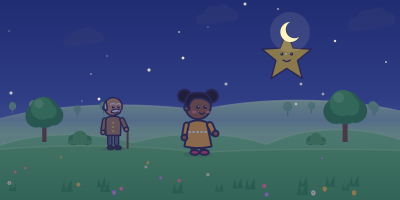
On a clear, dark summer night, Inez and her grandpa spread a blanket on the grass. Grandpa pointed up. "Those stars make a shape like a teapot," he said. "There is the handle, and there is the spout." Inez found it. "Now look just above the spout," said Grandpa. "That is the middle of our galaxy, and a giant black hole is there."
Inez sat straight up. "What is a black hole?" she asked. "It is not really a hole," said Grandpa. "It is a place where a huge amount of stuff is squeezed into a very tiny space. Squeezing it that tight makes its pull, its gravity, very strong. A black hole pulls so hard that nothing can get out. Not even light."
Inez thought about her sandwich, squished flat at the bottom of her lunch bag. "How tight is very tight?" she asked. Grandpa held up a marble from his pocket. "Think of the whole Earth," he said, "with all its mountains and oceans and cities. If you could squeeze all of it down to the size of this marble, Earth would be a black hole."
"Who squeezes them?" asked Inez. "Many black holes are made when a very big star dies," said Grandpa. "The middle of the star falls in on itself, and the star blows up with a giant blast called a supernova." "Will our Sun turn into one?" Inez asked. "No," said Grandpa. "Our Sun is not big enough."
"Will it eat us?" Inez whispered. "No," said Grandpa. "Black holes do not zoom around space eating planets. None is close enough for Earth to fall in." Even if a black hole as heavy as the Sun took the Sun's place, Earth would keep going around it. That will never happen, but if it did, Earth would just get very cold.
Inez squinted at the sky just above the spout. All she could see was dark. "If no light comes out," she said, "how do people know it is there?" "Nobody can see a black hole," said Grandpa. "But you can watch what it does to the things around it, the way you can see wind by watching leaves."
Near the middle of our galaxy, there are stars that race around and around something that nobody can see. Scientists watched those stars for many years and won a big prize for it. From the way the stars move, they could tell how heavy the hidden thing is. It is as heavy as four million suns, all squeezed into one dark spot.
Some black holes have a star right next to them. The black hole pulls gas off the star. The gas swirls around it in a flat, spinning circle and gets hotter and hotter. Then it makes a kind of light that our eyes cannot see. Telescopes up in space can catch that light, and that is another way to find a black hole.
"Are they all giant?" Inez asked. "No," said Grandpa. "Some are as heavy as a few stars. The ones in the middle of galaxies are huge." Some scientists think there may be tiny black holes, too, no bigger than one atom but as heavy as a mountain. Inez tried to picture a mountain inside a speck. She could not.
"What is inside a black hole?" asked Inez. Grandpa was quiet for a moment. "Nobody knows," he said. "Nothing can come back out to tell us." Inez liked that answer. It meant there was still a mystery left in the sky, a real one, waiting for somebody to figure it out. "Maybe me," she said. Grandpa nodded.
Before they went inside, Inez looked just above the spout one more time. She could not see the black hole, and she never would. But she knew that the stars near it were racing around in the dark, right then. On a clear summer night, look low in the south for the teapot in the stars. What do you think is just above the spout?
Questions
- Just above the spout of the teapot stars
- Next to the Moon
- Inside the Sun
- It is painted dark
- Its pull is so strong that not even light can get out
- It is always night there
- They hear it
- They fly to it
- They watch how stars and gas near it move and glow
- Pressed into a tiny space
- Painted black
- Thrown very far
- She wanted to go to bed
- It meant there was still a real mystery to figure out
- She thought Grandpa was joking
Words to know
- gravity: pulling force
- galaxy: huge star group
- supernova: exploding star
- squeezed: pressed tight
- telescope: far-seeing tool
Answer key: Just Above the Spout
- A. Just above the spout of the teapot stars
- B. Its pull is so strong that not even light can get out
- C. They watch how stars and gas near it move and glow
- A. Pressed into a tiny space
- B. It meant there was still a real mystery to figure out
Teaching a mixed class? Black holes at three reading levels
Three true passages from the same facts, a basic, a middle and an advanced one, so every group reads about the same thing and the class can talk about it together. Print one PDF: a sheet for each group, marked with a shape instead of a level, and a page for you that says which is which.
- ● Just Above the Spout (this passage)Basic, for about 6 to 8 · reading level 8 · 669 words · Flesch-Kincaid grade 2.9 · 5 questions
- ▲ Too Strong for LightMiddle, for about 9 to 12 · reading level 10 · 1025 words · Flesch-Kincaid grade 5.4 · 6 questions
- ■ Dark Stars and DoubtersAdvanced, for about 13 to 16 · reading level 14 · 1455 words · Flesch-Kincaid grade 8.9 · 6 questions
The story in pictures
- Part One · The teapot
- Part Two · Squeezed tight
- Part Three · Seeing the unseeable
- Part Four · Still a mystery
For the teacher: how this passage is levelled
“Just Above the Spout” is a reading level 8 story. Every Peabody story at this level is written and checked to keep sentences to 26 words or fewer, to aim at an average of 10 words a sentence, and to show 40 to 65 words on a screen. At most 9% of its words may be off the familiar-word list. Children in 4th grade start at this level.
| This passage | 669 words, 11 screens, 5 multiple-choice questions with an answer key, and 5 vocabulary words with kid-sized meanings |
|---|---|
| Longest sentence at this level | 26 words |
| Words on a screen | 40 to 65 |
| Skills practised at this level | vocabulary, spelling |
Reading level 8: the limits, a real sample and the free games. Peabody is a learning app, not an assessment: use the questions to talk about the story, not to grade a child.