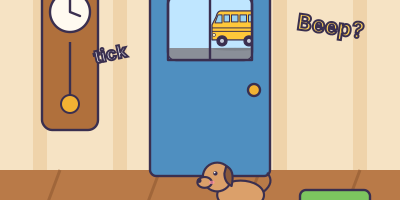
Mop Is Sad
"Bye, Mop!" said Nina.
Nina is off on the bus.
Mop sits at the door.
Mop is sad. Sad, sad, sad.
Tick, tick, tick.
Mop gets Nina's red hat.
Mop naps in the hat.
Is it the bus?
Mop runs. No!
It is a big red truck.
Mop sits. Tick, tick, tick.
Beep! It is the bus!
The door! It is Nina!
Hug, hug, hug! Lick, lick!
Mop is glad. Nina is too.
Questions
- On a bus
- On a bike
- On a log
- A box
- A bed
- Nina's red hat
- A truck
- A cat
- A boat
- It is cold
- It smells like Nina
- It is a bed
- Wet
- Happy
- Big
Words to know
- sad: not happy
- door: a way in
- bus: a big car
- hug: hold tight
- glad: happy
Answer key: Mop Is Sad
- A. On a bus
- C. Nina's red hat
- A. A truck
- B. It smells like Nina
- B. Happy
For the teacher: how this passage is levelled
“Mop Is Sad” is a reading level 3 story. Every Peabody story at this level is written and checked to keep sentences to 6 words or fewer, to aim at an average of 4 words a sentence, and to show 1 to 6 words on a screen. At most 6% of its words may be off the familiar-word list. Children in 1st grade start at this level.
| This passage | 73 words, 15 screens, 5 multiple-choice questions with an answer key, and 5 vocabulary words with kid-sized meanings |
|---|---|
| Longest sentence at this level | 6 words |
| Words on a screen | 1 to 6 |
| Skills practised at this level | first sounds, rhymes |
Reading level 3: the limits, a real sample and the free games. Peabody is a learning app, not an assessment: use the questions to talk about the story, not to grade a child.