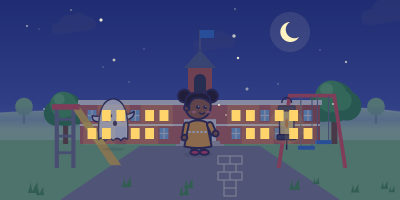
Seat Fourteen
Every school theater has a few strange traditions, but the Whitfield Middle School auditorium had a genuine mystery. Row F, seat fourteen, was always freezing cold. On the hottest afternoons in June, when the other seats were sticky and warm, that single seat felt like the inside of a refrigerator. Priya, who ran the lights for the spring musical, had noticed it during the very first rehearsal. She told herself it was only a draft from the air conditioning vent above it.
But the air conditioning could not explain the way the seat moved. At every rehearsal, usually just as the orchestra reached the second verse of the opening number, seat fourteen folded itself down with a loud, deliberate thud. Nobody had touched it. Priya watched it happen from the lighting booth at the back of the room, and she saw the cushion lower itself slowly. It was as though somebody invisible had decided to sit down and enjoy the show. The cold seemed to spread outward from it in a faint, silvery shimmer.
The stage crew began to keep a notebook about it. Marcus, the stage manager, wrote down every time the seat dropped, along with the exact minute and the song that was playing. He discovered that it never folded down during the comedy scenes. It only dropped when the leading actor sang. It always rose again, quietly and politely, when the final chorus ended. "It is a critic," Marcus joked nervously. "A very quiet critic who only comes to the good parts."
Nobody laughed as hard as they expected to. The cold in row F was getting stronger, and one afternoon the water in Priya's bottle formed a thin skin of ice. That evening, she stayed behind with Marcus, who waited by the stage door with a flashlight, and she climbed down from the booth. The theater was dark except for the single ghost light glowing on the empty stage. Her footsteps echoed on the carpet as she walked slowly down the aisle toward row F. Her heart thumped against her ribs.
Seat fourteen was already folded down. Priya stopped three steps away. A freezing breath drifted across the aisle, smelling faintly of old velvet and chalk dust. She had never been so afraid, yet she could not make herself turn and leave. "Hello?" she whispered. The air did not answer, but the cushion of the seat sank very slightly, as if somebody small had leaned forward with great attention. Priya understood that the visitor was listening. He had been listening for a very long time.
The next morning, she brought the whole crew to the drama teacher, Ms. Okonkwo, who listened without interrupting. When they finished, she sighed and unlocked a cabinet at the back of her classroom. Inside were stacks of dusty programs, one from every show in the school's history. "I had a feeling this day would come," she said. "Every few years, a student notices that seat. Let me show you something that I found when I first arrived at this school."
She opened a faded program from 1974, the year the theater was built. It listed the cast of the very first musical. At the bottom of the cast page, someone had written a name in pencil, squeezed in sideways: Teddy Marsh, understudy. "He rehearsed for months," said Ms. Okonkwo. "The old teacher's notes say he knew every part by heart. But something went wrong the week before opening night, and he never saw the show. Somehow, his name was left out of the printed program."
Priya looked at the pencil marks for a long time. Her throat felt tight. She thought about all those afternoons when seat fourteen had dropped down only during the leading actor's songs. Teddy had been the understudy for the leading role. He had learned every word, every note, every step of the dance, and then he had been left outside the story. He had not been angry. He had only been waiting, patiently, to see the performance he had worked so hard to make.
"Then we have to give him his opening night," said Marcus. The crew gathered around the table and began to talk, all at once, about what that might mean. Priya suggested the simplest idea of all. They would hold seat fourteen empty for the real opening. They would not sell the ticket, and they would not let anyone sit there. And in the middle of that seat, they would place a program with Teddy's name printed inside, properly, in ink, at the top of the cast list.
Ms. Okonkwo helped them rewrite the program. On the cast page, in bold letters beneath the leading actor's name, they printed: "Understudy, Teddy Marsh, who learned every part." The crew polished the seat until its brass number glowed. Priya tucked a single folded program onto the cushion and stepped back. For the first time all month, the row felt calm. The terrible cold had faded into a soft, patient chill, like the air in a concert hall before the music begins.
Opening night arrived in a flurry of nerves and makeup. The house filled slowly, row by row, until every seat was taken except one. Priya stood in the booth with her hand on the dimmer, watching the empty seat with the program on its cushion. Nobody in the audience had noticed anything unusual. When the lights went down and the orchestra began the overture, she held her breath. Down in row F, the cold began to gather, and the air above seat fourteen shivered as if it were smiling.
The musical began. In the middle of the opening number, just where the seat had always dropped, the cushion lowered itself gently and quietly, and the folded program tilted slightly toward the stage. Priya could see, in the glow from the footlights, the faint outline of a boy about her own age, leaning forward with his chin on his hands. He was not frightening at all. He looked like any audience member with the best seat in the house, utterly absorbed in the show.
The leading actor sang her heart out that night. The audience laughed and cried and gasped in all the right places. At the final chorus, the entire cast threw their arms wide. The audience rose to its feet in a thunder of applause. Priya noticed that the cushion of seat fourteen had risen too, and for a moment she heard one more pair of hands clapping in the middle of row F, faint but unmistakably joyful, before the sound melted into the roar.
When the house lights came up, the seat was empty, and the program was gone. In its place, folded neatly on the cushion, lay a single pencil, worn down almost to a stub. The cold never returned to row F. But every year, on opening night of the spring musical, the stage crew still leaves seat fourteen empty, with a new program placed on its cushion. The cast list is open to the very bottom, where the last name always reads: Teddy Marsh, who learned every part.
Questions
- It is broken
- It is freezing cold and folds down by itself
- It is very big
- During the comedy
- Only at night
- When the leading actor sings
- An understudy who never saw opening night
- The stage manager
- A critic
- To save money
- To give Teddy the opening night he missed
- To keep it clean
- A stage light
- A kind of ticket
- A backup actor
Words to know
- theater: a place for plays
- understudy: a backup actor
- auditorium: a big hall for shows
- overture: music at the start of a show
Answer key: Seat Fourteen
- B. It is freezing cold and folds down by itself
- C. When the leading actor sings
- A. An understudy who never saw opening night
- B. To give Teddy the opening night he missed
- C. A backup actor
The story in pictures
- Part One · The Cold Seat
- Part Two · The Missing Name
- Part Three · Opening Night
For the teacher: how this passage is levelled
“Seat Fourteen” is a reading level 11 story. Every Peabody story at this level is written and checked to keep sentences to 40 words or fewer, to aim at an average of 13 words a sentence, and to show 80 to 115 words on a screen. At most 15% of its words may be off the familiar-word list. Children in 7th grade start at this level.
| This passage | 1189 words, 14 screens, 5 multiple-choice questions with an answer key, and 4 vocabulary words with kid-sized meanings |
|---|---|
| Longest sentence at this level | 40 words |
| Words on a screen | 80 to 115 |
| Skills practised at this level | vocabulary, spelling |
Reading level 11: the limits, a real sample and the free games. Peabody is a learning app, not an assessment: use the questions to talk about the story, not to grade a child.