Sink or Float?
Plop! Will it sink, or will it float? Here is a game for a kitchen table, and all you need is a big bowl of water and a few things to drop in. But wait, because you must guess first! Scientists always make a guess, then they test it, and then they write down exactly what happened.
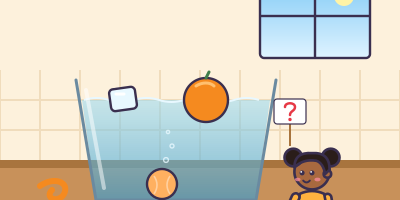
Start with an ice cube. Guess first, then drop it in, and it floats! Ice is made of the very same water, but when water freezes, its tiny pieces spread out a little more. Scientists say that ice is less dense than liquid water, so it stays on top.
Next, try an orange that is still in its peel. It feels heavy in your hand, so most people guess that it will sink straight to the bottom. Ready? Plop, and it bobs right back up and floats! How can something that feels so heavy stay on top of the water? The next page has the clue.
Here is the clue. An orange's peel is porous, which means it is full of tiny pockets of air. Air is very light, so the peel makes the whole orange less dense than water. It works like a puffy life jacket for the fruit inside it.
Now peel the orange, and drop in only the fruit. Guess first! Splash, and down it goes, all the way to the bottom, because without its airy peel the fruit is more dense than water. It is the very same orange, and yet it floats in one coat and sinks in the other.
A lemon is trickier. A whole lemon floats, but with the peel off, some lemons float and some sink. A lemon is very close to water in density, so small things can tip the answer. Try yours, and write down what you see.
Now for a puzzle. Roll a ball of modeling clay and drop it into the water. Glug, glug, and it sinks fast, because clay is denser than water. So how could anything made of clay ever float? Use oil-based modeling clay for this, because play dough goes soft and mushy in water.
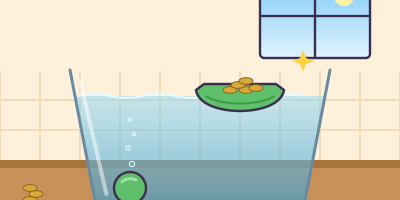
Take the very same clay and press it into a boat. Make it wide and flat, with high sides like a bowl, and set it gently on the water. It floats! You did not add any clay, and you did not take any away, because all you changed was the shape.
Here is the reason. The little ball pushes aside only a small bit of water. The wide boat pushes aside a great deal more. The more water something pushes aside, the harder the water pushes back up. The boat shape pushes aside enough water to hold up all of the clay.
Now make it a contest. Put coins in your boat one at a time, gently, right in the middle. How many coins can it carry before the water spills over the side? Guess first! Then try a wider boat, or a boat with higher sides, and see if you can beat your own number.
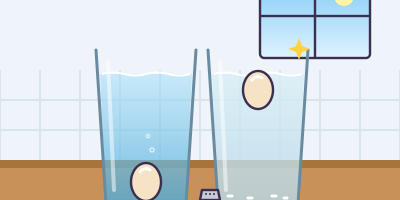
Here is the last test, and it is the strangest one of all. Put a raw egg into a tall glass of plain water from the tap. Guess first! Down it goes, right to the bottom, because a fresh egg is a little denser than plain water.
Now fill a second glass with warm water. Ask a grown-up to help you stir in lots of salt, spoon after spoon, until no more will go in. Then gently put in the very same egg. Guess first! Wait for it, because this time the egg floats!
The egg did not change at all, but the water did! Salt makes water heavier, so salty water is more dense than plain water. Now the egg is less dense than the water around it, so up it comes. That is also why people float more easily in the salty sea than in a lake.
So, will it sink or float? Now you have three clues to check. How dense is it, compared with the water? What shape is it? And what is the water like? Pick something from the kitchen and guess first, and then drop it in the bowl to see if you were right!
Questions
- It sinks
- It floats
- It melts
- The peel holds tiny pockets of air
- The orange is very small
- Oranges are hollow
- Very sweet
- Very cold
- Full of tiny holes
- The boat is lighter clay
- The boat pushes aside more water
- The boat is a different color
- The salt makes the egg lighter
- Salty water is more dense than plain water
- The warm water cooks the egg
- So you can check your own thinking
- So the test goes faster
- So the water stays clean
Words to know
- dense: packed tight
- float: stay on top
- porous: full of holes
- peel: outer skin
- guess: think first
Answer key: Sink or Float?
- B. It floats
- A. The peel holds tiny pockets of air
- C. Full of tiny holes
- B. The boat pushes aside more water
- B. Salty water is more dense than plain water
- A. So you can check your own thinking
The story in pictures
- Part One · Guess, Then Test
- Part Two · The Clay Puzzle
- Part Three · The Egg Trick
For the teacher: how this passage is levelled
“Sink or Float?” is a reading level 8 story. Every Peabody story at this level is written and checked to keep sentences to 26 words or fewer, to aim at an average of 10 words a sentence, and to show 40 to 65 words on a screen. At most 9% of its words may be off the familiar-word list. Children in 4th grade start at this level.
| This passage | 714 words, 14 screens, 6 multiple-choice questions with an answer key, and 5 vocabulary words with kid-sized meanings |
|---|---|
| Longest sentence at this level | 26 words |
| Words on a screen | 40 to 65 |
| Skills practised at this level | vocabulary, spelling |
Reading level 8: the limits, a real sample and the free games. Peabody is a learning app, not an assessment: use the questions to talk about the story, not to grade a child.