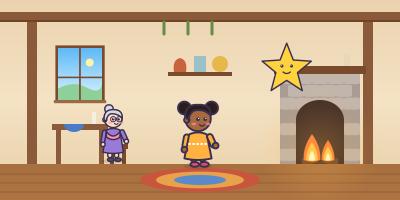
The Attic Music Box
Every afternoon, at about twenty past three, a tune floated down from the attic. It was soft and tinkly, like water falling over tiny stones. Lila heard it from the kitchen table, where she did her homework. And the house, as far as she knew, was empty.
Lila decided to be a scientist. She took a notebook and wrote down the time each day. Monday, 3:20. Tuesday, 3:20. Wednesday, 3:19. The song came at the same minute, nearly every time, and it was always the same song. It became her favorite game.
Then came a gray, rainy Thursday. Lila waited at the table, pencil ready. Three twenty came and went. The house was silent. “No music today,” she wrote. After a moment, she added, “Maybe it only plays on sunny days.” The kitchen clock ticked on.
On Friday, the sun came out. “Gran,” said Lila, “would you come to the attic with me?” Gran put down her knitting. “I thought you would never ask,” she said. They climbed the creaky stairs at ten past three. Gran held the rail all the way up.
The attic smelled of old paper and cedar. Dust floated in the light from a small round window. Boxes and trunks sat in rows. On top of one trunk was a little wooden music box with its lid open. It felt like stepping into another time.
Lila stood very still. A beam of sunshine slid slowly across the floor and climbed the trunk. It touched the shiny metal spring inside the box. There was a tiny click. Then, at twenty past three, the music began. Every note was clear and sweet.
“It is the sun!” whispered Lila. “It warms the spring, and the spring starts the music.” She wrote it down quickly. Gran said nothing. She was staring at the little box with a strange, faraway look. Outside, a bird sang along.
“I know that song,” Gran said at last. Her voice was shaky. “My grandmother used to hum it to me at bedtime. I have not heard it in fifty years. I thought it was lost.” Lila took her hand. Gran sat down on the old trunk.
“Nobody ever wrote the tune down,” said Gran. “She played it by ear, on the old piano.” Lila looked down the attic stairs toward the living room. The dusty piano sat in the corner, covered with a quilt. It had not been played in years.
The next day, Lila pulled the quilt off the piano. Each sunny afternoon, she and Gran went to the attic and listened. Then they went downstairs and tried to find the notes, one at a time, in the notebook. Gran called it the best homework ever.
It took many weeks. Some notes were wrong, and they tried again. It was slow, careful work. But little by little, the tune came back to life under Lila's fingers. When she played the last note, Gran wiped her eyes and smiled.
Now, on sunny afternoons, the music box plays at twenty past three, and Lila plays along on the piano. Gran hums the tune. The attic mystery was never a ghost at all. It was a song, waiting for someone to listen.
Questions
- At midnight
- About twenty past three
- At breakfast
- A clock
- A map
- A notebook
- Sunlight on the spring
- The wind
- A cat
- She is afraid
- It is her grandmother's lost tune
- She is bored
- A wooden board
- A kind of toy
- A line of light
Words to know
- spring: a coiled piece of metal
- tinkly: light and bell-like
- beam: a line of light
- faraway: dreamy and distant
Answer key: The Attic Music Box
- B. About twenty past three
- C. A notebook
- A. Sunlight on the spring
- B. It is her grandmother's lost tune
- C. A line of light
For the teacher: how this passage is levelled
“The Attic Music Box” is a reading level 8 story. Every Peabody story at this level is written and checked to keep sentences to 26 words or fewer, to aim at an average of 10 words a sentence, and to show 40 to 65 words on a screen. At most 9% of its words may be off the familiar-word list. Children in 4th grade start at this level.
| This passage | 535 words, 12 screens, 5 multiple-choice questions with an answer key, and 4 vocabulary words with kid-sized meanings |
|---|---|
| Longest sentence at this level | 26 words |
| Words on a screen | 40 to 65 |
| Skills practised at this level | vocabulary, spelling |
Reading level 8: the limits, a real sample and the free games. Peabody is a learning app, not an assessment: use the questions to talk about the story, not to grade a child.