The Boy Who Drew Cats
Long, long ago, a poor farmer and his wife lived with their many children in a little village among the rice fields of Japan. The big children worked in the fields with their father, and the girls helped their mother at home. The youngest boy was too small and thin for farm work, but he was the cleverest child in the family. So his parents took him to the old priest at the village temple, to be his helper and his student.
The old priest asked the boy some hard questions, and the boy answered every one. "He is a bright one," said the priest, smiling. "I will teach him." So the boy came to live at the temple. He swept the floors, he lit the lamps, and he learned his lessons quickly. He was a good boy in nearly every way. But he had one habit that he could not stop, no matter how hard he tried. He drew cats.
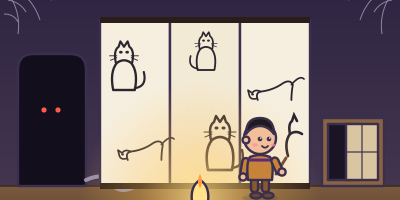
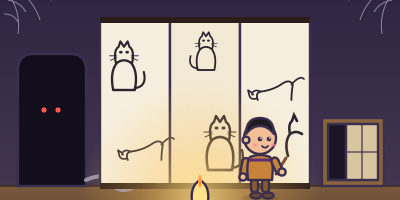
He drew cats on the edges of his lesson books. He drew cats on the paper screens and on the wooden pillars. He drew sleeping cats, stretching cats and cats pouncing on string. Whenever he was alone with a brush and a little ink, more cats appeared. "No more cats on my books," the priest told him, again and again. The boy always said he was sorry, and he meant it. But the next day, there was always a new cat somewhere.
One day the boy painted a whole row of cats across a beautiful paper screen. They were so good that they looked ready to jump off it. The old priest looked at them for a long time. Then he said, "My boy, you will never make a good priest, so you must leave the temple. But I think you may become a great artist one day. Before you go, here is some advice. Avoid large places at night. Keep to small."
The boy did not understand what that meant at all. He thought about it while he packed his little bundle, but he was too shy to ask. So he bowed, said goodbye, and walked sadly out of the temple gate. He was afraid to go home, because he thought his father would be cross with him. Then he remembered a big temple in the next village, a long walk away. "Perhaps they will take me there," he thought, and he set off down the road.
Nobody had told him the secret of that big temple. The priests had left it long ago, because a goblin had moved in and frightened them away. Brave warriors had gone there at night to drive the goblin out, but not one of them had managed it. Now the doors were shut, and no one in the village would go near the place after dark. But the boy did not know any of this, so he kept walking.
It was night by the time he reached the village, and everyone was asleep. At the far end of the street, the big temple stood on a hill, and a light glowed in one window. "Someone is still awake," thought the boy happily. He did not know that the goblin lit that lamp on purpose, to trick lonely travelers into knocking. He climbed the hill and knocked, but nobody answered. When he gave the door a gentle push, it swung open.
Inside, a single lamp was burning, but there was no priest anywhere. The boy sat down to wait. As he waited, he looked around and saw that everything was gray with dust and hung with cobwebs. "The priests will need a helper to clean all this," he thought. Then he noticed something that made him forget how tired he was. There were tall white screens all along the walls, plain and empty. They were perfect for drawing cats.
He found a brush and an ink stone, mixed some ink and began to paint. He painted a big cat and a small cat, a striped cat and a spotted cat, and a cat washing its face with its paw. Soon there were cats on every screen, all with bright eyes and sharp claws. At last the boy yawned, and he was just about to curl up beside the screens when he remembered the old priest’s words. "Avoid large places at night. Keep to small."
The temple was very large, and he was all alone in it. For the first time, the boy felt a little afraid. He looked around and found a tiny cupboard in the wall, with a sliding door. He crept inside, slid the door shut and lay down in the dark, where it was cozy and small and just the right size for a boy. In a moment he was fast asleep.
In the middle of the night, a terrible noise woke him up. There was thumping and crashing, and screeching and yowling, as if a great fight was going on outside the cupboard. The lamp went out. The whole temple shook. The boy was so frightened he did not dare to peek through the crack in the door. He hugged his knees in the dark, hardly breathing, and waited for it to end. After a long, long time, the noise stopped, and everything was quiet.
The boy stayed in his cupboard until the morning sun came shining through the cracks. Then he slid the door open, very slowly, and peeked out. In the middle of the floor lay an enormous rat, bigger than a cow. It was the goblin, and it lay still on the dusty floor, beaten, never to frighten anyone again. But who could have beaten it? There was nobody else in the temple at all.
Then the boy looked at the screens. All his painted cats were still there, but they were not quite the same as he had painted them. Their whiskers bristled, their fur stood up, and their claws were stretched out wide, as if they had just finished a fight. The boy stared at them. Then he understood. His cats had jumped down from the screens in the night and fought the goblin, while he slept safe in his small, small place.
Now he knew what the old priest had meant. In the big room, the goblin would have found him, but in the little cupboard he was safe. The boy never stopped drawing after that. He grew up to be a famous artist, and people came from far and wide to see his pictures. And they say that some of the cats he painted can still be seen in Japan today, with their bright eyes and their whiskers standing up.
Questions
- Work in the rice fields
- Draw cats
- Ring the temple bell
- Avoid large places at night and keep to small
- Never draw on paper screens
- Always go straight home
- A priest was still awake
- The boy's father had lit it
- The goblin lit it to trick travelers
- The brave warriors
- The cats the boy had painted
- The old priest
- It was a waste of time
- It only got him into trouble
- A gift that seems like a fault can turn out to be a strength
- Fell off
- Stood up stiffly
- Turned white
Words to know
- screens: paper walls
- goblin: small monster
- cobwebs: old webs
- bristled: stood up stiffly
- travelers: people on journeys
Answer key: The Boy Who Drew Cats
- B. Draw cats
- A. Avoid large places at night and keep to small
- C. The goblin lit it to trick travelers
- B. The cats the boy had painted
- C. A gift that seems like a fault can turn out to be a strength
- B. Stood up stiffly
The story in pictures
- Part One · The Boy and His Cats
- Part Two · Keep to Small
- Part Three · The Empty Temple
- Part Four · The Night
- Part Five · Morning




For the teacher: how this passage is levelled
“The Boy Who Drew Cats” is a reading level 9 story. Every Peabody story at this level is written and checked to keep sentences to 32 words or fewer, to aim at an average of 11 words a sentence, and to show 55 to 85 words on a screen. At most 11% of its words may be off the familiar-word list. Children in 5th grade start at this level.
| This passage | 1118 words, 14 screens, 6 multiple-choice questions with an answer key, and 5 vocabulary words with kid-sized meanings |
|---|---|
| Longest sentence at this level | 32 words |
| Words on a screen | 55 to 85 |
| Skills practised at this level | vocabulary, spelling |
Reading level 9: the limits, a real sample and the free games. Peabody is a learning app, not an assessment: use the questions to talk about the story, not to grade a child.