The Twelve Labors of Hercules
Long ago in Greece, a baby named Hercules was born. His father was Zeus, the king of the gods, and his mother was a mortal woman named Alcmena. Hera, the queen of the gods, was jealous of every child Zeus had with a mortal, and she disliked this baby most of all. One night she sent two great snakes sliding into his room. The nurse woke up screaming, but by the time she reached the cradle, baby Hercules was sitting up and laughing, with a limp snake held tight in each fat little fist.
Hercules grew up to be the strongest man in the whole world. He could pull a tree out by its roots, and he could throw a spear clear across a valley. But he had a hot temper, and Hera never stopped making trouble for him. At last, through her tricks, he did something terrible that he could never undo. He was so ashamed that he went to ask the wise oracle at Delphi what he should do. The answer came back: to make up for the wrong, he must serve his cousin, King Eurystheus, and do whatever the king commanded.
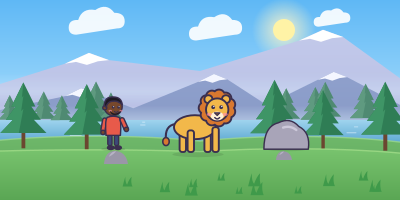
Eurystheus was a small, nervous man who was frightened of almost everything, and he was especially frightened of Hercules. He decided to give his mighty cousin jobs so dangerous that no one could possibly do them. These jobs came to be called the twelve labors of Hercules. "Your first labor," the king announced, "is to bring me the skin of the lion of Nemea." Everyone in the hall went quiet. The lion of Nemea was the size of an ox, and its golden skin was so tough that no arrow or sword could pierce it.
Hercules tracked the lion into the hills and found its cave, which had two doors. He shot his arrows, but they bounced off the lion's side like twigs. He swung his heavy club, and the club cracked in two. So Hercules blocked one door of the cave with a boulder and went in through the other. In the dark, he wrapped his enormous arms around the lion's neck and squeezed, and he did not let go, until the great beast lay still. Ever after, Hercules wore the lion's skin as a cloak, with its head for a helmet.
When Eurystheus saw Hercules striding toward the city with a lion on his shoulders, he was so terrified that he jumped into a big bronze jar and hid there. From then on, he made Hercules shout his reports from outside the city gates. The second labor was worse. In a swamp near the town of Lerna lived the Hydra, a water serpent with nine heads. Each time Hercules knocked one head away with his club, two new heads sprang up in its place, hissing and snapping.
Hercules had brought along his nephew Iolaus, a clever young man who drove his chariot. "Fetch a torch," Hercules called, "and be quick!" Every time Hercules knocked a head away, Iolaus pressed the burning torch against the stump, and no new head could grow there. One by one the snapping heads were gone, until only the middle head was left, the one that could never die. Hercules buried it deep under a huge rock beside the road, and it has never troubled anyone since.
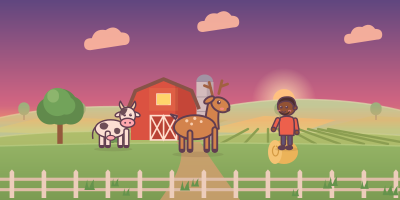
For the third labor, Eurystheus wanted the golden-horned deer of the goddess Artemis. It was not dangerous at all, but it could run faster than an arrow, and Hercules had promised not to harm it. So he followed it. He followed it through forests and over mountains and across frozen rivers, for one whole year, until at last the tired deer stopped to drink. Then he caught it gently in his arms. Artemis was angry at first, but when she saw how carefully he carried her deer, she let him show it to the king and set it free.
Next came a labor that was meant to make Hercules look silly. King Augeas owned three thousand cattle, and nobody had cleaned out their stables in thirty years. The muck was piled higher than the rooftops, and the smell drifted for miles. "Clean them," said Eurystheus with a sly smile, "in a single day." Hercules looked at the stables, and then he looked at the two rivers that flowed nearby. He picked up a shovel, but he did not shovel a single stall.
Instead, he dug a long ditch from each river to the stables, and he knocked a big hole in the wall at each end. Then he pulled away the last stones that held back the rivers. The water came rushing through the stables with a roar, and it carried thirty years of mess out the far side and away down the valley. By sunset the stalls were sparkling, and the cattle were blinking in surprise. Hercules had finished the dirtiest job in the world without getting his hands dirty.
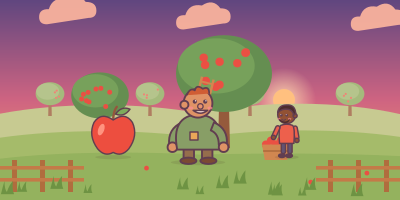
The labors went on and on. Hercules chased away a flock of birds with feathers as sharp as knives, captured a wild bull, tamed a herd of horses, and sailed across the sea to bring home a queen's golden belt. He traveled so far west that he set up two great pillars of stone where the sea met the ocean. Then Eurystheus gave him one of the hardest labors of all: "Bring me three golden apples from the garden of the Hesperides." The trouble was that nobody knew where that garden was.
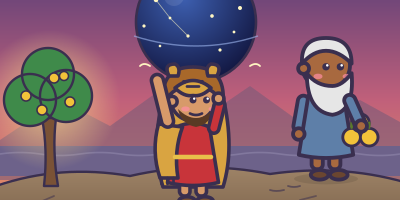
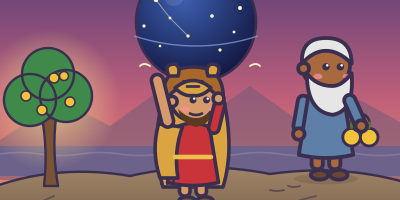
Hercules wandered for a long time, until at last he came to a mountain at the edge of the world. There stood the giant Atlas, holding the whole sky on his shoulders, which was his punishment for fighting against the gods. The Hesperides were his daughters, and only Atlas could fetch their apples. "I will gladly go," said Atlas, "but who will hold up the sky while I am gone?" Hercules stepped forward, bent his back, and took the sky onto his own shoulders. It was heavier than any mountain.
Atlas strolled off, stretching his arms, and soon came back with three shining golden apples. But he did not take back the sky. "I have had a lovely walk," he said. "I think I will carry these apples to your king myself, and you can stay here." Hercules was stuck, but he did not lose his temper. "Of course," he said politely. "Only hold the sky for one moment while I fold my lion skin into a cushion for my shoulders." Atlas set down the apples and took back the sky, and Hercules picked up the apples and walked away.
The twelfth labor was the most frightening of all. Hercules had to go down into the Underworld, the land of the dead, and bring back Cerberus, the huge three-headed dog that guarded its gates. He walked down the long dark path until he stood before Hades, the god of the Underworld. "You may borrow my dog," Hades said, "if you can take him without any weapon." So Hercules put down his club and his bow. Cerberus snarled with all three mouths at once, but Hercules wrestled him and held him fast.
Hercules carried the struggling dog all the way up into the sunlight and set him down outside the city gates. When Eurystheus peeked out and saw three heads growling at him, he dived straight back into his bronze jar. "Take it away!" he wailed from inside the jar. "You are free! I have no more labors for you!" So Hercules carried Cerberus back down to the Underworld, gave him a pat on each of his three heads, and returned him to his master, just as he had promised.
The twelve labors were done, and Hercules had made up for his terrible wrong. People all over Greece told stories about him, and they still do today. When someone does a huge job, we call it a Herculean task. Hercules had been the strongest man in the world from the day he was born, but strength alone had not been enough. He had needed patience to follow a deer for a year, cleverness to clean a stable with a river, and a cool head to trick a giant who held up the sky.
Questions
- He wanted to become king
- To make up for a terrible wrong
- To win a race
- He sent two rivers through them
- He shoveled very fast
- He asked Atlas to help
- It was his favorite seat
- He was hiding from Hera
- He was afraid of Hercules and the beasts he brought
- He tricked Atlas by asking him to hold it for a moment
- He threw the apples at him
- He asked Zeus for help
- Strength is all a hero needs
- Strength works with patience and cleverness
- Strong people never need help
- To color
- To poke through
- To fold
Words to know
- labors: hard jobs
- oracle: wise speaker
- pierce: poke through
- stables: animal barns
- Herculean: very hard
Answer key: The Twelve Labors of Hercules
- B. To make up for a terrible wrong
- A. He sent two rivers through them
- C. He was afraid of Hercules and the beasts he brought
- A. He tricked Atlas by asking him to hold it for a moment
- B. Strength works with patience and cleverness
- B. To poke through
The story in pictures
- Part One · The Strongest Baby
- Part Two · The Lion and the Hydra
- Part Three · The Deer and the Stables
- Part Four · The Sky on His Shoulders
- Part Five · The Dog with Three Heads
For the teacher: how this passage is levelled
“The Twelve Labors of Hercules” is a reading level 11 story. Every Peabody story at this level is written and checked to keep sentences to 40 words or fewer, to aim at an average of 13 words a sentence, and to show 80 to 115 words on a screen. At most 15% of its words may be off the familiar-word list. Children in 7th grade start at this level.
| This passage | 1382 words, 15 screens, 6 multiple-choice questions with an answer key, and 5 vocabulary words with kid-sized meanings |
|---|---|
| Longest sentence at this level | 40 words |
| Words on a screen | 80 to 115 |
| Skills practised at this level | vocabulary, spelling |
Reading level 11: the limits, a real sample and the free games. Peabody is a learning app, not an assessment: use the questions to talk about the story, not to grade a child.