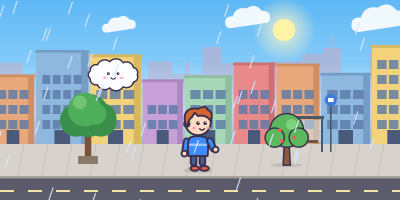
The Water Cycle Next Door
The storm blew through in the middle of the night, and in the morning the jar Ansel had wired to the back fence held exactly one inch of rain. One inch did not look like much. But that same inch had fallen on every roof, sidewalk and backyard on his street, and by lunchtime most of it seemed to have vanished. Where does rain go after it lands? The answer is the water cycle, the trip water takes from the ground to the sky and back again. In school, Ansel had seen it drawn as a tidy circle with three arrows. He was about to find out that it is much messier than that.
The first place Ansel looked was the gutter. During the storm it had been a small brown river, racing toward the storm drain at the corner. On a city street, rain has a hard time soaking in. Roofs and pavement send it sliding off, and storm sewers carry it straight to the nearest stream or lake, so a city sends far more water rushing away than a field or a forest does. Ansel crouched by the drain and listened to the water still trickling somewhere far below. He realized that his one inch was already on its way to the river at the edge of town.
Not all of it, though. In his grandmother's garden next door, the dirt was dark and soft, and the puddles had disappeared overnight. That water had soaked into the ground. Ansel pictured an underground river, but that is not how it works. Water below the surface moves more like water in a sponge, creeping sideways and down through the tiny spaces between grains of soil and cracks in rock. Some of it drifts very slowly toward streams. That is why the creek behind his school was still running even after three weeks without rain. It was being fed from underneath.
Some of the water that soaks in goes very deep, and then it can stay put for an astonishingly long time. Deep groundwater can stay beneath the surface for more than ten thousand years before it comes out again. Very old groundwater even has a name: fossil water. Ansel looked at the faucet on the side of his grandmother's house and wondered how old the water in it was. His town's water came from the river, so it was probably young. In some dry places, like desert towns in the western United States, people depend on water pumped up from deep underground, and some deep water is very old indeed.
Most of the rain that falls on land does not stay there long. Across the United States, about seventy out of every hundred drops that fall go back up into the air, either by evaporating or by passing through plants. Ansel tested the plant part himself. He tied a clear plastic bag around a leafy branch of the maple in the yard and waited. In an hour, the inside of the bag was foggy. The tree was pulling water up through its roots and letting it out of its leaves as invisible vapor. That is called transpiration, and on a sunny day it is happening in almost every green leaf you can see.
One maple branch made a little fog. A whole tree does far more. A large oak can send about forty thousand gallons of water into the air in a single year, quietly, without a single drop that anyone can see. Ansel looked down his street at all the trees in a row and imagined each one breathing out a slow, steady cloud. Once the vapor rises, it does not hang around. A bit of water that evaporates stays in the air for only about a week and a half before it falls again.
Up high, where the air is colder, vapor gathers on tiny specks of dust, salt and smoke and becomes cloud droplets. A cloud looks as light as cotton, but the water in it is heavy. A cumulus cloud about a kilometer on each side holds more than a million pounds of water. It floats because the damp air inside the cloud is lighter than the dry air below it, the way oil floats on water. If you watch one carefully for a few minutes, you can even see parts of it fading away while other parts puff up and grow.
So why doesn't a cloud just rain all the time? Cloud droplets are tiny, and rising air keeps pushing them up. To fall, droplets have to bump together and grow, and it takes millions of them to build a single raindrop. Ansel liked knowing that the inch in his jar had been built drop by drop, high above his roof. Then he learned something stranger. Most of the water that evaporates from the oceans falls right back into the oceans. Only about one drop in ten is carried over land. If any of Ansel's inch began in the ocean, those drops were the lucky travelers.
That winter, Ansel's grandmother hung a wet shirt on the clothesline on a freezing day. It froze stiff as a board. A day later it was dry, and it had never melted at all. The ice had turned straight into vapor, skipping the liquid part. This is called sublimation. In the American West, a warm, very dry wind called the Chinook does the same thing to whole fields of snow, which is why people call it the snow eater. Ansel added a new arrow to his school diagram, one that went straight from ice to air.
By now his drawing had arrows going everywhere: into gutters, into roots, under the ground, into clouds, back into the ocean and straight out of a frozen shirt. It also needed people. Dams hold back rivers, pumps pull water from the ground, and pipes carry it into kitchens and out again. In 2022, the U.S. Geological Survey released a new water cycle diagram that adds people, showing how the ways we use water change where it is kept, how it travels and how clean it stays. Ansel turned on the faucet in his grandmother's kitchen. The water cycle, he decided, ran right through her sink.
Ansel still checks his jar after every storm. He knows now that nobody can follow a single drop for very long, because the paths branch in too many ways. His inch of rain might be in the river by now, or inside a maple leaf, or high above another state in a cloud that has not decided to rain yet. If you want to follow part of the trip yourself, set a straight-sided jar in an open spot before the next storm, and measure the rain in it with a ruler. Then ask the question Ansel keeps asking: where will this water be next week?
Questions
- Roofs and pavement stop it soaking in, and drains carry it away
- City rain is heavier than country rain
- Fields are always dry
- Someone filled it with a hose
- Groundwater was seeping into it from underneath
- Snow was melting on the school roof
- Water soaking into soil
- Rain falling from a cloud
- Ice turning straight into vapor without melting
- The damp air in the cloud is lighter than the dry air below it
- Clouds are tied to mountains
- Clouds have no water in them
- Water only moves in one direction
- Water takes many paths, including through plants, the ground, ice and people's pipes
- Clouds never make rain
- It was the biggest raindrop
- It fell at night
- Most water from the ocean falls back into the ocean, not on land
Words to know
- transpiration: plants releasing vapor
- sublimation: ice becoming vapor
- groundwater: water underground
- vapor: water as gas
- cumulus: puffy cloud
Answer key: The Water Cycle Next Door
- A. Roofs and pavement stop it soaking in, and drains carry it away
- B. Groundwater was seeping into it from underneath
- C. Ice turning straight into vapor without melting
- A. The damp air in the cloud is lighter than the dry air below it
- B. Water takes many paths, including through plants, the ground, ice and people's pipes
- C. Most water from the ocean falls back into the ocean, not on land
Teaching a mixed class? The water cycle at three reading levels
Three true passages from the same facts, a basic, a middle and an advanced one, so every group reads about the same thing and the class can talk about it together. Print one PDF: a sheet for each group, marked with a shape instead of a level, and a page for you that says which is which.
- ● Where Did the Puddle Go?Basic, for about 6 to 8 · reading level 8 · 719 words · Flesch-Kincaid grade 2.9 · 5 questions
- ▲ The Water Cycle Next Door (this passage)Middle, for about 9 to 12 · reading level 11 · 1147 words · Flesch-Kincaid grade 6.3 · 6 questions
- ■ The Tax Collector's RainAdvanced, for about 13 to 16 · reading level 14 · 1355 words · Flesch-Kincaid grade 9.2 · 6 questions
The story in pictures
- Part One · One inch
- Part Two · Down and in
- Part Three · Up and over
- Part Four · The messy circle
For the teacher: how this passage is levelled
“The Water Cycle Next Door” is a reading level 11 story. Every Peabody story at this level is written and checked to keep sentences to 40 words or fewer, to aim at an average of 13 words a sentence, and to show 80 to 115 words on a screen. At most 15% of its words may be off the familiar-word list. Children in 7th grade start at this level.
| This passage | 1147 words, 11 screens, 6 multiple-choice questions with an answer key, and 5 vocabulary words with kid-sized meanings |
|---|---|
| Longest sentence at this level | 40 words |
| Words on a screen | 80 to 115 |
| Skills practised at this level | vocabulary, spelling |
Reading level 11: the limits, a real sample and the free games. Peabody is a learning app, not an assessment: use the questions to talk about the story, not to grade a child.