Thumbelina
There was once a woman who wanted a child more than anything in the world, but she had none. So she went to an old wise woman and asked for help. "That is easily done," said the wise woman. "Here is a barleycorn, but it is not the kind that grows in farmers' fields or that the hens eat. Plant it in a flowerpot, and watch what happens." The woman thanked her, paid her twelve pennies, and hurried home to plant the seed.
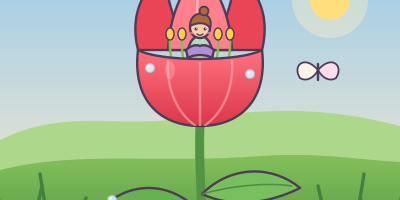
At once a tall flower grew, as handsome as a tulip, but with its petals shut tight like a bud. "What a lovely flower," said the woman, and she kissed the red and golden petals. At that moment the flower opened with a pop, and she saw that it was a real tulip. In the middle of it, on the green stamens, sat a tiny girl, hardly as long as a thumb. The woman was so delighted that she called her Thumbelina, and she made her a bed from a polished walnut shell, with blue violet petals for a mattress and a rose petal for a quilt.
By day, Thumbelina played on the table. The woman had set out a plate of water with flowers around its edge, and on the water floated a tulip petal that served as a boat. There Thumbelina sat and rowed from one side of the plate to the other, with two white horsehairs for oars. And as she rowed, she sang, in a voice so soft and sweet that nobody had ever heard anything like it. It was a very happy time, and it might have lasted forever, if a toad had not come in through a broken window one night.
The toad was large and ugly and wet. She hopped onto the table where Thumbelina lay asleep under her rose-petal quilt. "What a pretty wife she would make for my son," said the toad, and she snatched up the walnut shell and carried it off through the window and into the garden. By the edge of a wide stream lived the toad's son, who was even uglier than his mother. When he saw the tiny girl, all he could say was, "Croak, croak, croak."
The old toad set the shell down on a broad water lily leaf in the middle of the stream, so that Thumbelina could not run away, and then went off to get the wedding room ready under the mud. When Thumbelina woke up, she saw water all around her and no way to reach the shore, and she began to cry. The toads came back, bowed low, and said, "This is my son. He will be your husband, and you will live happily in the mud." Then they took her pretty bed and swam away, leaving her alone on the leaf.
But the little fish who lived beneath the water had heard everything. They did not like to think of such a pretty girl living with the toads, so they gathered round the stem of the lily leaf and nibbled it through with their teeth. The leaf floated away down the stream, carrying Thumbelina far from the toads. She sailed past many towns, and the little birds in the bushes sang, "What a lovely creature!" A white butterfly fluttered around her and landed on the leaf, and Thumbelina tied her sash to him, so that he could pull her along faster.
Then a big beetle flew by, and when he saw her, he caught her round the waist with his claws and carried her up into a tree. Her poor butterfly was still tied to the leaf, and Thumbelina worried that he would starve. But the beetle sat her down on a green leaf, gave her honey from the flowers, and told her she was very pretty, although she was not at all like a beetle. Soon the other beetles came to look. "She has only two legs!" they said. "She has no feelers! How ugly she is!" And the beetle who had carried her off began to believe them.
He flew down from the tree and set her on a daisy, and he would have nothing more to do with her. Thumbelina wept, because she thought she must be so ugly that even the beetles did not want her. And all the time she was the loveliest creature one could imagine, as soft and delicate as a rose petal. All summer she lived alone in the wide wood. She wove a bed out of grass and hung it under a big leaf to keep off the rain, she ate the honey of the flowers, and each morning she drank the dew from the leaves.
So the summer and the autumn passed, and then came the long, cold winter. The birds that had sung so sweetly flew away, the trees lost their leaves, and the flowers faded. Thumbelina's clothes were in rags, and she was cold and hungry. Snow began to fall, and every flake was like a whole shovelful thrown on her, because she was only an inch high. She wrapped herself in a dry leaf, but it cracked and gave no warmth, and she shivered. At the edge of the wood lay a cornfield, but the corn had been cut long ago, and only stiff stubble stood up from the frozen ground.
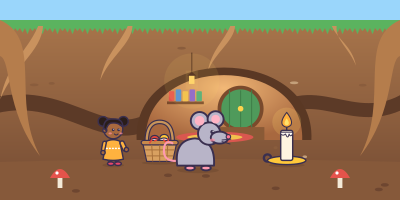
She wandered on until she came to the door of a field mouse, who lived in a snug hole under the stubble, with a warm room, a kitchen and a pantry full of grain. Thumbelina stood at the door like a beggar child and asked for a bit of barley, because she had not eaten for two days. "Poor little thing," said the field mouse, who was kind at heart. "Come in and eat with me. If you will keep my rooms tidy and tell me stories, you may stay here all winter." Thumbelina was glad to agree, and she lived comfortably.
"We shall have a visitor soon," said the field mouse one day. "My neighbour comes every week. He is rich, and he lives in a big house under the ground, but he cannot see, because he is a mole." The mole did come, in his black velvet coat, and he talked about how clever he was and how silly the sun and the flowers were, since he had never seen them. Thumbelina sang for him, and he fell in love with her voice. He was very careful and said nothing about it, but he dug a long passage from his house to the mouse's.
In the passage, the mole showed her a swallow lying on the ground. "The poor bird must have died of cold," he said, and he kicked it aside with his short legs. But Thumbelina was sorry. That night she crept out, wove a blanket of hay, spread it over the swallow, and laid her ear against its chest. She heard a faint beat. The bird was not dead, only numb with cold. All winter she fed it and nursed it in secret, and in spring it flew out into the sunshine and asked her to come along. But she stayed, for she could not leave the field mouse.
Now the field mouse told Thumbelina that she was to marry the mole. "He is a rich man, and you must have a good wedding dress," she said. All summer Thumbelina spun and sewed, and each evening the mole came and talked of the wedding. But Thumbelina did not want to marry him, and she did not want to live under the ground, never to see the sun again. She asked if she might step outside for a moment to say goodbye to it.
She stood in the field and held up her arms, saying, "Farewell, bright sun." And above her she heard a "Tweet, tweet!" It was the swallow. "Winter is coming, and I am flying to the warm lands," he said. "Will you come with me? You can sit on my back, and we will fly far away from the ugly mole and his dark house." "Yes, I will come," said Thumbelina, and she sat on his back with her feet on his outspread wings. Up they rose, over forests and lakes, over high mountains capped with snow, and she kept warm under his feathers.
At last they came to a land where the sun shone warm and the sky was twice as high, and where grapes hung green from the hedges. Among the ruins of an old white marble palace there grew many lovely flowers. "This is my home," said the swallow. "Choose a flower for yourself, and I will set you down on it, and you will have everything you wish." Thumbelina clapped her hands for joy. In the largest flower of all, which was white as snow, there sat a tiny man, shining like glass, with a gold crown on his head and bright wings at his shoulders.
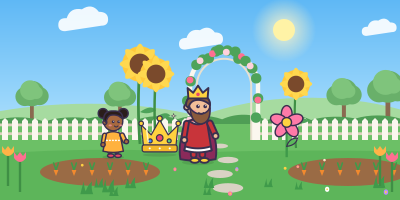
He was the king of the flower people, and he thought he had never seen anyone so lovely. He took the gold crown from his own head and put it on hers, and asked if she would be his queen. She said yes, and out of every flower stepped a lady or a gentleman, each with a present. The best was a pair of wings, which they fastened to her back so that she could fly from flower to flower.
Thumbelina was never cold or lonely again. All day she flew among the flowers, and every evening she sang to the swallow, who had once lain numb on the cold ground. He sang to them from his nest, though his heart was a little sad, for he was fond of her. When spring came, he flew north again, and he built his nest above the window of a man who wrote fairy tales. There he sang "Tweet, tweet!" to the man, and that is how the story came to be told.
Questions
- She was found in a walnut tree
- She grew inside a tulip from a magic barleycorn
- She came down the stream on a leaf
- The fish nibbled the stem of her leaf
- The butterfly carried her off
- The woman came to find her
- She wanted to fly away
- She felt sorry for it and heard its heart beating
- The mole told her to
- warm and cosy
- very cold
- far away
- She did not want to live under the ground and never see the sun
- He was too poor
- He was too tall
- A kind act can come back to help you later
- Tiny people should stay indoors
- It is best to marry quickly
Words to know
- barleycorn: a grain seed
- stamens: flower's middle parts
- stubble: cut corn stalks
- numb: unable to feel
- feelers: insect antennae
- snug: warm and cosy
Answer key: Thumbelina
- B. She grew inside a tulip from a magic barleycorn
- A. The fish nibbled the stem of her leaf
- B. She felt sorry for it and heard its heart beating
- A. warm and cosy
- A. She did not want to live under the ground and never see the sun
- A. A kind act can come back to help you later
The story in pictures
- Part One · The Barleycorn
- Part Two · The Toad
- Part Three · Down the Stream
- Part Four · The Cold Winter
- Part Five · The Field Mouse
- Part Six · The Swallow
- Part Seven · Flying Away
- Part Eight · The Flower King



For the teacher: how this passage is levelled
“Thumbelina” is a reading level 11 story. Every Peabody story at this level is written and checked to keep sentences to 40 words or fewer, to aim at an average of 13 words a sentence, and to show 80 to 115 words on a screen. At most 15% of its words may be off the familiar-word list. Children in 7th grade start at this level.
| This passage | 1676 words, 17 screens, 6 multiple-choice questions with an answer key, and 6 vocabulary words with kid-sized meanings |
|---|---|
| Longest sentence at this level | 40 words |
| Words on a screen | 80 to 115 |
| Skills practised at this level | vocabulary, spelling |
Reading level 11: the limits, a real sample and the free games. Peabody is a learning app, not an assessment: use the questions to talk about the story, not to grade a child.