The cheetah is the fastest land animal. In 2013, researchers in Botswana used a GPS tracking collar to record a top speed of 25.9 meters per second (58 miles per hour, or 93 kilometers per hour) for a wild cheetah (as of November 2026). The team built its own tracking collar with a GPS and motion sensors, and it recorded 367 hunting runs by five wild cheetahs.
A cheetah can speed up from zero to 45 miles per hour (72 kilometers per hour) in just 2.5 seconds, according to the National Zoo. Pound for pound, a cheetah's acceleration power is about four times that of Usain Bolt, the sprinter, in his world-record 100 meters. Most hunts in the Botswana study involved only moderate speeds.
In Namibia, researchers fitted 164 male and female cheetahs with GPS collars, and adult males follow one of two plans. They roam over areas of up to 1,600 square kilometers, or they defend a small territory of about 380 square kilometers. Females in the study used home ranges of about 650 square kilometers.
A coalition of male cheetahs is usually two to three littermates that stay together for life, hunting together and claiming a territory. Cheetahs hold a territory mark by leaving urine or droppings on prominent landmarks such as large trees and termite mounds.
The chirp is the cheetah's most common call, which sounds a little like a small dog's bark, and an intense cheetah chirp can be heard from a mile away. Cheetah calls such as yipps and churrs can go on for up to 20 minutes without a break.
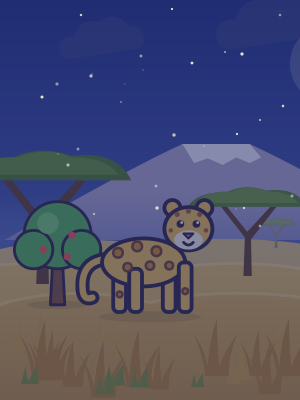
Camera traps identify cheetahs by their unique spots, but the huge number of pictures is very time-consuming to check. In a Namibia camera-trap study, a computer pattern tool lowered the count from 43 cheetahs to 40 after re-checking, which suggests human eyes may overcount.
Researchers can work out which cheetah left a dropping, what it ate and its health from DNA, hair and hormones in its scat.
A mother cheetah carries her cubs for 90 to 95 days before they are born, and a cheetah mother gives birth to three to five cubs, and sometimes as many as eight in one litter. Female cheetahs raise their cubs on their own and meet adult males only to breed.
A mother cheetah moves her cubs often to keep them safe, and cubs are strong enough to follow their mother on a hunt by the time they are six weeks old. Cubs are weaned between 3 and 6 months of age and stay with their mother until they are 15 to 17 months old.
Cheetah genomes are on average 95 percent homozygous, compared with 24 percent for the outbred domestic cat, which shows very little genetic variation in the species.
In 2016, a study estimated about 7,100 cheetahs worldwide, living in only 9 percent of their historical range (as of November 2026), and the 2016 study found 77 percent of the cheetah's current range lies outside protected areas.
Cheetahs live on grasslands and open plains, and most cheetahs live in Africa. As of November 2026, cheetahs are found in 23 African countries and two Asian countries, according to Panthera.
Words to know
- collar: neck band
- coalition: male cheetah group
- territory: claimed area
- scat: animal droppings
- homozygous: matching gene pairs