The cheetah is the fastest land animal. A cheetah can speed up from zero to 45 miles per hour (72 kilometers per hour) in just 2.5 seconds, according to the National Zoo.
In 2013, researchers in Botswana used a GPS tracking collar to record a top speed of 25.9 meters per second (58 miles per hour, or 93 kilometers per hour) for a wild cheetah (as of November 2026).
A cheetah's spine is very flexible, which helps it take long strides, and at top speed a cheetah takes four strides every second. Each stride is about 23 feet (7 meters) long.
An adult cheetah weighs 75 to 140 pounds (34 to 64 kilograms), according to the Smithsonian's National Zoo. Males are slightly larger than females. A cheetah's body is 44 to 56 inches (112 to 142 centimeters) long, with another 26 to 33 inches (66 to 84 centimeters) of tail. It stands about 30 inches (77 centimeters) tall at the shoulder.
A cheetah's claws work like cleats and help it grip the ground when it runs. Its long tail helps it steer and balance during sharp turns. It also has large nostrils that let it take in more air while it runs.
Cheetahs hunt by sight. A cheetah usually creeps to within about 100 yards (91 meters) of a gazelle or other prey before it speeds up. Cheetahs eat small antelope such as springbok, impala and gazelles.
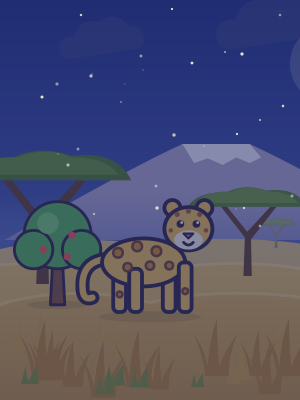
A cheetah is covered in black spots, and each cheetah has its own pattern of spots, like a fingerprint. A black line, called a tear mark, runs from each eye down to its mouth. A cheetah's spots may help it hide, and the dark tear marks under its eyes may cut down the glare of the sun.
Cheetahs cannot roar like lions do, but they can purr. The chirp is the cheetah's most common call, and it sounds a little like a small dog's bark. An intense cheetah chirp can be heard from a mile away.
According to the San Diego Zoo, a cheetah mother gives birth to three to five cubs, and sometimes as many as eight in one litter. Female cheetahs raise their cubs on their own and meet adult males only to breed. Cubs are strong enough to follow their mother on a hunt by the time they are six weeks old.
Cheetahs live on grasslands and open plains, and most cheetahs live in Africa. As of November 2026, cheetahs are found in 23 African countries and two Asian countries, according to Panthera.
Words to know
- spine: backbone
- stride: one long step
- collar: neck band
- nostrils: nose holes
- litter: cubs born together