A Fiddle and a Winter: the full story
Part One · The Good Days
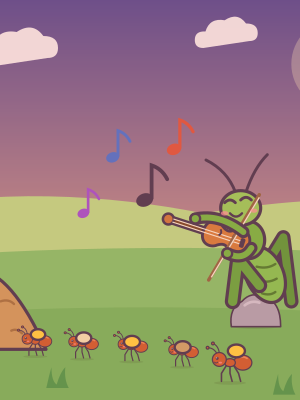
Grasshopper had made his fiddle himself, out of a hollow reed and a few threads of spider silk, and he was prouder of it than of anything else he owned. Every morning he climbed to the top of a tall stalk, tucked the fiddle under his chin and played until the whole meadow was awake. The sleepy beetles in the roots stirred, and the swallows swooped down to listen. It was the best part of his day.
Down in the grass, the ants had been awake for hours. Grasshopper often watched them from his stalk as they marched past. They carried crumbs of cheese, grains of corn and bits of dried clover. "Poor things," he thought. "They never look up, and they never hear a note of all this music. How dull it must be to be an ant, with nothing to do but carry and carry, day after day."
One evening, as the sun slid behind the hill, he noticed that the air smelled different, a little like frost and dry leaves. A small, cool worry crept into his mind. Perhaps he ought to start gathering some food. But just then a cricket began a lively new tune, and Grasshopper forgot his worry completely and joined in with a cheerful trill, and the song lasted well into the night.
A week later, a sharp wind rattled the stalks, and for the first time he had to wrap his wings around himself to sleep. "Tomorrow," he promised, "I will make a sensible plan." But when tomorrow came, the sun was shining and the butterflies were out, and a plan seemed far too serious a thing for such a bright and lovely morning, so he left it for another day. It was not a hard choice. It felt like no choice at all.
At last real winter arrived, and it did not wait for any plan. Snow covered the meadow from one edge to the other, and the brook froze solid. Grasshopper dug under a drift. He found nothing but bare, icy dirt. He sat down and tried to play, but the tune came out thin and wobbly, like a sad little hiccup. He put the fiddle down and stared at the snow, which suddenly looked a great deal less beautiful than before.
Part Two · The Door in the Oak
As he sat there shivering, he thought of the ants for the first time in weeks. He wondered where they went when the summer was over. A faint line of tiny footprints led across the snow to a mound at the foot of an old oak. He followed them slowly, with his fiddle tucked under his arm and his stomach rumbling at every step, and he hoped very much that the trail would lead somewhere kind.
The door in the oak was no bigger than a button. When Grasshopper knocked, he felt ashamed of every unkind thought he had ever had about the ants. A sentry opened it a crack and peered out into the swirling snow. "We are closed to visitors," she began, and then she recognized him. "Oh," she said coldly. Her feelers twitched. "You are the one who laughed at us, in the middle of summer."
"I did laugh," said Grasshopper, "and I was wrong, and I am sorry. I thought the summer would last forever. It was a silly thing to believe. Now I have no food, and I do not know where else to go." The sentry thought it over for a long moment. "We worked very hard for what we have," she said at last. Behind her, a few ants nodded, and a small one at the back sniffed. "Still, we are not the kind to leave anyone out in the snow."
She opened the door wide, and a wave of warmth rolled out to meet him. Grasshopper stepped into a great hall lined with shelves of grain, seeds and dried berries, every one labeled in tiny, careful writing. Hundreds of ants were chatting beside the fire. When they saw him, the whole room fell silent. Then the queen herself came over to see what all the fuss was about. The little ants made room for him by the fire.
"You are welcome here," she said, "but a guest ought to give something in return. What can you do?" Grasshopper looked at the fiddle in his hands and gave a small, hopeful smile. "I can play," he said. "And if you will let me, next summer I would like to learn how to carry, too." That winter the dark hall rang with music, and the youngest ants danced in circles on the floor, while Grasshopper played tune after tune and slowly learned what the hall was really made of: shared work.