A Fox and His Pride: the full story
Part One · The Jumps
There are two kinds of hunger in this world, and a fox on a country road in late September had both of them. The first lived in his stomach, and it was loud. The second lived somewhere nearer his whiskers, and it was quiet. It was the hunger to be admired, and it had made a more careful hunter of him than any empty stomach ever could. It showed in the way he walked, with his nose high and each paw set down just so, as if the road had been laid out for his benefit alone.
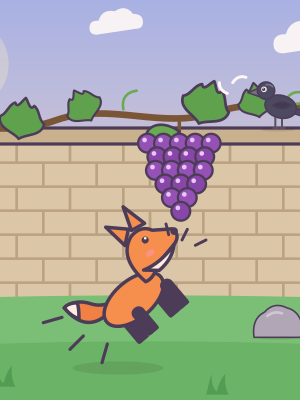
On this particular afternoon, the fox came upon a stone wall with a vine growing over it, and in the vine hung a bunch of grapes. They were round, dark and glossy, and the sun shone on them as if on purpose. He did not hesitate. He had slipped past the fiercest farm dog in the valley without so much as a rustle, and he was not about to be frightened by a few grapes. Fruit, after all, does not bite.
His first jump was the sort of jump a fox makes when he is certain that it will work. It carried him a handsome distance up the wall, and then it stopped, and he came down again with his dignity bent. "Poor footing," he said to the empty road. "The dust. It is always the dust." He shook himself, smoothed his coat with one paw and tried again, with the air of an animal who is doing a favor to the wall.
His second jump was higher, and his third was higher still, and by the sixth the fox had begun to explain each failure aloud, in the manner of a man who is not sure that he is alone. The wall was damp. The sun was in his eyes. A breeze had come up at the wrong moment. It was a magnificent collection of reasons, and none of them was the right one. The fox, who was clever enough to know it, was not quite clever enough to stop.
On the wall above him, an old black crow had settled down to watch the whole sorry show. Crows are not generous judges of a performance, and this one did not applaud or even flap a wing. He only tilted his head and waited, with the patience of a bird who has seen many animals make fools of themselves, and who would be seeing it again tomorrow. The crow's name was Bartholomew, though no one had ever called him that. Nobody had ever asked.
Part Two · The Speech
By the time the shadows had stretched across the road, the fox had tried a tall, wobbly pile of stones, a rotten plank and a sort of running leap from the far hedge. The leap ended with a tail full of burrs and a very short remark in fox language that we shall not translate. He sat down at the foot of the wall. The truth, which had been walking patiently beside him all afternoon, sat down beside him too.
The truth was very simple, and a little embarrassing, too. The grapes were too high, and he was not tall enough. A wiser animal would have said so, shrugged and gone home to look for a plum tree. But the fox had a reputation to think about, and the reputation was, at that moment, sitting on the wall, wearing black feathers and a look of polite interest. It is one thing to fail. It is quite another to fail in front of an audience.
So the fox did what clever creatures have done for as long as there have been grapes. He stood up, lifted his chin and arranged his face in an expression of calm, bored superiority, the way a king might look at a muddy boot. "I was never actually hungry," he announced to the road. "And anyone with an ounce of sense can see that those grapes are sour. I would not touch them, not if they were handed to me on a silver plate."
It was, in its way, a masterpiece, and it did everything that it was meant to do. The fox walked off with his tail held high and his reputation tucked safely under his arm, and for the first half mile he felt wonderfully pleased. Only toward the end of the second mile did he notice that his stomach was still empty and his speech had fed nobody, least of all himself. Pride, he reflected, is a very filling word, but a poor supper.
Behind him, the crow climbed along the wall, pulled one grape free and ate it. It was sweet, as it happened, and it was sunlit, and it tasted a good deal better for having been watched for so long. The crow finished it and wiped his beak on a stone. It is remarkable, he remarked to no one at all, what people will say about things they cannot have. Then he flew off over the hedge, whistling something that sounded very much like a laugh.