Kidnapped: the full story
Part One · The House of Shaws
I begin my story on a June morning in the year 1751, when I was seventeen and took the key out of my dead father's door for the last time. The minister of Essendean walked me as far as the river and gave me a packet with three small presents in it: a shilling, a little Bible, and a recipe for lily-of-the-valley water, which he said would cure almost anything. My father had left a letter for his brother, Ebenezer Balfour, who owned a great house called Shaws, and I was to carry it there. I thought that my fortune was waiting for me. I did not understand that when a poor boy is sent to a wealthy relation, there is usually a suspicious reason.
The House of Shaws was a tall gray ruin, only half finished, with most of its windows dark and weeds growing everywhere in the yard. My uncle opened the door only a crack and examined me with small, restless eyes, like a bird's. He was a shriveled, bent man in clothes that had been worn out long ago, and he had nothing to say to me except a string of suspicious questions. We ate cold porridge. He would not let me light a candle. I went to bed hungry, and I lay awake wondering why a man who owned such an enormous house lived in one small kitchen, and why every time I looked up, I discovered him secretly staring at me.
The next evening, after he had told me a long and obvious lie about money that he supposedly owed to my father, he handed me an old key. There was a chest at the top of the tower at the end of the house, he said, and I should fetch it down. I was not to take a light. I felt my way up a stone staircase in complete darkness, with my left hand on the wall, until a flash of lightning revealed what he had not mentioned: the staircase stopped in the middle of the air, and a single step further would have dropped me five floors onto the stones. I stood absolutely still, and was suddenly more furious than frightened. My own uncle had deliberately sent me up there to die.
I crept down again, found him in the kitchen with his back to me, and silently put both my hands on his shoulders and shouted. He collapsed on the floor as if I had shot him. When he could speak, he begged for a blue bottle of medicine, and I gave it to him, and he promised to explain everything in the morning. But in the morning he had devised a new plan. He said he would take me to see his lawyer in the harbor town of Queensferry, and he walked me there himself. At the inn we met a sea captain named Hoseason, who was smooth and polite, and who invited me aboard his brig, the Covenant, to look at her cabin. As I climbed over the side, a blow fell on the back of my head.
Part Two · The Brig Covenant
I woke in the dark, in the bottom of the ship, with blood in my hair and my wrists tied. Above me there was constant creaking and the roar of water, and for a long time I was too confused to think. Then a cabin boy named Ransome crept in with food, and from him and the officers I learned the ugly truth: my uncle had paid Hoseason to carry me across the ocean and sell me as a laborer on the plantations of the Carolinas, and I would never see Scotland again. The first mate, Mr. Shuan, was a violent and drunken man, and a few days later, in a fit of uncontrollable rage, he beat Ransome so badly that the boy died. The captain merely shrugged, and I was set to work in the cabin in his place.
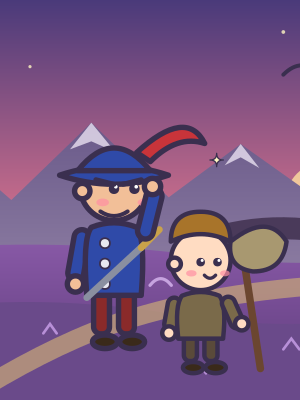
For a week the Covenant struggled against terrible weather around the north of Scotland, and one night in thick fog the brig ran down a small boat, and one man out of its crew scrambled up the bowsprit and onto our deck. He was small, as light on his feet as a goat, with sunburnt, pockmarked skin and pale eyes that seemed to dance. He wore a feathered hat, a red waistcoat and a blue coat whose buttons were made of silver, and he carried two silver pistols and a sword. He informed the captain that his name was Alan Breck Stewart, that he was a Jacobite returning to Scotland from France, and that he carried a belt full of gold for his exiled chief. Hoseason's eyes lit up like candles.
I was setting out the supper when I overheard the captain and his officers whispering together in the fog. They intended to lure Alan out of the round-house, and kill him, and divide the gold, and they wanted me to steal his pistols. I returned to the cabin with my heart pounding and touched Alan's shoulder. "They are all murderers here," I told him. "They killed a boy already, and now they mean to kill you." Alan looked at me for a moment with those strange, dancing eyes. "Will ye stand with me?" he said. I said I would. He barred one door, left the other open so he could fight facing it, and put me at the window with a heap of loaded pistols.
Fifteen men came at us with cutlasses, one attack after another, and for what felt like an hour the round-house echoed with shouts and the clash of steel. Alan defended the door as though he had been born to it. I fired my pistols at the men who tried to break in through the skylight, and I shall not forget what that was like, and I do not care to describe it. When the sailors finally fell back, bruised and bleeding, with Mr. Shuan among the dead, Alan threw his arms around me and kissed me on both cheeks. "David," he said, "ye are as dear to me as a brother." I sat down on the floor and cried. He said that I had been brave, and needed rest.
Part Three · The Wreck and the Heather
Beaten and frightened, Captain Hoseason agreed to put us ashore in the Highlands. But that very night, as the brig slipped carefully around the island of Mull in the moonlight, she struck a reef with a tremendous roar that shook the whole ship. The sea poured in, and I was swept overboard and found myself clinging to a spar in the dark. I do not know how long I drifted. When dawn came I was washed onto a small, rocky island. My clothes were soaked, I had nothing to eat, and as far as I could tell, I was alone in the world, with a stretch of deep water between me and the mainland.
For three days I survived on limpets and raw shellfish, which made me terribly sick, and sheltered from the rain between two enormous rocks. I was certain that I would die. On the fourth day a fishing boat passed close enough for me to shout, and the men on board called back something I could not understand, and sailed on. Only later did I realize that I had been on a tidal islet, that at low water the sea between me and the larger island was shallow enough to wade, and that I could have walked off whenever I wished. I wept from sheer foolishness, and then I laughed, and then I walked across with the water barely above my knees.
I found my way across Mull, and was told that the ship had gone down with all hands except Alan, who had escaped in a boat. I decided to look for him in Appin, his country, across the water. In a wood, one morning, I met a party of travelers, among them a great red-headed man named Colin Campbell, the King's agent, who was evicting poor tenants from their land. A rifle cracked from the hillside above me. The man cried out and fell, and died where he lay. I saw a figure in a dark coat running along the slope, and I ran toward him, and found Alan Breck.
Everyone suspected us, because we were the only people nearby. Alan was an outlaw already, and soon there were soldiers in red coats all over the country, and a reward offered for both of us. He told me he had not fired the shot, though he knew who had, and I believed him. We fled together through the Highlands, and for weeks we lived in the heather. We hid among the rocks in the daytime and ran at night, slept on bare ground in the rain, ate little but oatmeal mixed with cold water, and sometimes crept past a sentry so close that we could hear him breathing.
We quarreled once, bitterly, and for a time I refused to speak to him, which I regret. I grew so ill from exhaustion and cold that I could not walk any farther, and Alan, who could have abandoned me, stayed and nursed me instead. He helped me across a stretch of moor, and begged my pardon, and we went on together. For a while we hid in a hut that was built like a cage into the side of a mountain, where a chief named Cluny Macpherson, who was himself an outlaw, fed us and played cards. Then at last we came down out of the hills to the edge of the Lowlands.
Part Four · Home
We crossed the great firth in the dark and came back to Queensferry, where all of my troubles had begun. I knew now what I wanted: to find a lawyer named Rankeillor, who had known my father. He listened to my whole story with his hands folded, his spectacles pushed up on his forehead, and when I had finished, he told me what I had half guessed. My father, Alexander, had been the elder brother, and the rightful heir to Shaws, and Ebenezer, the younger, had taken the house as though it were his own, and had paid to have me carried out of the country so that nobody would ever ask who owned it.
The trap was my own idea, and Rankeillor liked it so much that he carried it out himself. That night he and his clerk came with me to the House of Shaws, and my uncle, who thought he was talking to nobody but a lawyer and a stray boy, swore and blustered and finally admitted every word of his crime. By morning he was beaten. He agreed to give up the estate and live on a small allowance, and Rankeillor, shaking his head, said that it would have been better for the old man if he had been hanged. I walked out of the House of Shaws as its master, with the sun shining on its gray walls.
Alan and I walked toward Edinburgh together, saying very little. He had to leave the country, and I had a promise to keep about speaking up for an innocent man, and we both knew that this was the last road we would share. At a place called Rest-and-Be-Thankful, we came to where our ways parted, and we stood together for a long minute looking out at the city. Then he said, "Well, good-bye," and put out his left hand, and I gave it a little squeeze, and walked down the hill. Neither of us looked back. But I was so lost without him, as I went into the noisy streets of Edinburgh, that I could have sat down at the roadside and wept.