Bellerophon and Pegasus: the full story
Part One · The Winged Horse
In the ancient Greek city of Corinth, where a narrow strip of land held back two seas, there lived a young man named Bellerophon, the grandson of a king. He was admired throughout the city for his courage and his steady hands, but he had never yet accomplished anything truly remarkable. Then, one terrible afternoon, an accident left another man dead. Bellerophon had never intended any harm, but by the ancient laws of Greece, a man who caused a death, even by mistake, was obliged to leave his home and be purified of the guilt. So he packed a few belongings, said a sorrowful farewell to his family, and set out alone on the long road to a foreign court.
The king of Tiryns, a gracious man named Proetus, welcomed the stranger warmly. He performed the solemn ceremony that washed away Bellerophon's sorrow, and he gave him a comfortable room in the palace and an honored place at his table. But Proetus's wife, Queen Anteia, grew angry with the young man when he would not do as she wished, and she hurried to her husband with a terrible lie. "Your guest has insulted me," she declared, "and he must be punished." Bellerophon had no idea that she had said anything at all, but Proetus believed his wife, and his friendly face turned cold and hard.
Proetus now found himself in a difficult position. The Greeks believed that Zeus himself protected every guest, and a king who harmed someone sitting peacefully at his table would bring the anger of the gods down upon his own head. So Proetus smiled as though nothing were wrong, and he devised a cleverer plan. He wrote a message on a wooden tablet, folded it carefully, and sealed it with wax. "Carry this to my father-in-law, King Iobates of Lycia," he said pleasantly. "He will reward you generously." Bellerophon thanked him and sailed across the sea, never suspecting that the tablet he carried contained a single, terrible instruction: put the man who brings you this to death.
Lycia was a country of rugged mountains and sunny valleys on the southern coast of Asia Minor, and King Iobates received the young stranger as hospitably as Proetus had. For nine days he honored Bellerophon with a magnificent feast, with roasted meat, honey cakes and music beside the fire. Only on the tenth morning did he ask to see the message that his son-in-law had sent. Iobates broke the seal, read the tablet, and turned pale. He had grown fond of this young man, and he, too, knew that a guest was sacred, but he could not ignore the command of a fellow king. After a long and troubled silence, he looked up with a strange, tight smile. "Bellerophon," he said, "I have a favor to ask of you."
In the wild mountains of Lycia lived a creature that no hunter had ever dared to face. It was called the Chimera, and it was composed of three animals at once. Its front half was a lion, with a shaggy mane and a roar that shook the valleys. Its middle was a goat, with a second head that bleated and glared from its back. And its tail was a living serpent, which hissed and lashed from side to side. Worst of all, the Chimera breathed fire. Entire villages had burned, whole fields had been reduced to ash, and no shepherd dared to lead his flock into the hills. "Destroy the Chimera," said Iobates, "and I will know that you are a true hero."
Bellerophon was courageous, but he was certainly not foolish. He knew that no sword could reach a monster that scorched everything near it, and that no shield could withstand its flames. He sailed home to Corinth and went to a wise seer named Polyidus to beg for advice. The old man closed his eyes for a long moment. "You cannot defeat the Chimera on the ground," he said at last. "You must attack it from above. Go and sleep one night on the floor of the temple of Athena, the goddess of wisdom, and then be prepared for whatever you discover." Bellerophon did not understand, but he trusted the seer's words, and when darkness fell he made his way to the temple.
That night, in the silent temple of Athena, with only the moon shining through the doorway, Bellerophon lay down upon the cold stone and fell asleep. He dreamed that the goddess herself stood over him, tall and gray-eyed, holding something that glittered. "Are you sleeping, young hero?" she asked. "Take this charm for taming horses. Show it to Poseidon, the god of the sea, who is also the master of horses, and offer him a sacrifice." When Bellerophon woke at dawn, the dream had vanished, but a golden bridle lay in his hand, warm as sunshine, its jeweled bit still gleaming. He sprang to his feet, thanked Athena aloud, and hurried to make his offering to Poseidon exactly as he had been told.
Then Bellerophon climbed to the spring of Pirene, the clear pool above Corinth where, people said, a magnificent winged horse came to drink. Pegasus was as white as sea foam, and on his shoulders he carried two enormous feathered wings. He had been born when the hero Perseus cut off the head of the monster Medusa, for as her blood soaked into the ground, the horse had leapt up out of it, and ever since he had lived wild and free. Bellerophon concealed himself behind a boulder and waited, hour after hour, day after day. At last, one misty morning, the horse swooped down from the sky, folded his wings, and lowered his graceful head to the water.
Bellerophon crept forward as quietly as a shadow. Pegasus lifted his head and snorted, and for a long moment the two of them stood perfectly motionless, staring at each other. Then Bellerophon held out the golden bridle. The horse sniffed it cautiously, and a mysterious calm settled over him. He allowed the hero to slip the bridle over his head, and he allowed him to climb upon his back. Then, with a tremendous beat of his wings, Pegasus rose from the ground. Corinth shrank to a cluster of tiny rooftops, and the two seas gleamed on either side of the narrow land like sheets of blue glass, and Bellerophon laughed aloud, because no human being had ever seen the world from so high.
They flew southeast across the sea, with the wind singing through the feathers, and by evening they reached the mountains of Lycia. Beneath them the countryside was gray and black. Scorched fields stretched across the valley floor, the roofs of deserted villages stood open to the sky, and the smell of smoke hung over everything. Pegasus snorted and tossed his head, because he had noticed something else beneath the smoke, something hot and wild and dreadful. Bellerophon strung his bow and made certain that his quiver was full. "Steady, my friend," he whispered, patting the white neck. "We will keep to the sky."
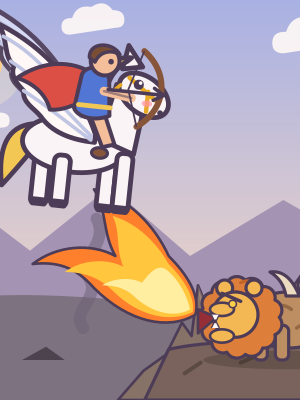
The Chimera burst out of a rocky gully with a roar that sent loose stones clattering down the mountainside. The lion's jaws opened wide, and an enormous river of orange fire came streaming into the air. Pegasus swerved so sharply that Bellerophon had to cling to his mane with both hands, and the flames passed so close that the hero felt the heat on his face and smelled the singed feathers. The goat's head screamed, and the serpent's tail whipped upward, snapping at the empty sky, but the monster could not reach them. Bellerophon steadied himself, drew his bow, and shot an arrow straight at the lion's chest.
Round and round they circled. Pegasus dived and climbed, and every time the Chimera roared out another blast of fire, he slipped sideways through the air as though the wind itself were dancing with him. Bellerophon shot again and again, and every arrow struck home. The monster staggered and thrashed. Its flames sputtered, dwindled and flickered out, and at last the Chimera sank down among the rocks with a groan that echoed through the whole valley. Then everything was silent. For the first time in many years there was no smoke on the mountain, and the winged horse, proud and trembling, whinnied softly.
King Iobates could scarcely believe his eyes when Bellerophon returned alive, but he was not yet ready to trust him. He sent him next against the Solymi, the fiercest warriors in the land, and the hero defeated them. He sent him then against the Amazons, the famous warrior women, and the hero defeated them as well. At last Iobates selected the bravest soldiers in Lycia and ordered them to hide in the hills and ambush Bellerophon on his way home, but when they saw the white horse swooping out of the sky, one after another they lost their nerve and fled. Then the king finally understood. "No ordinary man could have done this," he said slowly. "He must be the child of a god."
Iobates summoned Bellerophon to the palace and confessed everything. He showed him the sealed tablet at last, and Bellerophon read the words that Proetus had written and understood the lie that had been told about him. The old king was deeply ashamed, and he begged the young man's forgiveness. To make amends, he gave Bellerophon his own daughter in marriage and half of his kingdom to rule. The people of Lycia presented him with the richest land they owned, full of orchards and plowed fields, and Bellerophon lived there in great honor. He and his wife had children, and one day his grandson Glaucus would grow up to fight in the Trojan War.
For many years Bellerophon was the most celebrated hero in Greece. People told and retold the story of the man who had tamed the winged horse, and the more they told it, the more he began to believe that he was no ordinary mortal at all. One brilliant morning he looked up at the peak of Mount Olympus, where the gods lived, glittering above the clouds, and a dangerous thought occurred to him. "I have conquered the Chimera," he said to himself, "and the Solymi, and the Amazons. Why should I not ride to Olympus itself, and take my seat among the gods?" He bridled Pegasus, climbed onto his back, and flew higher than he had ever flown before.
Pegasus climbed through the clouds, through the cold, thin air, until the earth was only a patchwork of green and gold far below, and Bellerophon's heart raced with triumph as he urged the horse on and on. But Zeus, the king of the gods, saw them coming, and he was not at all pleased. He sent a tiny gadfly buzzing across the heavens, and it stung the winged horse beneath his tail. Pegasus screamed and reared, and Bellerophon, who had been gazing up at Olympus instead of watching his reins, lost his grip entirely. He slid from the horse's back and fell, tumbling and spinning, down and down and down through the clouds.
He did not die. He crashed into a thicket of thorns on a lonely plain, and the bushes slowed his fall, but his leg was broken, and he never walked straight again, and the gods no longer favored him. For the rest of his life he wandered alone across the plain, far from the paths of other people, remembering the days when he had flown. Pegasus, meanwhile, soared all the way up to Olympus, where Zeus welcomed him gladly. The winged horse carried the god's thunderbolts across the sky for all time, and some say that on a clear autumn night you can still find him there, shining among the stars.