Nausicaa and the Stranger: the full story
Part One · The Raft
After seven years on the island of the nymph Calypso, Odysseus was finally permitted to leave, because the gods had decided that he had suffered long enough. Calypso presented him with an axe and showed him where the tallest trees grew, and for four days he chopped, trimmed and fitted the timbers of a sturdy raft, and wove a fence of willow around it to keep out the waves. She sewed his sail herself. On the fifth morning she gave him a bag of bread, two flasks of wine and a flask of water, and she pointed out the constellation that would guide him. He sat down on the raft, spread the sail and watched the island grow smaller until it was only a smudge on the horizon.
For seventeen days the voyage went remarkably well, and then Poseidon, the sea god, who had never forgiven Odysseus for blinding his son, saw the raft and stirred up a tremendous storm. The mast snapped, the sail blew away, and Odysseus was flung across the deck. A sea nymph named Ino took pity on him, surfaced in the shape of a gull and gave him a veil to wind around his chest. "As long as you wear it," she told him, "you cannot drown. When you reach land, throw it back into the water." Moments later a gigantic wave smashed the raft, and Odysseus, clinging to one beam like a rider on a horse, was washed into the ocean.
He swam for two long days and the nights between. At the third dawn he saw land, but the shore was a wall of jagged rocks with surf exploding against them, and one wave nearly smashed him open, tearing the skin from his hands. He swam along the coast, desperately searching for an opening, until he felt fresh water mixing with the salt. "Hear me, river god," he prayed, "I come to you as a stranger who needs help." The current slackened, and he staggered ashore, completely exhausted. After a while he remembered the veil, and he threw it back into the waves, where Ino caught it. Then he crawled between two olive trees, buried himself in leaves, and slept.
Part Two · The Princess
That same night, the goddess Athena, who watched over Odysseus, slipped into the palace of the nearby city and entered the dream of a girl named Nausicaa, the king's daughter. In the dream, Athena appeared as one of Nausicaa's friends. "Your family's clothes are all dirty," she said, "and your wedding day is not far off. Take a wagon to the river first thing in the morning and I will help you wash them." Nausicaa woke up determined, and discovered her father on his way to an important meeting. She felt too shy to talk about weddings, so she said her brothers wanted clean clothes for the dances, and he smiled, and ordered a wagon and mules to be made ready.
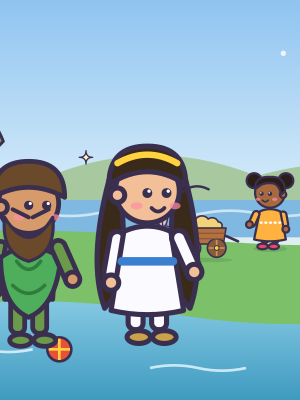
The girls loaded the wagon with enormous piles of laundry and a basket of bread, cheese and wine, and Nausicaa herself took the reins. At the river they trampled the clothes in the shallow water with their bare feet, and spread them across the pebbles to dry. Then they bathed and ate their lunch on the grass, and, since the laundry was not yet dry, they began a game of ball. Nausicaa stood tallest, and she was the loveliest of them all. Then one of the girls missed the ball, and it bounced into the river and floated away, and the entire group shrieked. The squeal woke a man sleeping under the olive trees, and he crept out of the bushes, wearing nothing but a branch of leaves.
The servant girls screamed and ran in every direction, except for Nausicaa, who stood her ground because the goddess had put courage in her heart. Odysseus stopped at a respectful distance and spoke gently. He did not know whether she was a goddess or a woman, he said, but he had been on the sea for twenty days. Could she lend him a scrap of cloth and tell him the way to the town? Nausicaa answered like the daughter of a king. "Stranger, you will not go without clothing or kindness in our land," she said. "Come back, girls. This man is no enemy. Every stranger who arrives is sent by the gods."
The girls gave him oil to wash the salt off his back, and a cloak to wear. When he came back from the river looking like a magnificent hero, Nausicaa was silent for a moment. "Not long ago," she whispered to her friends, "he looked terrifying." They fed him, and loaded the dry laundry onto the wagon. Then she gave him careful instructions. He should follow the wagon through the countryside, but wait at a grove outside the city, so that no one would gossip about her bringing a stranger home. Then he must find the palace and go straight to her mother, the queen. "If she is kind to you," Nausicaa said, "you will reach home."
Part Three · The Stranger's Name
Odysseus followed every instruction carefully. He stood in front of the queen, Arete, in a hall with doors of gold, where apple, pear and fig trees dropped ripe fruit all year, and he knelt and begged for help. For a long time nobody spoke. Then an old councillor reminded the king that a guest should not sit among the ashes, and Alcinous raised him up, seated him in a silver chair and called for food. The next day the king announced that the stranger would be given a ship and fifty-two oarsmen, and that there would be games and a feast to honor him. Odysseus, who had hurled a discus farther than the Phaeacian youths, was handed gifts by every prince in the city.
That evening, as he passed through the hall in splendid clothes, Odysseus saw Nausicaa standing beside a pillar. She had expected, perhaps, that he would stay and become her husband, but now she understood that nothing could keep him from going home. "Farewell, stranger," she said, quietly. "When you are in your own country, think of me sometimes, because I was the one who helped you first." He took her hand. "Daughter of Alcinous," he said, "if the gods bring me home, I will thank you every day of my life, for it was you who gave me my life." Then he went in to supper, and Nausicaa watched him go, and never saw him again.
At the feast a blind poet named Demodocus took up his lyre and sang about the Greeks at Troy, and then, because Odysseus asked, about the wooden horse. As the song reached the part where the soldiers came pouring out of the horse into the sleeping city, Odysseus pulled his cloak over his face and wept, and only the king noticed. "Our guest cannot bear this song," Alcinous told the company. "No one has asked your name, stranger, because we were taught to serve a guest first and question him afterward. But we would like to know it now. Why do you weep? Did you lose a friend at Troy?" Odysseus slowly lowered his cloak. "I am Odysseus, son of Laertes," he said, "and my home is Ithaca."