A free Grade 2 story from the Peabody library, Level 7. It has 17 short pages and about 335 words, so it reads in a few minutes. It is also called “The Shepherd Boy and the Wolf”.
Words this story teaches
village: small town
bored: not having fun
tricked: fooled
cross: a bit angry
fibber: someone who lies
At reading level 7, Peabody's practice works on phonics (sounding words out), sight words, spelling; the level page says what is in each.
The short version
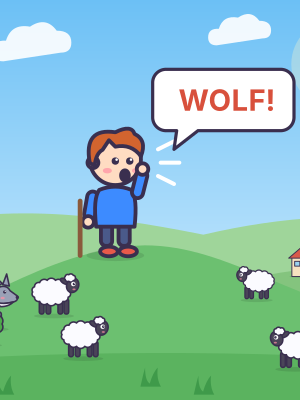
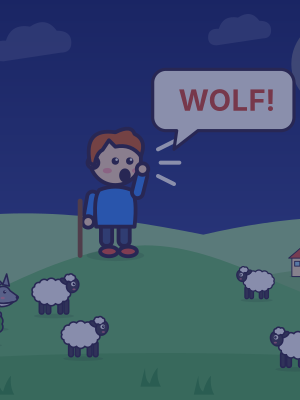
A bored shepherd boy shouts “Wolf!” to make the villagers run up the hill, even though there is no wolf. He does it twice, and then a real wolf comes and nobody believes him. The sheep scatter, and the boy finds out that nobody believes a fibber, even when he is telling the truth.
Quick facts
One of Aesop's fables. The old Greek version ends with the lesson that liars are not believed, even when they tell the truth.
It was written down only in Greek and not translated into Latin until the 15th century.
To “cry wolf” means to give a false alarm.
In the Greek fable the wolf eats the sheep. Some later English verse retellings, such as John Hookham Frere's in 1830, have it eat the boy too.
What it teaches
If you fib, people stop believing you.
Where this story comes from
Aesop, a storyteller in Greece, told this about 2,600 years ago.
What is the moral of The Boy Who Cried Wolf?
Nobody believes a liar, even when the liar is finally telling the truth. The old Greek version of the fable puts it just that way: even if liars tell the truth, no one believes them. In this telling the boy learns it the hard way, and afterwards he tells only the truth.
Where does The Boy Who Cried Wolf come from?
It is attributed to Aesop and dates from classical times, in Greek. It was not translated into Latin until the 15th century, and a collection of fables by Heinrich Steinhöwel helped spread it across Europe.
Does the boy die in The Boy Who Cried Wolf?
Not in this telling: the wolf chases the sheep away, and the boy spends the night finding them. In the old Greek fable the wolf eats the sheep. Some later retellings in English verse have the wolf eat the boy as well.
What does “cry wolf” mean?
To “cry wolf” is to give a false alarm. If you do it often enough, people stop paying attention, even when the danger is real. It is just what the boy in this fable does.
For teachers: read it to the class, questions and key
📺 Read this to the class: one page at a time on the board, big arrows, and Peabody reads a page when you ask. Sound is off until you tap.
📚 More books at level 7 for a guided-reading group. This is Peabody's own level, not a Lexile or a guided-reading letter. Pick a group's books from their level, and one level up to stretch them.
 When the Wolf Was Real
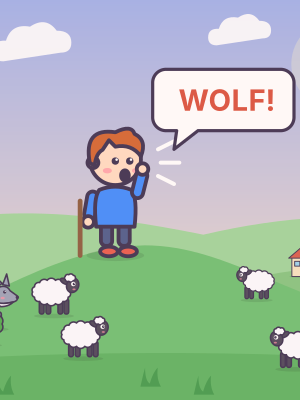 Boy Yells Wolf
 The Fox and the Crow
 Belling the Cat