The Miracle of Purun Bhagat: the full story
Part One · The Prime Minister
Once there lived in India a man named Purun Dass, who was Prime Minister of a small kingdom in the north. He had been born into a very learned family, and he was so clever and so quiet that he rose, step by step, until he held more real power than the king himself. He built schools for little girls, and roads, and hospitals, he wrote clear and careful letters to the newspapers, and visitors came from all over the world to dine with him. When he traveled to London, the people he met there declared that they had never known a more fascinating man at a dinner table.
When he came home, the greatest ruler in the land gave him a title of honor, with a jeweled badge and a blaze of cannon fire, and he made a speech that few other men could have bettered. A month later, he did something that no ordinary man would have dreamed of doing. He gave back the jeweled badge, resigned his palace and his power, put on the plain ocher robe of a holy wanderer, took a begging-bowl made from a polished brown shell, and walked out through the city gates, barefoot and alone, while the cannons behind him fired in honor of his successor.
He had been a student for twenty years, a worker for twenty years, and the head of a household for twenty years, and he had spent his riches and his authority on what he judged them to be worth. Now he felt that he could let it all go, like a cloak that he no longer needed. He had never eaten meat in his life, and a few coins would have paid for his food through a whole year. Even at the grandest dinners in London, he had dreamed of a long white dusty road marked with the prints of countless bare feet, and of the smoke of cooking fires rising among the fig trees at dusk.
From that day he called himself Purun Bhagat. He slept wherever the night overtook him, in a roadside shelter, on the edge of a village, or on the bare ground beside a campfire, and earth, people and food were all one to him. But without knowing it, his feet drew him north and east, until one day he saw the far white line of the great Himalaya mountains, and he remembered that his mother had come from the hills and had been homesick for the snow all her life. “Yonder I shall sit down and get knowledge,” he said, and the cool wind of the mountains whistled about his ears.
Part Two · The Shrine
He followed the narrow mountain road, blasted out of the rock above gulfs a thousand feet deep, through dripping forests and past herdsmen with their flocks, until one evening, at the top of a high pass, he found a deserted shrine under dark cedar trees. He swept the floor, made a little fireplace of mud, laid his antelope-skin mat over fresh pine needles, and sat down. Far below him lay a village of stone houses, with tiny terraced fields like scraps of cloth sewn onto the slope, and cows as small as beetles. “Here shall I find peace,” said Purun Bhagat.
The village priest climbed the hillside to welcome the stranger, and when he met Purun Bhagat’s eyes, the eyes of one who had ruled over thousands, he bowed to the earth and carried the begging-bowl away without a word. “At last we have a holy man among us,” he told the villagers. Every housewife cooked her best for him, with buckwheat and corn, honey and dried apricots, and every morning the filled bowl was set silently in the hollow between two twisted roots outside the shrine. Purun Bhagat never went down to the village, but he could see it spread out like a map below him.
Season followed season. The roofs of the houses turned golden when the corn was laid out to dry, and the rice was sown and cut, and he sat watching, and wondering what it all led to in the end. Soon the wild things came to see who had moved into the shrine. The big gray langur monkeys came first, because they are curious about everything, and after they had upset the bowl, tried their teeth on the crutch, and made faces at the antelope skin, they decided that the quiet man was harmless. At night they huddled around his fire, and in the morning there was often a furry monkey sharing his blanket.
After the monkeys came the barasingh, the great stag, who wanted to rub the velvet from his antlers against the cold stone of the statue, until Purun Bhagat very gently rubbed it off for him. The stag brought his doe and fawn, and even the shy little musk deer crept out of the shadows. Last of all came Sona, the black bear, who was moody and suspicious until the man showed no fear. Purun Bhagat called them all “my brothers,” and when he cried “Bhai! Bhai!” they came running out of the forest. The villagers said that he worked miracles, but the miracle lay only in keeping still.
Part Three · The Rains
Miracles were the last thing on his mind, and he had no wish at all to be admired. He believed that everything in the world was one great Miracle, and that nothing was great and nothing was little, and day and night he tried to reason his way to the center of everything. His hair grew long on his shoulders, and the stone beside his antelope skin wore into a hollow where his crutch rested, and the place where the begging-bowl sat sank into a hollow as smooth as the bowl itself. When strangers asked the villagers how long their holy man had lived there, they answered, “Always.”
Then came summer rains such as the hills had not known for many years. For three months the valley was wrapped in cloud, and the shrine stood above it, so that for a whole month he never saw his village. The water fell in sheets that peeled the skin off the ground and sprang back in mud. One night, when the rain was at its worst, Purun Bhagat piled his fire high, because he was sure that his brothers would need its warmth, but not a single animal came, though he called and called until he fell asleep, wondering what had happened to them in the woods.
In the black heart of the night he was woken by a tugging at his blanket, and it was the little hand of a langur. He told the monkey to take the blanket and be warm, but it caught his hand and pulled with all its strength. Then the great stag strode into the shrine, with his antlers clashing against the stone figure, and pushed him toward the door. As the Bhagat turned, he heard the sound of something opening with a sigh, and he saw two slabs of the floor drawing slowly apart. “The mountain is falling,” he said. “No blame to my brothers that they did not sit by the fire tonight.”
Part Four · The Night of the Mountain
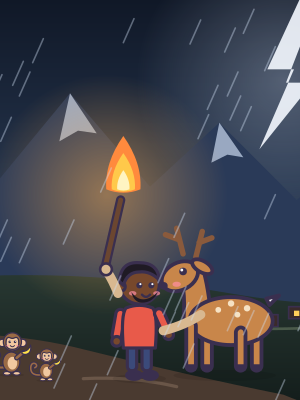
He could have saved himself. But then he looked at the empty begging-bowl, and his face changed. “They have given me good food every day since I came,” he said, “and if I am not swift, tomorrow there will not be one mouth left in the valley.” He thrust a pine torch deep into the fire, twirled it until it blazed, clutched the stag’s neck with one hand, and stepped out into the roaring night, with the langurs pressing around him and the bear grunting at his heels. He was no longer a holy man. He was Purun Dass, the old Prime Minister, a man who gave orders, going out to save lives.
Down the steep path they poured together, the old man and his brothers, until they reached the one crooked street of the village, and he beat with his crutch on the shutters of the blacksmith’s house. “Up and out!” he cried, though he hardly knew his own voice, for it was years since he had spoken aloud to a man. “The hill is falling! Up and out, all of you!” The doors flew open. In the torchlight the villagers saw their holy man holding back the frightened stag, with the monkeys plucking at his robe and the bear sitting on his haunches, roaring.
“Over the valley and up the far hill!” he shouted. “Leave none behind! We follow!” The seventy people of the village ran as only hill people can, wading the small river on the valley floor and scrambling up the terraces opposite, calling each other’s names as they went, while the old man climbed after them, leaning on the great stag. At last the stag stopped in the shadow of a pine wood, five hundred feet up the hillside, where his instinct told him that they would be safe. Purun Bhagat sank down beside him, white and faint. “Stay with me, Brother,” he whispered. “Stay until I go.”
There was a sigh in the air, then a mutter, then a roar that passed all hearing, and the whole hillside that they had left was torn away in the darkness, and the mountain under their feet shook. For five minutes one deep note drowned every other sound, and then it died away, and the rain changed to the soft drumming of water on new earth. The villagers crouched under the pines until daylight, and then they looked across the valley, and where the village and the road and the shrine had stood, there was only one raw, red scar, a mile wide and two thousand feet deep.
One by one the villagers crept through the wood to give thanks to their Bhagat, but he was dead. He sat cross-legged against a tree, with his crutch under his arm and his face turned toward the northeast, and the great stag stood watching over him, and the monkeys wailed in the branches. The priest said that it was a miracle after a miracle, since this was exactly how holy men are buried, and they built a small temple on that very spot. They still worship there, with lights and flowers, and they call the hill the Bhagat’s hill. But they never learned that their saint had once been a great Prime Minister.