The Swiss Family Robinson: the full story
Part One · The Wreck
For six days and nights a terrible tempest had driven our ship across the ocean, and on the seventh day the storm increased until every hope was lost. The masts had snapped, the hull was leaking in a dozen places, and the exhausted sailors were praying aloud. My wife and our four sons, Fritz, Ernest, Jack and little Franz, clung together in the cabin, and I told them that whatever happened, we would meet it together. Suddenly the ship struck a rock with a tremendous shock. When I hurried onto the deck, I saw the crew crowding into the last boat, and I watched it vanish into the spray without us. The captain and his sailors had abandoned the vessel, and we were alone.
Our situation was not entirely hopeless, however. The stern of the ship, which contained our cabin, had lodged between two enormous rocks, and through the drifting mist I could see a rugged coastline not far away. By morning the wind had weakened, and the sky was clearing. During the night Fritz and I had fastened empty flasks together into floating belts, so that my wife and the younger boys would be safe if the wreck broke apart. Now I called a council. "We must not despair," I said. "Courage and invention will help us more than weeping. Let everyone search the ship for whatever may be useful." The children scattered immediately, delighted to have an important duty.
Presently we gathered in the cabin to display our discoveries. Fritz had located guns and powder, Ernest had brought an ax and a hammer, and little Franz presented a box of fishhooks, which I declared would probably prove more valuable than anything else on the ship. Jack had opened the captain's cabin and released two enormous dogs, Turk and Juno, who knocked him head over heels and then licked his face apologetically. My wife had learned that a cow, a donkey, two goats, six sheep and a sow were still alive, and she had carefully fed them. But how could we carry so many passengers to the shore? "Why not sail in tubs?" inquired Jack, who often sailed around the pond at home in a washing tub.
I was astonished to discover that this was a remarkably intelligent suggestion. We located four powerful casks, which I sawed in half, and I fastened the eight tubs along a plank, with long poles and empty barrels at the ends to keep the craft balanced. It was so heavy that our united efforts could not move it an inch, until I explained the principle of the lever, and with a bar and several rollers we sent it gliding into the water. The next morning we loaded tools, canvas, guns, biscuits and a large iron pot, put the hens into one tub, and let the ducks and geese swim alongside. My wife, who had refused at first to climb into a tub, finally took her place at the front. Then we cast off from the wreck.
Part Two · The Strange Shore
The two dogs, whom we had left behind to save weight, howled so pitifully that they leaped into the sea and followed us, resting their paws on the poles whenever they were exhausted. Jack wished to push them away, but I reminded him that a kind person takes care of his animals. As we drew nearer, the coast appeared rocky and barren, and I feared that we had come to a place of hunger. Then Fritz noticed a little creek between the cliffs, and a strip of sand lay beyond. We steered into it, the hens flew out of their tub, the boys splashed into the shallows, and at last we stood on solid ground. That evening we pitched a tent of canvas, and my wife prepared a supper of biscuit and soup that tasted better than any feast.
The next morning Fritz and I set out to explore, leaving the rest of the family at the tent. We crossed a stream and entered a forest where we encountered coconut palms and curious trees whose fruit grew directly from the trunk. They were calabash trees, I told Fritz, and the difficult shell of the gourd makes excellent bowls, spoons and bottles. I demonstrated him how to divide one evenly by tying a string tightly around it and tapping the string with my knife, and we left several gourds drying in the sun. Farther on, we noticed a thicket of sugar canes growing wild, and Fritz sucked the sweet juice with such enthusiasm that he cut a dozen more than he could possibly carry.
In a grove of palms, a troop of monkeys chattered at us from the treetops, and Fritz raised his gun, but I stopped him. "Never take the life of any creature needlessly," I said. "A live monkey in a tree is more useful to us than a dozen dead ones, as I will show you." I threw a handful of small stones toward them, and the monkeys, who cannot resist imitating, immediately seized the coconuts and sent a hail of them down upon us. We drank the milk and ate the cream inside, and on the way home we noticed a tiny monkey that had been left behind when the troop fled. Fritz picked it up gently, tamed it within a week, and named it Knips.
Each night, jackals howled around our tent, and the dogs fought them off, but nobody slept well. My wife, who had been thinking about the problem, proposed a bold solution. "We should build a nest in a tree," she said, "like the arbor I once saw at home in Switzerland, high above the ground, where nothing could reach us." I laughed at her. "Unless we have wings or a balloon," I said, "your plan is impossible." But the next day Jack and Ernest returned from an expedition with remarkable news. They had located an enormous tree near the shore, with roots arching over the ground like the pillars of a cathedral, and a canopy of branches so extensive that it covered half the sky.
Part Three · Falconhurst
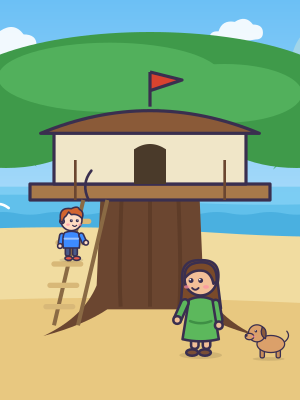
It was exactly the tree we needed, and measuring it was the first problem. We could not touch the lowest branch with any of our poles, so I used geometry, marking a distance on the ground and calculating the angle with a rod, and announced that we should live thirty feet above the earth. Then I made a bow and arrows from bamboo, and fastened a ball of thread, which my wife produced from her wonderful bag, to an arrow. It flew over a high bough, trailing the thread behind it. With the thread I drew up a cord, and with the cord a rope ladder, and Jack, the lightest of us, sprang up first and waved his cap at the top. "Hurrah for our jolly nest!" he shouted.
For several days we hauled planks and beams into the branches with a pulley, using the cow and the donkey to drag the heavier timbers across the sand. The boys constructed the floor, and I assembled walls of sailcloth and a roof of bark, while my wife stitched hammocks and prepared meals. A flamingo that Fritz had brought home with an injured wing, which I nursed carefully, eventually became tame and joined the chickens in the yard. On the evening when we finally climbed the ladder to our new home, we pulled it up behind us and slept soundly for the first time since the wreck. We named the place Falconhurst, and it was the beginning of everything.
We gradually realized that the shipwreck was a treasure chest, and for several weeks Fritz and I returned to it again and again. The vessel had been carrying supplies to a colony, so it contained everything we could possibly want: nails, tools, seeds, window glass, furniture, a pinnace in pieces, and even a captain's cabin door complete with hinges. We assembled a raft, and later a small boat, and we never again had to leave the cow, the sheep or the goats behind. Little by little, a bare island was becoming a home, and each journey made the boys more skillful sailors, more careful builders, and, I hoped, better men.
My wife's wonderful bag was full of surprises, because it contained seeds of nearly every garden plant, and she had been secretly sowing them wherever we dug potatoes. Within a few months the ground around Falconhurst was green with peas, beans, lettuces and young corn. Then the boys captured a wild onager, a powerful and handsome animal like a small horse, and Fritz, who was determined to tame it, spent weeks teaching it to wear a bit and carry a rider. We made a staircase inside the hollow trunk of the tree, after driving out a swarm of bees, and we manufactured a cart and a sledge for hauling our harvests. Each new invention made our life easier, and the rainy season no longer frightened us.
Part Four · New Switzerland
When the rains arrived, we learned how difficult it is to keep a family dry in a tree. So the next spring we commenced carving a new home in the face of a cliff. After several weeks of continuous hammering, we broke into a huge natural cave, and Jack, who was always the first to explore, observed that the walls were covered with sparkling crystals of salt. We spent a whole season enlarging and furnishing our hall, with doors and window frames from the wreck, a kitchen, a workshop and a stable. We called it Rockburg. It was a comfortable winter home, and in the evenings, while the rain beat against the cliff, the boys read aloud, carved toys and worked at their lessons.
As the years went by, we established a considerable number of other settlements, and each one eventually received an appropriate name. Woodlands was a farm among the trees, Prospect Hill was a summerhouse on a hilltop, and Tentholm was a small island in the bay where we sheltered our numerous poultry. We called the whole island New Switzerland. My sons had grown into powerful young men, who could ride, swim, build and navigate, and my wife possessed a magnificent garden, a dairy and a pantry full of provisions. We had almost forgotten that any other civilization existed. Then one day, when Fritz was exploring the coast in his kayak, he encountered a young English girl who had been shipwrecked on a lonely, uninhabited island, and he brought her safely home to Rockburg.
Her name was Jenny Montrose, and she had been traveling from India to England to rejoin her father, a colonel, when her ship was destroyed in a storm. She was welcomed into the family like another daughter, and she taught the boys several unfamiliar songs that they enjoyed immediately. One spring morning, a few months later, the sound of a distant gun echoed along the shore, and nobody in our family had fired it. We hurried to the headland and anxiously searched the horizon with our telescope, and then we saw a sail, and an English ship dropped anchor in the bay. After so many years, the outside world had finally located us, and we hardly knew whether to laugh or to weep.
Her captain, a considerate and gallant officer named Littlestone, had been searching for shipwrecked sailors, and he had found us instead. He shared our supper, admired our comfortable settlement and listened to our extraordinary story with astonishment. That night, however, we faced a difficult question, because some of us longed to see Europe again, and others could not imagine abandoning New Switzerland. Fritz decided that he must accompany Jenny home to her father, Ernest declared that he would stay and continue his studies of the plants, birds and minerals, and Jack announced that he would become the finest rider on the island. Franz, who longed for a school, would go with Fritz, and the captain promised to carry them safely to England.
On the evening before the ship sailed, I gave Fritz the journal that I had faithfully kept since the wreck, and requested that he print it, in case it might be useful to other children. "Children are very much alike everywhere," I told him. "If they learn from our adventure how much can be done by patience, work and good sense, then every page was worth writing." The next morning the sails rose, and my wife and I stood on the shore, waving, until the ship was a speck. Then we turned back toward Falconhurst. The island, as I told her, was still our home, and a good home is wherever a family is working, learning and helping each other.