Toomai of the Elephants: the full story
Part One · The Camp
Kala Nag, whose name means Black Snake, was an old working elephant who had served the elephant-catchers for forty-seven years. Since he had been twenty when he was first tamed, he was nearly seventy, which is a ripe old age for an elephant. His mother had told him long ago that elephants who were afraid always got hurt, and he had taken her advice so completely that by the time he was twenty-five he was no longer frightened of anything. He had carried tents and hauled heavy timber, he had crossed the sea in a ship, and he now stood ten feet tall at the shoulder, with his tusks cut short and bound in bands of copper.
Big Toomai, his driver, was the son of Black Toomai and the grandson of Toomai of the Elephants, and for three generations the family had fed and groomed Kala Nag. "There is nothing the Black Snake fears except me," said Big Toomai. "He is afraid of me also," said Little Toomai, who was ten years old and stood four feet high in a single ragged shirt. He had been born in Kala Nag's shadow. He had played with the tip of the great trunk before he could walk, and he had led the old elephant down to the river as soon as he could. He scolded the old elephant like a lazy pig, and Kala Nag obediently lifted his feet one after the other.
Big Toomai was growing old, and he longed for the brick elephant stables in the big town, with one stall for each elephant, flat roads to walk on, and only three hours of work a day. His son wanted exactly the opposite. Little Toomai loved the wild camp, with its narrow paths that only an elephant could climb, the warm rains when the hills smoked, and the foggy dawns when no one knew where the day would end. Best of all he loved the last night of a drive. The wild elephants came pouring into the pen like rocks in a landslide, and the whole hillside blazed with torches and shouting. Even a small boy could help there, and Toomai did the work of three.
One night he slid down from his post on the fence, darted among the huge legs, and tossed a dangling rope to a man who was struggling with a kicking calf. Kala Nag spotted him, scooped him up in his trunk, and passed him to Big Toomai, who gave him a smack and put him straight back on the post. The next morning his father scolded him loudly and warned him that Petersen, the chief of all the elephant camps, had heard about it. Little Toomai was frightened, because Petersen caught more wild elephants than any man living and seemed to him the greatest person in the world.
Part Two · The Joke
Petersen rode into camp on his clever she-elephant Pudmini, and Machua Appa, the head tracker, murmured that it was a pity to send such a boy back to the plains. Petersen listened for a living to the quietest creatures on earth, so his hearing was sharp, and he turned at once and called the boy forward. Kala Nag lifted Toomai in his trunk until he hung level with Pudmini's forehead, and the boy covered his face with both hands. "Why did you teach your elephant that trick?" Petersen asked, smiling under his mustache. "Was it to steal green corn?" "Not corn, sir," Toomai whispered. "Melons." The whole camp burst out laughing, for most of them had done the same thing when they were boys.
Petersen gave the boy four silver annas to spend on sweets, and he said, "In time thou mayest be a hunter too. But a Keddah is no place for a child to play. Come to me when thou hast seen the elephants dance, and then I will let thee go into all the Keddahs." Everyone laughed again, because that was an old joke among the elephant-catchers, and it meant never. Deep in the forests there are cleared places called elephants' ballrooms, but they are found only by accident, and no man alive had ever seen the elephants dance. Little Toomai went away glowing with pride all the same, because the great Petersen had spoken to him.
On the long march down to the plains, the elephants gave trouble at every ford, and an old driver from the hills, riding a few places ahead, called back over his shoulder that the wild elephants would dance that very night. The catching season was over, he explained, and the herds knew it. "Double-chain thy pickets tonight," he told Big Toomai, who only snorted. For forty years, from father to son, said Big Toomai, his family had tended elephants, and none of them had ever heard such moonshine about dances. "A man who stays at home learns only what his own house can teach him," the old driver answered, and rode on, laughing.
That evening Little Toomai borrowed a small drum from the sweet seller and sat down in front of Kala Nag in the starlight to thump out his happiness. There was no tune and there were no words, but the thumping made him glad. From the camp hut he could hear his mother singing his baby brother to sleep with an old song about the great god Shiv, who gave every creature its share of food and toil. Then the boy stretched out on the fodder and slept, until he woke in brilliant moonlight and saw Kala Nag still standing with his ears cocked, listening to a wild elephant that was calling from the hills, as small and far away as a pinhole in the silence.
Part Three · The Night Ride
Every elephant in the lines scrambled to its feet, and the drivers hurried out with mallets to hammer the pegs deeper and to tighten the ropes. Big Toomai unfastened Kala Nag's iron chain and tied his leg with a loop of plain grass string, telling the old elephant to behave as though it were a chain. Kala Nag, however, had already made up his mind. When the camp had settled down again, the grass gave way with a faint snap, and he glided out of the line as quietly as a cloud drifts out of a valley. Little Toomai ran after him on bare feet, begging, "Take me with thee, O Kala Nag!" The elephant stopped, curled his trunk around the boy, and lifted him onto his neck, and then the two of them slipped away between the trees.
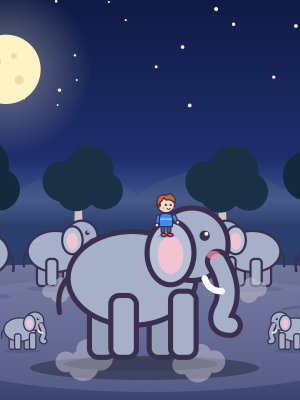
Kala Nag moved without a sound, drifting through the thick forest like smoke, up one hill and down into a valley where the night mist lay chill and heavy. Then he plunged downhill in one great rush, tearing through the undergrowth and swinging the saplings aside with his shoulders, until at last he waded into the bed of a river and felt his way across it step by careful step. Toomai could hear splashing and trumpeting upstream and downstream, and all the mist around him seemed to be full of rolling, wavy shadows. "The elephant-folk are out tonight," he whispered, with his teeth chattering. "It is the dance, then!"
At the top of the hill, between two tree trunks, Kala Nag stopped. Before them lay a clearing of three or four acres, trampled as hard as a brick floor, with a ring of trees around it and a few bare trunks rubbed white in the middle. In the moonlight the ground looked iron gray, and more and more elephants swung out of the forest onto it. There were great wild tuskers with leaves caught in the wrinkles of their necks, slow mothers with tiny calves running under their stomachs, young bulls proud of their first tusks, and one old giant with a broken tusk and the long scars of a tiger's claws. Toomai could count only as far as ten, and he lost count again and again.
Toomai lay flat against the broad neck. Even in the worst of a drive a wild elephant will never reach up to pull a boy off a tame elephant's back, and tonight these elephants were not thinking about people at all. Once they all started, with their ears thrown forward, at the clink of a chain in the forest, but it was only Pudmini, Petersen's clever elephant, who had snapped her own chain and come all the way from the camp to join them. At last Kala Nag walked out into the middle of the crowd, clucking and gurgling, and all the elephants began to talk together in their own language.
Part Four · The Dance
Then a cloud slid across the moon, and in the sudden darkness a low drumming began. Toomai had no idea what it was. Kala Nag raised a forefoot, set it down, raised the other, and soon all around him hundreds of feet were thudding together in time, like enormous hammers on the hard ground. The sound was like a giant war drum in a cave. The earth trembled, the dew shook out of the branches like a downpour, and although he pressed both hands over his ears, the beat went straight through his bones. For two long hours it never changed, until at last a thin smell of morning came drifting through the trees.
With the first gray light the stamping stopped dead, as if the dawn had given a command. Toomai was still shaking the ringing from his head when he found that the whole herd had disappeared, leaving only Kala Nag, Pudmini and one lone stranger, and there was not a rustle on the hillside to say where the rest had walked off to. The clearing was larger than it had been at midnight, because the elephants had trampled the grass to dust to widen their dance floor. Toomai's eyelids were drooping. "Take me to Petersen's camp, my lord," he murmured, "and follow Pudmini, for I am falling asleep."
Petersen was eating an early breakfast when Pudmini plodded into the camp, mud up to her shoulders, with a footsore Kala Nag behind her. Toomai's face was pale, and there were leaves tangled in his dew-soaked hair. "The dance," he said weakly. "I have seen the elephants dance!" And he toppled off the great neck in a faint. By midday he was resting in Petersen's hammock with warm milk inside him, while the scarred old hunters of the camp crowded around and stared at him as if he had come back from the dead. In plain, short words he told them everything. "Send men to look," he finished, "if you think I lie."
Petersen and Machua Appa rode off to follow the tracks, and they traced them fifteen miles across the hills to a wide clearing as hard as paving stone. Machua Appa counted seventy sets of tracks crossing the river. "The boy has told the truth," he said quietly. That night the whole camp feasted around the fires, and Machua Appa swung Toomai up over his head. "From now on," he shouted, "this boy is Toomai of the Elephants, like his great-grandfather before him!" All down the line the elephants raised their trunks together in the loud salute of the camp. It was a salute for the one boy who had watched the herds dance, at night and alone, in the heart of the hills.