Tyr and the Wolf: the full story
Part One · The Wolf Grows
The gods of Asgard had always known how to handle trouble when it was small, which was precisely why they grew so careless about the children of Loki. The trickster had three of them with a witch in the Iron Wood, and they were not born like other children; they possessed no shape of their own, only an appetite, and each appetite assumed whatever body suited it best. When the gods summoned the three to Asgard, the first appeared as a serpent, the second as a woman who was half living and half corpse, and the third as an enormous wolf called Fenrir, whose appetite was simply for destruction. Nobody in Asgard slept well that night, and the wisest of them slept worst of all.
Even the gods were horrified by the spectacle. Odin hurled the half-dead woman down to the deepest region beneath the world, where she became the queen of the dead, and Thor threw the serpent far out into the sea that surrounds the world, and in those depths the creature swelled until it could ring the whole land. But Fenrir could not be seized by anyone. He wandered through Asgard as he pleased, and since nobody was strong enough to restrain him, the gods arrived at a compromise instead: if he would consent to stay in the outer courtyards, he could eat as much as he wanted, whenever he wanted it. It sounded like a sensible arrangement, the sort of arrangement that people make when they would rather not think about what comes next.
Feeding a wolf of that size was not an assignment that anybody desired, and only one of the gods volunteered for it. This was Tyr, the swordsman, whom everyone acknowledged as the bravest of all the inhabitants of Asgard, and every single day he carried an immense portion of meat to the lair and fed the creature from the point of his blade. Fenrir grew. He grew until his shoulders stood as high as a roof and his jaws could have closed around a farm cart, and every morning the gods looked out of their windows with a feeling of dread that they preferred not to discuss, and each of them privately hoped that somebody else would eventually solve the problem.
Part Two · The Chains
At last they assembled in council, and the council reached the conclusion that councils usually reach, which was to try a chain. In their own forge they manufactured one called Laeding, heavier than Thor's hammer, and they dispatched Frey's servant Skirnir to the wolf's lair with a friendly proposition. How strong was Fenrir, really? Surely a creature of his magnificent power could not possibly be afraid of a harmless game, and the gods would be delighted, they said, to watch him prove it. Fenrir looked down at the chain with scorn and allowed it to be wound around his body. Then he stretched, employing only the smallest portion of his strength, and Laeding broke in half.
Dismay spread among the gods, though they were also remarkably stubborn. They gathered more iron, built hotter fires, swung heavier hammers, and forged a second chain called Dromi, which was stronger by half than the first. Fenrir permitted this one too, curious to discover what would happen. This time he was obliged to make an effort; his eyes blazed, he growled, and he strained until the links shrieked, and then Dromi broke across with a crack that echoed through the whole of Asgard. The wolf stood among the pieces and regarded the gods, and he understood something new about them. They were terrified of him, and they were failing to conceal it, which is a dangerous combination in any place that depends upon being feared.
No chain that gods could forge would ever hold him, and every one of them knew it. So Skirnir undertook a longer journey, down beneath the mountains into the country of the dwarfs, who had once made Odin's spear and Thor's hammer and a ship that folded up like a handkerchief. The dwarfs listened to the request with the gravity of experts who are rarely consulted. The chief of the dwarfs swelled with pride and declared that his people could construct such a fetter from six ingredients: the roots of a mountain, a fish's breath, the beard of a woman, a cat's footfall, the sinews of a bear, and the spit of a bird. Skirnir confessed that he had never encountered any of them. "Nobody has," said the dwarf. "That is why nobody else could make it."
Part Three · The Silken Cord
What the dwarfs finally delivered, after days and nights of laborious work, looked like nothing at all. The fetter was named Gleipnir, and it felt like a silk ribbon, slight enough to wind around a finger. The gods passed it from hand to hand, unable to believe their eyes, and no one would have blamed them for suspecting that the dwarfs had cheated them. Then they invited Fenrir to an outing on a distant island called Lyngvi, and there, in the middle of the festivities, one of them drew out the ribbon and remarked, as casually as he could manage, that perhaps the great wolf would like to demonstrate that he could snap this one as well.
Fenrir was not stupid. He sniffed at the cord and observed that it was far too slender to bring him any glory if he broke it, and that if it was stronger than it appeared, there had to be some sort of enchantment in it. The gods replied that if he could not break it, he was no danger to anybody, and they need never fear him again. That insult stung him worse than any chain. "I will let you bind me," said the wolf slowly, "but only if one of you will lay a hand between my jaws as a guarantee that you intend no trickery. If this is a trick, the hand will pay for it."
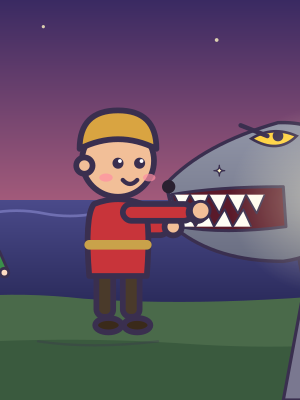
The gods looked at one another in silence, because every one of them knew perfectly well that there was a trick. One after another they stepped backward, hoping that somebody else would volunteer, and the silence in the clearing grew heavier with every second. Then Tyr stepped forward, quite calmly, the bravest of them all, and held out his left hand to the wolf. "Not that one," said Fenrir. "The right, the hand that holds your sword." Tyr said nothing at all, and with perfect steadiness he laid his right hand between those tremendous teeth, and the gods wound the silk cord around the wolf from his neck to his tail.
Fenrir did what he had done twice before and stretched himself to his full, terrible size, and nothing happened. The silk stretched with him and only drew tighter, and the harder he fought, the more firmly it held. When he finally understood, he closed his jaws in a fury, and the hand of Tyr was gone. The gods fastened a mighty chain to the cord and passed it through a hole in a great rock, deep on a far-off island, and there Fenrir lay bound, howling. Asgard was safe, but the old poets always add that it had been made safe by a deception, and that the wolf, alone in the dark, remembered it. Even now, say the poets, he waits for the day when the chain gives way.