The Southern Taurids for Kids
Next peak · 5 nights to go
Night of 4–5 November 2026 · Moon 17% · Quiet
A quiet one. Look at the Moon instead.
Up in the evening, so a bedtime look counts, but expect only a few an hour.
The next Southern Taurids peak is the night of 4–5 November 2026. A 17% Moon is up for part of the night. Verdict: quiet. A quiet one. Look at the Moon instead. At best a dark sky gives about 5 an hour, by the American Meteor Society's calendar; the Moon is from astronomy-engine.
The Taurids are a slow, small shower in the fall. Sometimes they make a big, bright fireball.
The Southern Taurids come from Comet Encke. They give only about five an hour, but their bits are bigger than most, so now and then one makes a bright fireball that lights up the ground.
The Taurid stream is old and spread out, so its rate is low and its peak broad, lasting weeks. Comet 2P/Encke goes around the Sun every 3.3 years, the shortest of any bright comet. Some years Earth hits a swarm of larger grains and the fireballs are many.
Taurid fireballs can be brighter than Venus for a second.
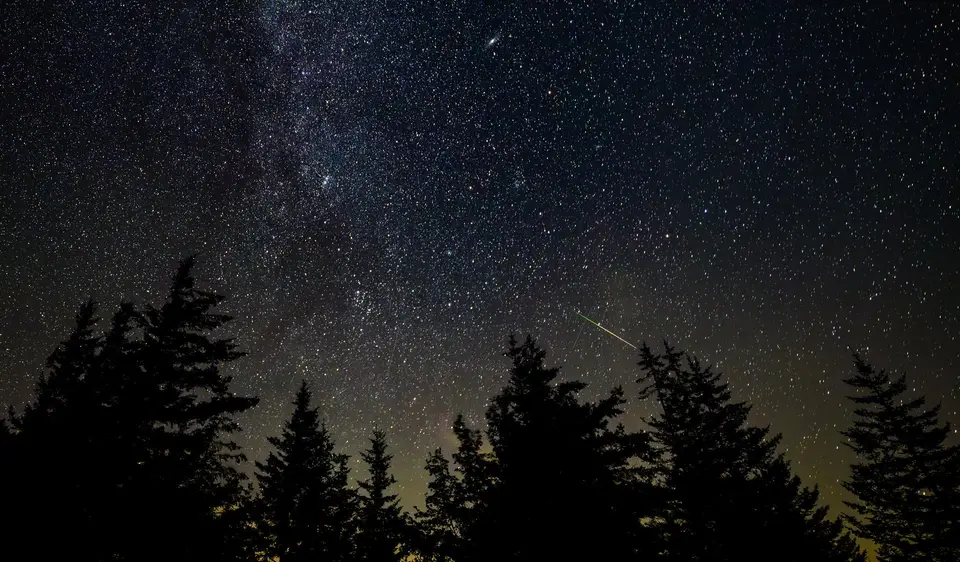
Which way to look, and when
East in the evening, high in the south around midnight.
Up all night; the rate is low but steady. Active 10 September to 20 November.
Where does it come from?
The Southern Taurids are dust from Comet 2P/Encke. The bits hit the air at about 27 kilometers a second and glow as they burn up. The streaks seem to start from Taurus, which is how the shower got its name.
Every peak in our table
| Night of 4–5 November 2026 | Quiet. A 17% Moon is up for part of the night. |
|---|---|
| Night of 4–5 November 2027 | Quiet. A 39% Moon that sets before midnight, so the late hours are dark. |
Some calendars give a peak one night either side; a shower is active for days around it, so the nights next to the peak are worth a look too.
How to watch
- Go out with a grown-up, dressed warmer than you think, with a blanket or a reclining chair.
- Put phones away and give your eyes twenty minutes to get used to the dark.
- Look up at the whole sky, not at one spot, and count every streak you see.
The shower night kit
One sheet to take outside: a box for every ten minutes, a line for the brightest one, and a tick for the clouds. Counting is the game.
The Southern Taurids: my shower night
Peak: the night of 4–5 November 2026. Look up at the whole sky. The streaks point back to Taurus. peabody.kids/space/showers/southern-taurids
☐ Warm coat and hat ☐ Blanket or chair ☐ Grown-up ☐ Phones away for 20 minutes
| Ten minutes from | Shooting stars I counted (|||| ||) |
|---|---|
| ____ : ____ | |
| ____ : ____ | |
| ____ : ____ | |
| ____ : ____ | |
| ____ : ____ | |
| ____ : ____ |
The brightest one went from ________________ to ________________.
Clouds? ☐ none ☐ some ☐ lots · My total: ______
If the sky is clear. Peak night and rate: American Meteor Society; the Moon: astronomy-engine.
Other showers
“Don't look at one spot. Lie back and let your eyes take in the whole sky.”