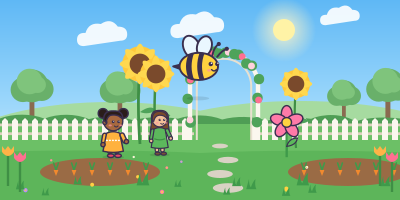
A Sip, a Fan, a Lid
A bee landed on a purple flower. Oona stood very still. What was it doing in there?
The bee pushed its head deep into the flower. It was having a drink.
Inside the flower is a sweet juice called nectar. The bee sips it with a long tongue. It works like a straw.
The nectar goes into a special tummy, just for carrying. It is called the honey stomach.
Then the bee flew to another flower, and another. On one trip, it can visit hundreds of flowers.
Oona saw yellow dust on its fuzzy legs. "That is pollen," said Aunt Mabry. "The bee packs it into baskets on its back legs."
Some of the dust rubs off on the next flower. Now that flower can make seeds. Some flowers grow into fruit.
Moving pollen from flower to flower is called pollination. Bees help grow many fruits and vegetables we eat.
At last the bee flew home. Home was a wooden box in the garden. It was Aunt Mabry's hive.
Thousands and thousands of bees live inside one hive. They all work together, and each one has a job.
Aunt Mabry lifted out a frame. The bee did not keep the nectar. It gave it to a house bee, mouth to mouth.
The house bee put it in a tiny wax room. Each room has six sides.
Nectar is very wet. Most of it is water. Honey is thick, so the water has to go.
So the bees fan their wings, fast, fast, fast. The moving air dries the nectar out.
Slowly the nectar gets thicker and stickier. Now it is honey! Oona could see it shine.
When a room is full, the bees close it up. They put a lid of wax on top.
Why do bees save honey? It is their food for winter, when few flowers bloom.
Aunt Mabry gave Oona a spoon of honey. It tasted a little like flowers.
Honey from different flowers looks and tastes different. Some is pale, and some is dark.
If you see a bee, stand back and watch. Look at its back legs. Do they have yellow lumps?
Questions
- Nectar
- Milk
- Rain
- To keep warm
- To dry it out
- To scare birds
- Making wax rooms
- Sleeping in winter
- Moving pollen from flower to flower
- A leaf
- A lid of wax
- A stone
- It is their food for winter
- They give it to birds
- They use it to build the hive
Words to know
- nectar: sweet flower juice
- pollen: yellow flower dust
- hive: bee home
- wax: bee-made building stuff
- pollination: moving pollen
Answer key: A Sip, a Fan, a Lid
- A. Nectar
- B. To dry it out
- C. Moving pollen from flower to flower
- B. A lid of wax
- A. It is their food for winter
Teaching a mixed class? Bees and honey at three reading levels
Three true passages from the same facts, a basic, a middle and an advanced one, so every group reads about the same thing and the class can talk about it together. Print one PDF: a sheet for each group, marked with a shape instead of a level, and a page for you that says which is which.
- ● A Sip, a Fan, a Lid (this passage)Basic, for about 6 to 8 · reading level 7 · 357 words · Flesch-Kincaid grade 2.2 · 5 questions
- ▲ How Do Bees Make Honey?Middle, for about 9 to 12 · reading level 11 · 1176 words · Flesch-Kincaid grade 6.4 · 6 questions
- ■ Nectar, Minus the WaterAdvanced, for about 13 to 16 · reading level 14 · 1391 words · Flesch-Kincaid grade 9.4 · 6 questions
For the teacher: how this passage is levelled
“A Sip, a Fan, a Lid” is a reading level 7 story. Every Peabody story at this level is written and checked to keep sentences to 10 words or fewer, to aim at an average of 6 words a sentence, and to show 12 to 30 words on a screen. At most 8% of its words may be off the familiar-word list. Children in 3rd grade start at this level.
| This passage | 357 words, 20 screens, 5 multiple-choice questions with an answer key, and 5 vocabulary words with kid-sized meanings |
|---|---|
| Longest sentence at this level | 10 words |
| Words on a screen | 12 to 30 |
| Skills practised at this level | phonics (sounding words out), sight words, spelling |
Reading level 7: the limits, a real sample and the free games. Peabody is a learning app, not an assessment: use the questions to talk about the story, not to grade a child.