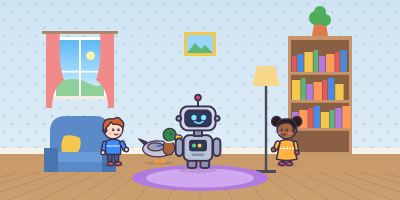
Be My Robot
"Will you be my robot?" asked Cass. Ezra blinked at his big sister in surprise. Cass wanted to show him how coding works.
"Code is a list of steps," Cass explained. "A computer follows the steps, one by one. Today, you can be the computer."
Ezra stood by the kitchen door. "Walk to the couch," said Cass. "I need every single step," Ezra beeped.
Cass tried again. "Step, step, step, then turn, then step." Ezra stepped, turned and plopped into a squishy pillow.
"Oops," said Cass, laughing. "That is called a bug. A bug is a mistake hiding in the steps."
"Why is it called a bug?" asked Ezra. Cass told him a true story from long ago.
Once, a moth got stuck inside a giant computer. The workers found it and taped it into their notebook.
The word bug already meant a mistake. So they wrote a funny note about a real bug.
Fixing a bug is called debugging. Cass carefully looked at her steps again. "I said turn too soon," she said.
Ezra ran to get his yellow rubber duck. "Tell the duck," he said. So Cass read each step out loud to the duck.
Coders really do this, too! Say your steps out loud, one at a time. The mistake often jumps right out at you.
Cass tried once more. "Step, step, step, step, then turn, then step." Ezra landed right on the couch.
"It works!" cheered Cass. The duck stayed perfectly quiet. Ezra gave it a proud little pat.
Then Cass opened her laptop to show him Scratch. It is a free program for coding. You snap blocks together, like pieces of a puzzle.
Each block is one step, like "move" or "turn." There is no hard typing at all. You just drag the blocks and snap them.
Cass drew a spotted frog and snapped on hopping blocks. Then she clicked a little green flag. The frog hopped!
"Can I try?" asked Ezra. He cannot read many words yet. But ScratchJr, a coding app, uses picture blocks instead.
With picture blocks, kids can code before they read! Ezra made a little fish swim across the screen.
The fish swam right off the edge. "Another bug!" shouted Ezra. He grinned and grabbed the yellow duck.
Now it is your turn to play robots. Give a grown-up the steps to touch their nose. Did you find a bug?
Questions
- A secret word
- A list of steps
- A kind of game
- He was tired
- There was a mistake in the steps
- The duck pushed him
- Catching moths
- Washing a duck
- Fixing a mistake
- To find his new bug by saying the steps out loud
- To take a bath
- To hide it from Cass
- It talks to him
- Its blocks use pictures
- It has no blocks
Words to know
- code: steps for computers
- robot: step-following machine
- bug: a mistake
- debugging: fixing mistakes
- moth: night insect
Answer key: Be My Robot
- B. A list of steps
- B. There was a mistake in the steps
- C. Fixing a mistake
- A. To find his new bug by saying the steps out loud
- B. Its blocks use pictures
Teaching a mixed class? Learning to code at three reading levels
Three true passages from the same facts, a basic, a middle and an advanced one, so every group reads about the same thing and the class can talk about it together. Print one PDF: a sheet for each group, marked with a shape instead of a level, and a page for you that says which is which.
- ● Be My Robot (this passage)Basic, for about 6 to 8 · reading level 7 · 400 words · Flesch-Kincaid grade 1.7 · 5 questions
- ▲ How Do You Learn to Code?Middle, for about 9 to 12 · reading level 10 · 1021 words · Flesch-Kincaid grade 5.4 · 6 questions
- ■ Debugging Since 1843Advanced, for about 13 to 16 · reading level 13 · 1449 words · Flesch-Kincaid grade 8.3 · 6 questions
For the teacher: how this passage is levelled
“Be My Robot” is a reading level 7 story. Every Peabody story at this level is written and checked to keep sentences to 10 words or fewer, to aim at an average of 6 words a sentence, and to show 12 to 30 words on a screen. At most 8% of its words may be off the familiar-word list. Children in 3rd grade start at this level.
| This passage | 400 words, 20 screens, 5 multiple-choice questions with an answer key, and 5 vocabulary words with kid-sized meanings |
|---|---|
| Longest sentence at this level | 10 words |
| Words on a screen | 12 to 30 |
| Skills practised at this level | phonics (sounding words out), sight words, spelling |
Reading level 7: the limits, a real sample and the free games. Peabody is a learning app, not an assessment: use the questions to talk about the story, not to grade a child.