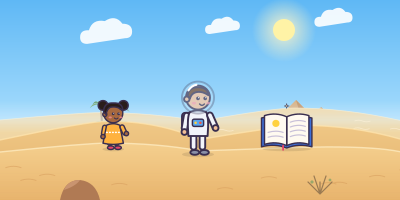
Could We Live on Mars?
The question on the science club whiteboard was four words long: Could we live on Mars? Anouk wrote "Facts About Mars" at the top of a clean page and drew a line down the middle. On the left she would list what Mars gives you. On the right she would list what you would have to bring. By Friday she had to stand up and give an answer, and she wanted it to be a true one.
She started with the trip. A spacecraft flying a fairly direct route takes seven to ten months to reach Mars, about as long as a school year. A crew would also have to wait for the planets to line up again before flying home, so astronauts would be away for roughly three years. Anouk counted on her fingers. She would leave in sixth grade and come back in high school. On the right side she wrote: patience.
Next came air. Mars has some, but it is very thin, and about 96 percent of it is carbon dioxide, the gas you breathe out. Nobody could breathe it. On the right side Anouk wrote: oxygen, a lot of it. Then she found something better. A machine called MOXIE has already shown that oxygen can be pulled out of the Martian air. She moved oxygen halfway to the left side, with a question mark.
Water was harder. Long ago, Mars had rivers, lakes and deltas, and the rocks still show where they ran. Today the air is too thin for liquid water to last for long on the ground. But there is ice hidden just under the surface near the poles. Anouk wrote ice on the left side. Then she added a careful note: ice is not a glass of water. Somebody would have to dig it up and melt it.
The cold came next, and it was worse than she expected. The average temperature on Mars is about 85 degrees below zero Fahrenheit. Because the air is so thin, the Sun's heat escapes quickly. On a warm day at the equator, a person standing on the ground at noon might feel spring at their feet and winter at their head. Anouk pictured wearing shorts on her legs and a parka on top, and laughed out loud in the library.
Light was a surprise. Anouk had assumed a base on Mars would run on solar panels, because there is plenty of sunshine in space. But dust storms on Mars can cover much of the planet and last for months, so a small nuclear power plant would be more reliable than solar panels for a future crew living there. On the right side she wrote: power that works in the dark.
Some things on Mars felt almost friendly. A day there, called a sol, lasts about 37 minutes longer than a day on Earth, so the days would feel nearly normal. Anouk decided she could live with a little extra time before bed. Gravity is weaker, too: someone who weighs 100 pounds here would weigh only 38 pounds there. Anouk liked the idea of carrying heavy boxes with one hand. She wrote both on the left side, then underlined sol twice.
Other dangers cannot be seen at all. Earth wraps us in a magnetic field and a thick blanket of air, and together they block much of the radiation that streams through space. Mars has no global magnetic field today and only a thin atmosphere. Astronauts cannot see or even feel radiation, yet it is one of the most dangerous parts of a trip to Mars. On the right side Anouk wrote: shielding, and then: thick walls.
Then came the phone call problem. Messages travel at the speed of light, but Mars is so far away that each one can take up to about twenty minutes to arrive, depending on where the two planets are. A question and its answer could take most of an hour. Anouk imagined calling her grandmother and waiting through a whole math lesson to hear her say hello. A crew on Mars would have to fix most problems alone.
Food was the last big item. There are no grocery deliveries on the way to Mars. A crew would have to carry its meals and grow some of its own. Anouk was not sure anyone could manage that for years, until she read about Houston. There, NASA has built a pretend Mars home and asked volunteers to live inside it for a year at a time. She decided that would be her best evidence.
The home is called a habitat, and it was printed by a giant 3D printer at NASA's Johnson Space Center. It is about the size of a small house, shared by four people. The first crew went inside in the summer of 2023 and came out 378 days later. They grew vegetables, looked after their own equipment, and waited through long delays to hear from Earth. They also took pretend Marswalks in a room full of red sand.
A later crew practiced something even lonelier: two whole weeks with no messages at all. Anouk thought about that for a while. Nobody has been to Mars yet, so these crews are the closest thing to an answer that anyone has. They are teaching NASA how people cope with being shut in, far from home, with only the supplies they brought. They cannot show what a real Martian dust storm or real radiation would do to a real crew.
On Friday Anouk held up her page. The right side was much longer than the left. "Could we live on Mars?" she said. "Maybe, but only if we bring nearly everything with us: air, water, power, food and walls." Then she asked the club the one question she still could not answer. If you could pack only one thing from the right side of this list, which would you choose?
Questions
- It is thin and mostly carbon dioxide
- It is too hot to breathe
- There is no air on Mars at all
- Mars has no sunlight
- Dust storms can last for months
- Robots would break them
- They had been to Mars before
- They lived with red sand at home
- Nobody has gone to Mars, so they are the closest test
- A home built for living in
- A kind of rocket
- A machine that makes oxygen
- About one second
- Up to about twenty minutes
- About seven months
- She ran out of time
- Mars has more good things than bad
- People would have to bring almost everything
Words to know
- habitat: place to live
- radiation: invisible harmful energy
- atmosphere: air around planet
- sol: a Mars day
- evidence: proof you show
Answer key: Could We Live on Mars?
- A. It is thin and mostly carbon dioxide
- B. Dust storms can last for months
- C. Nobody has gone to Mars, so they are the closest test
- A. A home built for living in
- B. Up to about twenty minutes
- C. People would have to bring almost everything
Teaching a mixed class? Mars at three reading levels
Three true passages from the same facts, a basic, a middle and an advanced one, so every group reads about the same thing and the class can talk about it together. Print one PDF: a sheet for each group, marked with a shape instead of a level, and a page for you that says which is which.
- ● The Rusty Red DotBasic, for about 6 to 8 · reading level 8 · 708 words · Flesch-Kincaid grade 2.9 · 5 questions
- ▲ Could We Live on Mars? (this passage)Middle, for about 9 to 12 · reading level 10 · 988 words · Flesch-Kincaid grade 5 · 6 questions
- ■ The Rust That Remembers WaterAdvanced, for about 13 to 16 · reading level 14 · 1335 words · Flesch-Kincaid grade 9 · 6 questions
The story in pictures
- Part One · The question
- Part Two · Air and water
- Part Three · Cold and dust
- Part Four · Light and invisible
- Part Five · Far away
- Part Six · Pretend Mars
For the teacher: how this passage is levelled
“Could We Live on Mars?” is a reading level 10 story. Every Peabody story at this level is written and checked to keep sentences to 38 words or fewer, to aim at an average of 12 words a sentence, and to show 70 to 100 words on a screen. At most 13% of its words may be off the familiar-word list. Children in 6th grade start at this level.
| This passage | 988 words, 13 screens, 6 multiple-choice questions with an answer key, and 5 vocabulary words with kid-sized meanings |
|---|---|
| Longest sentence at this level | 38 words |
| Words on a screen | 70 to 100 |
| Skills practised at this level | vocabulary, spelling |
Reading level 10: the limits, a real sample and the free games. Peabody is a learning app, not an assessment: use the questions to talk about the story, not to grade a child.