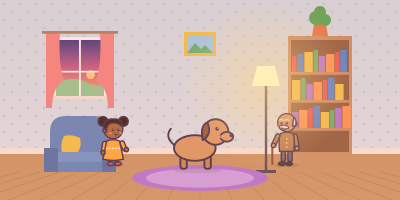
Seven Days With Pickle
Every morning before the sun is fully up, Mira's dog, Pickle, pushes her nose under Mira's hand. Pickle is a young, bouncy dog, and Mira has promised to help with her care all week. The first job is the bowl. Dogs need clean, fresh water at all times, so Mira empties the old water, washes the bowl, and fills it again. Then she and Grandpa talk about breakfast, and why a dog's dinner is a job with rules.
Pickle would eat all day if she could. Grandpa does not leave food out, because for most dogs that leads to overeating. He weighs her portion on a kitchen scale and feeds her for her healthy weight, which is not always the weight a dog has now. A treat is fine once in a while, but then her meals shrink a little. Grandpa asks the vet how many meals a day Pickle needs, because different experts give different answers.
On walking days, Mira clips on the leash and Pickle's tag jingles. Pickle stops at every post, and Mira lets her. A dog's sense of smell is far better than ours, and she can hear sounds that are four times quieter than anything a person can hear. For Pickle, a walk is a long newspaper made of smells and sounds. Her collar has an ID tag, and she also has a microchip, so that she can be returned if she ever gets lost.
On Wednesday it rains, and Pickle chews a slipper. Mira is cross until Grandpa explains. Dogs have strong urges to dig, chew, chase and fetch. Exercise burns calories and keeps a dog's mind busy too, and a bored dog can turn destructive. Pickle needs more play than a slipper can give. So Mira drags out a rope toy and plays tug in the hall. Soon Pickle is panting, happy, and much too tired to chew anything.
After lunch, Pickle trots to her bed in the quiet corner of the living room and curls up. Grandpa has put out two beds. One is somewhere quiet and out of the draft, where she can rest undisturbed, and one is in the room where the family spends time. Mira's rule is simple: when Pickle is in her bed, nobody bothers her. None of us like being woken up, and dogs are no different. Rest is an important part of a dog's day.
Pickle follows Mira from room to room, even to the bathroom door. Dogs form strong social bonds with people and become very attached to particular ones, and many enjoy the company of other dogs too. That is why Saturday is Pickle's favorite day. Mira brushes her short coat once a week, and Grandpa looks inside her ears without poking anything in. If Pickle's nails click on the floor, they need trimming, and a grown-up does that part carefully.
Grandpa keeps a short list taped inside the cupboard of foods that are not safe for dogs. It includes chocolate, grapes, raisins, onions, garlic and anything with a sugar substitute called xylitol. Some of these can make a dog very sick, and with grapes nobody can tell in advance which dog will be affected. Mira never feeds Pickle from her plate. If a dog ever eats something on that list, a grown-up phones the vet right away.
On Sunday Mira practices reading Pickle's body. A relaxed dog has loose shoulders, soft eyes, relaxed ears and an open, easy mouth. A worried dog may tuck her tail, pin her ears back, lick her lips, yawn when she is not tired, or show the whites of her eyes. Mira has learned to look at the whole dog, because a wagging tail alone does not always mean happy. When Pickle seems worried, Mira stops and gives her some space.
There is one more kind of sign. A dog cannot say that she feels ill, but a very sleepy or sad dog might need help. Mira's job is not to guess what is wrong. Her job is to notice and tell a grown-up. The vet also gives Pickle her shots to keep her well. Then Mira washes her hands with soap and water, because that is the best way to remove germs. Ask a grown-up to look at Peabody Pets with you. You will find it at pet.peabody.kids.
Questions
- It could lead to overeating
- Pickle dislikes cold food
- The bowl would get dusty
- She is a bad dog
- She needs more play and exercise
- She wants a new bed
- Very quiet
- Easy to train
- Breaking or ruining things
- One is for winter
- She chews them up
- One is quiet for resting, one is near the family
- She gives her space
- She picks Pickle up
- She plays louder
- Pickle needs a new toy
- The vet can find out what is wrong
- Grandpa wants to know the time
Words to know
- urges: strong wants
- microchip: tiny ID tag
- relaxed: loose, calm
- destructive: breaking things
- social: liking company
Answer key: Seven Days With Pickle
- A. It could lead to overeating
- B. She needs more play and exercise
- C. Breaking or ruining things
- C. One is quiet for resting, one is near the family
- A. She gives her space
- B. The vet can find out what is wrong
The story in pictures
- Part One · Water and dinner
- Part Two · Noses, play and rest
- Part Three · Company and care
- Part Four · Reading Pickle
For the teacher: how this passage is levelled
“Seven Days With Pickle” is a reading level 10 story. Every Peabody story at this level is written and checked to keep sentences to 38 words or fewer, to aim at an average of 12 words a sentence, and to show 70 to 100 words on a screen. At most 13% of its words may be off the familiar-word list. Children in 6th grade start at this level.
| This passage | 721 words, 9 screens, 6 multiple-choice questions with an answer key, and 5 vocabulary words with kid-sized meanings |
|---|---|
| Longest sentence at this level | 38 words |
| Words on a screen | 70 to 100 |
| Skills practised at this level | vocabulary, spelling |
Reading level 10: the limits, a real sample and the free games. Peabody is a learning app, not an assessment: use the questions to talk about the story, not to grade a child.