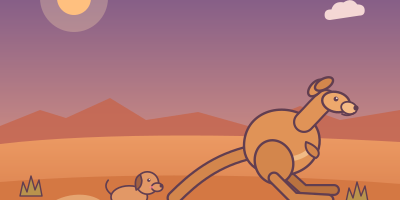
The Sing-Song of Old Man Kangaroo
Not always was the Kangaroo as we now see him. Long ago he was a Different Animal, with four short legs. He was grey, and he was woolly, and his pride was enormous. One day he danced on a rock in the middle of Australia, and he went to the Little God Nqa, at six in the morning, before breakfast. "Make me different from all other animals," he said, "by five this afternoon." Up jumped Nqa from his seat on the sandflat, and he shouted, "Go away!"
The Kangaroo was grey and woolly, and as proud as ever. He danced on a ledge of rock and went to the Middle God Nquing, at eight, after breakfast. "Make me different from all other animals," he said. "And make me, also, wonderfully popular by five this afternoon." Up jumped Nquing from his burrow, and he shouted, "Go away!" Still grey, still woolly, and still proud, the Kangaroo danced on a sandbank and went to the Big God Nqong.
It was ten o'clock, before dinner. "Make me different from all other animals," he said. "Make me popular, and wonderfully run after, by five this afternoon." Up jumped Nqong from his bath in the salt-pan, and he shouted, "Yes, I will!" Nqong called Yellow-Dog Dingo, who was always hungry and dusty in the sunshine. He showed him the Kangaroo, and said, "Dingo, do you see that gentleman dancing? He wants to be popular, and very truly run after.
Dingo, make him so!" Up jumped Dingo and said, "What, that cat-rabbit?" Off ran Dingo, grinning like a coal-scuttle, after the Kangaroo. Off went the proud Kangaroo on his four little legs, like a bunny. This, O Beloved of mine, ends the first part of the tale! He ran through the desert and the mountains, through the salt-pans and the reed-beds, through the blue gums and the spinifex. He ran till his front legs ached, because he had to.
Still ran Dingo, hungry and grinning, never getting nearer, never getting farther. Still ran Kangaroo. He ran through the ti-trees and through the mulga, through the long grass and through the short grass. He ran till his hind legs ached, because he had to. And then they came to the Wollgong River, and there was not any bridge, nor any ferry-boat, and Kangaroo did not know how to get over. So he stood up on his hind legs and hopped, because he had to.
He hopped through the Flinders and the Cinders and the deserts in the middle of Australia, and first he hopped one yard, then three yards, then five yards, while his legs grew longer and stronger. He hopped like a cricket, like a pea in a saucepan, like a new rubber ball on a nursery floor. He tucked up his front legs, and stuck out his tail for a balance behind him, and hopped through the Darling Downs.
Behind him still ran Dingo, hungrier and hungrier, and very much bewildered, wondering what in the world or out of it made Old Man Kangaroo hop. Then Nqong came from his bath in the salt-pan and said, "It is five o'clock." Down sat Dingo, Poor Dog Dingo, who hung out his tongue and howled, and down sat Kangaroo, who stuck out his tail like a milking-stool and said, "Thank goodness that is finished!" Then Nqong, who is always a gentleman, said, "Why aren't you grateful to Yellow-Dog Dingo?
Why don't you thank him for all he has done for you?" Then said the Kangaroo, "He has chased me out of my home. He has chased me out of my regular mealtimes. He has altered my shape, so that I shall never get it back, and he has played tricks with my legs." Said Nqong, "But didn't you ask me to make you different from all other animals, and also to make you very truly sought after? And now it is five o'clock."
"Yes," said Kangaroo, "and I wish that I had not. I thought you would do it by charms and spells, but this is a practical joke." "Joke?" said Nqong. "Say that again, and I will whistle up Dingo and run your hind legs off." "No," said the Kangaroo. "I must apologize. Legs are legs, and you need not alter them any further for me. I only meant to say that I have had nothing to eat since morning, and I am very empty indeed."
"Yes," said Yellow-Dog Dingo, "I am in just the same uncomfortable situation. I have made him different from every other animal in the world, but what may I have for my tea?" Nqong answered from his bath, "Come and ask me tomorrow, because I am going to wash." So they were left in the middle of Australia, Old Man Kangaroo and Yellow-Dog Dingo, and each one said to the other, "That is your fault."
Questions
- Make him bigger than a lion
- Make him different from all other animals
- Make him quiet
- Nqong
- Nqa
- Nquing
- He learned to hop on strong back legs
- He grew wings
- He learned to swim
- Run away
- Say sorry
- Ask for more
- He got what he asked for, but not the way he pictured it
- He did not get to be different
- He lost the race
- You might get them in a way you did not expect
- Gods never listen
- Dingoes are always kind
Words to know
- pride: feeling very proud
- spinifex: spiky desert grass
- burrow: animal's hole
- balance: steady weight
- apologize: say sorry
Answer key: The Sing-Song of Old Man Kangaroo
- B. Make him different from all other animals
- A. Nqong
- A. He learned to hop on strong back legs
- B. Say sorry
- A. He got what he asked for, but not the way he pictured it
- A. You might get them in a way you did not expect
The story in pictures
- Part One · Three Gods
- Part Two · The Race
- Part Three · Five O'Clock
For the teacher: how this passage is levelled
“The Sing-Song of Old Man Kangaroo” is a reading level 10 story. Every Peabody story at this level is written and checked to keep sentences to 38 words or fewer, to aim at an average of 12 words a sentence, and to show 70 to 100 words on a screen. At most 13% of its words may be off the familiar-word list. Children in 6th grade start at this level.
| This passage | 814 words, 10 screens, 6 multiple-choice questions with an answer key, and 5 vocabulary words with kid-sized meanings |
|---|---|
| Longest sentence at this level | 38 words |
| Words on a screen | 70 to 100 |
| Skills practised at this level | vocabulary, spelling |
Reading level 10: the limits, a real sample and the free games. Peabody is a learning app, not an assessment: use the questions to talk about the story, not to grade a child.