The Great Fire of London
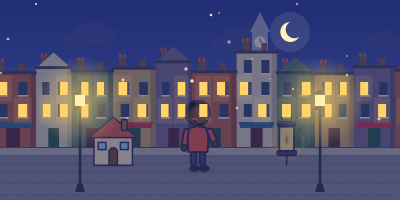
It began in a bakery, in the dark. A baker named Thomas Farriner went to bed on Pudding Lane in London, in the year 1666. At about one o'clock in the morning, a fire woke up his house. Maybe a spark from an oven landed on a pile of wood. Nobody can say for sure. But we do know that this one small fire would burn for four days, and it would burn down much of a great city.
Why did one bakery fire grow so big? Look at the street. The houses were made of wood, and they were crammed close together, like books squeezed onto a shelf. The summer had been dry, so the wood was dry too. Then a strong wind blew from the east and pushed the flames west, from house to house to house. The fire moved faster than anyone could run with a bucket.
London had no fire brigade. Instead, each parish, which was a district around a church, kept some water buckets and some long hooks. When a house caught fire, neighbors used the hooks to pull nearby houses down, so the flames had nothing left to eat. It is like clearing a path through dry grass so a fire cannot cross it. But this fire was too fast, and the houses stood too close.
The Lord Mayor, Thomas Bludworth, was the most important person in the city. He heard about the fire and went to see it. He thought it was not serious, and he went back to bed. All the while, the strong east wind kept pushing the flames west, from one wooden house to the next, deeper into the city. By the time the whole city understood what was happening, whole streets were burning.
A man named Samuel Pepys was in London that week, and he kept a diary. On the first evening, he looked out over the river and saw the fire make one great arch of flame, more than a mile long. He wrote down, "it made me weep to see it." Because he wrote down what he saw that night, we can still know, hundreds of years later, how the fire looked to someone who was really there.
The king, Charles the Second, sent an order to the Lord Mayor: spare no houses, but pull them down before the fire. On the third day, gunpowder was used to blow buildings apart, which made gaps faster than hooks could. The king also promised that bread would be brought into the city every day, so that the people who had lost their homes, and their shops, and their kitchens, would still have something to eat.
Pepys did more than watch. He was afraid, so he hid his treasures. On the fourth of September, his friend Sir William Batten dug a pit in the garden and laid his wine in it. In the evening, Pepys and another friend dug a second pit. Into it went their wine, and his office papers, and his "Parmazan cheese." That is how he spelled it. He was burying his cheese to keep the fire away.
Then the fire was out, and a great deal of London was gone. It had burned 13,200 houses and 87 churches. It had burned the Guildhall, where the city's government met, and the old St Paul's Cathedral too. Tens of thousands of people had no home, and many of them camped in the fields outside the city with whatever they could carry. Nobody knows exactly how many, because nobody counted them while they were running.
How many people died? The records name very few. The London Museum says that fewer than ten are recorded. But one historian thinks the real number could be several hundred, or even more, because a fire that hot can burn away almost everything, and almost nothing would be left to count. Nobody knows. The records cannot settle it, so it is still an open question, and historians still argue about it.
Then London was rebuilt. Many grand new plans were drawn for a tidy city, but none of them was used. Most of the city grew back on its old streets. Some streets were a little wider than before. By 1676, almost all the burned land had new buildings, and many were made of brick or stone instead of wood. That meant a great many bricks had to be made, carried and stacked, one at a time, by hand.
Near Pudding Lane stands a tall stone column called the Monument. It is about 202 feet tall. Christopher Wren and Robert Hooke designed it, and it was built to remember the fire. A baker's oven, a dry summer, a strong wind and a street of wooden houses were enough to change a city. And if you had been Pepys, standing in the garden with a shovel while the sky glowed red, what would you have buried?
Questions
- In a church
- In a ship on the river
- In a bakery on Pudding Lane
- The city had too many fire brigades
- Wooden houses, a dry summer and a strong wind
- It rained heavily
- Gave it to the king
- Buried it in a pit
- Sold it
- Burned down
- Painted
- Built again
- The fire was too small
- The records were all saved
- A fire that hot may have left nothing to count, so many deaths may never have been written down
- They were made of brick or stone
- They were bigger
- They had no doors
Words to know
- bakery: bread shop
- parish: church district
- gunpowder: explosive powder
- diary: daily journal
- brick: baked clay block
- rebuilt: built again
Answer key: The Great Fire of London
- C. In a bakery on Pudding Lane
- B. Wooden houses, a dry summer and a strong wind
- B. Buried it in a pit
- C. Built again
- C. A fire that hot may have left nothing to count, so many deaths may never have been written down
- A. They were made of brick or stone
The story in pictures
- Part One · The Spark
- Part Two · The Fire
- Part Three · After
For the teacher: how this passage is levelled
“The Great Fire of London” is a reading level 10 story. Every Peabody story at this level is written and checked to keep sentences to 38 words or fewer, to aim at an average of 12 words a sentence, and to show 70 to 100 words on a screen. At most 13% of its words may be off the familiar-word list. Children in 6th grade start at this level.
| This passage | 821 words, 11 screens, 6 multiple-choice questions with an answer key, and 6 vocabulary words with kid-sized meanings |
|---|---|
| Longest sentence at this level | 38 words |
| Words on a screen | 70 to 100 |
| Skills practised at this level | vocabulary, spelling |
Reading level 10: the limits, a real sample and the free games. Peabody is a learning app, not an assessment: use the questions to talk about the story, not to grade a child.