Echo and Narcissus
Long ago, in the green hills of Greece, there lived a nymph named Echo. Nymphs were the spirits of the woods and the rivers, and they looked like young women who never grew old. Echo ran with the goddess Artemis when she went hunting, and she was quick and cheerful and full of jokes. But Echo had one habit that drove everyone a little bit crazy. She loved to talk, and she always, always had to have the last word.
One afternoon, Hera, the queen of the gods, came marching through the forest. She was searching for her husband Zeus, who she suspected was playing in the meadows with the nymphs instead of doing his work. Echo saw her coming, and she wanted to give her friends time to slip away. So she stepped into the path and began to chat. She talked about the weather, and the flowers, and a deer she had seen, and a funny cloud shaped like a goat.
By the time Hera escaped from the conversation, the meadow was empty, and she realized she had been tricked. Her eyes flashed. "You like words so much," she said, "that you used them to fool a queen. From now on, you will never speak first again. You will only repeat the last words that somebody else says." Echo opened her mouth to apologize, but no sound came out. She had nothing to repeat, because nobody had spoken.
Now, in those same hills there lived a young hunter named Narcissus. He was so handsome that people stopped in the road to stare at him, and the nymphs sighed whenever he walked past. He had curly hair, bright eyes, and a smile that could warm a winter morning. But Narcissus did not care about anyone at all. When a nymph waved to him, he looked away. When a friend asked him to stay, he walked off without a word.
One day, Echo was gathering berries when she saw Narcissus hunting on the mountain. She loved him the moment she saw him. She followed him quietly from tree to tree, longing to call out his name and tell him how she felt. But she could not say a single word of her own. She could only wait, and hope that he would speak first, so that she could answer him with his own words.
That afternoon, Narcissus wandered away from the other hunters and found himself alone in the trees. "Is anybody here?" he shouted. "Here!" called Echo from behind a bush. Narcissus spun around, but he saw nobody. "Come out!" he called. "Come out!" Echo called back. He frowned. "Why are you hiding from me?" he asked, and from the leaves came the very same question. "Let us meet," said Narcissus at last, and Echo's heart leaped. "Let us meet!" she cried happily.
Echo ran out of the trees with her arms open wide. But Narcissus stepped back and folded his arms. "Go away," he said coldly. "I would never want to be with you." Echo stood still. "With you," she whispered, but he had already turned his back and walked away. Her cheeks burned, and she ran far into the woods, where nobody could see her. She went to live in the caves and the rocky cliffs, alone.
Echo was so sad that she stopped eating and stopped sleeping. Little by little she grew thinner and paler, until she was as pale as the mist. At last there was nothing left of her body at all, and the gray stones of the mountain held only her voice. Her voice is there still. Go to a canyon or a cave, and shout, and Echo will answer you with your own last words. She still likes to have the last word.
Echo was not the only one Narcissus had hurt. One nymph whom he had treated unkindly lifted her hands to the sky. "Let him love someone who cannot love him back," she prayed. "Then he will know how it feels." Nemesis heard her. Nemesis was the goddess who made sure that proud people got what they deserved. She nodded, and the wind in the trees grew very still.
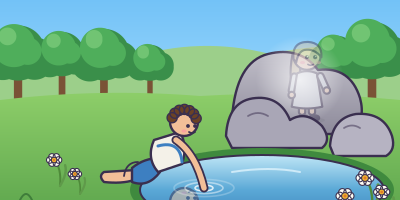
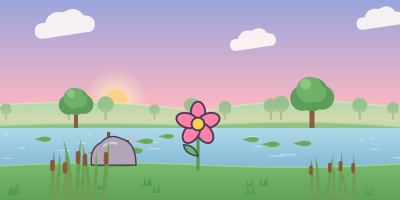
Deep in the forest there was a pool of perfectly clear water, smooth as a mirror. No goats had ever drunk from it, and no leaves had ever fallen in it. Soft grass grew around its edge, and tall rocks shaded it from the sun. One hot day, Narcissus came to the pool, tired and thirsty after a long hunt. He knelt on the grass and bent down to drink, and there in the water he saw a face looking up at him.
It was the most beautiful face he had ever seen, with curly hair, bright eyes, and a lovely smile. Narcissus did not understand that it was only his own reflection. He thought a water spirit lived in the pool. He smiled, and the face smiled back. He reached out his hand, and the face reached out too. But when his fingers touched the water, the face broke into ripples and vanished. He waited, and slowly it came back.
"Why do you run from me?" Narcissus asked the face. "When I smile, you smile. When I reach for you, you reach for me. Why will you not come out?" The face only moved its lips when he moved his. For the first time in his life, Narcissus knew how it felt to love someone who would never love him back. He could not stop looking. He forgot to hunt, and he forgot to eat, and he forgot to go home.
Days went by, and Narcissus stayed beside the pool. He grew thin and pale, just as Echo had, and his bright eyes grew tired. Echo had never stopped caring about him, and she stayed close by, unseen among the rocks. When he sighed, "Oh, dear," she sighed, "Oh, dear." At last he whispered to the face in the water, "Goodbye." And from the stones came a soft voice, "Goodbye."
The next morning, the nymphs of the forest came looking for him. They searched the pool and the grass and the rocks, but Narcissus was gone. In the place where he had knelt, there was a flower they had never seen before. It had white petals around a golden center, and it bent its head over the water, as if it were still gazing at its own reflection.
People still call that flower the narcissus, and every spring it nods beside ponds and streams, bending toward the water. And people still use the word echo for the voice that answers from the hills. The two of them never did meet properly. One loved too much and could not say it, and the other loved only himself. But if you stand by a pond full of white flowers and say hello, someone may answer you.
Questions
- Echo sang too loudly at night
- Echo used her talking to trick Hera
- Echo was rude to Narcissus
- She could only repeat his last words
- She was too far away
- She did not know his name
- A water spirit
- Echo hiding under the water
- His own reflection
- Little waves
- Small fish
- Bright lights
- It makes you a better hunter
- It can leave you lonely and stuck
- It helps you make friends
- It speaks first
- It sings a song
- It repeats your last words
Words to know
- nymph: nature spirit
- repeat: say again
- reflection: mirror picture
- apologize: say sorry
- ripples: little waves
Answer key: Echo and Narcissus
- B. Echo used her talking to trick Hera
- A. She could only repeat his last words
- C. His own reflection
- A. Little waves
- B. It can leave you lonely and stuck
- C. It repeats your last words
The story in pictures
- Part One · The Nymph Who Talked
- Part Two · The Proud Hunter
- Part Three · Only a Voice
- Part Four · The Still Pool
- Part Five · The Flower by the Water

For the teacher: how this passage is levelled
“Echo and Narcissus” is a reading level 9 story. Every Peabody story at this level is written and checked to keep sentences to 32 words or fewer, to aim at an average of 11 words a sentence, and to show 55 to 85 words on a screen. At most 11% of its words may be off the familiar-word list. Children in 5th grade start at this level.
| This passage | 1154 words, 15 screens, 6 multiple-choice questions with an answer key, and 5 vocabulary words with kid-sized meanings |
|---|---|
| Longest sentence at this level | 32 words |
| Words on a screen | 55 to 85 |
| Skills practised at this level | vocabulary, spelling |
Reading level 9: the limits, a real sample and the free games. Peabody is a learning app, not an assessment: use the questions to talk about the story, not to grade a child.