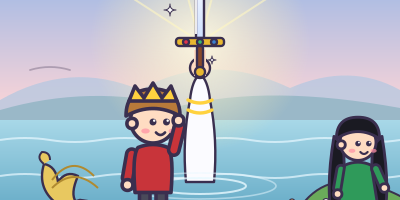
Excalibur and the Lady of the Lake
King Arthur was resting in the Forest of Usk on a warm spring afternoon, surrounded by his knights, when a wounded stranger rode out of the trees with his head hanging on his chest. He came from a distant country, his young page explained, and had been seeking adventure when three golden-haired women, tossing a golden ball on a lawn, had pointed him toward a stone bridge across a river. On the bridge hung a black shield with a brass hammer beside it, and a warning in red letters: whoever struck the shield did so at his peril. The knight had struck it, and a giant in black armor had ridden out of the castle beyond and hurled him from his horse. Then the black knight had hung the stranger's shield on an apple tree, and gone inside without a backward look.
A young squire named Griflet begged to be made a knight, so that he could go and punish the black giant, and although Arthur had a bad feeling about it, he could not refuse. Griflet rode away singing. By evening he was carried back on his horse, his shield gone and a broken spearhead lodged in his side, and the wounded stranger had died. Arthur sat up all night, pacing the floor of his tent. At dawn he put on his armor, climbed onto a milk-white horse and rode off alone, telling himself that a king who let such an insult stand did not deserve to be one. He did not stop to wonder whether he might be wrong.
In a clearing he came upon three sooty ruffians chasing an old man with a white beard, and he charged them with a shout, and they ran away into the bushes. The old man turned out to be Merlin, who had been at the court that morning and had no business being here. "I may have saved your life," said Arthur, pleased with himself. "You may have thought so," said Merlin, "but I could have saved myself without any trouble. I wanted you to understand that there is a real danger waiting for you ahead, and no one will be around to help. Let me come with you." Arthur said he would not turn back for anything, but Merlin could ride beside him if he liked.
They found the bridge exactly as the page had described it. On the apple tree beyond hung a hundred shields, some of them clean, some hacked and bloodstained, and the black shield swung from its chain in the middle of the bridge. Arthur struck it with the brass hammer so hard that the echo rattled the castle walls. Out rode the giant knight, and they charged each other three times. Twice the spears splintered and neither man fell, and the third time Arthur's saddle strap burst, and he was almost flung to the ground. They dismounted and fought with swords, and neither would give way, until Arthur struck so hard that his blade broke into three pieces, leaving him unarmed in front of an enemy with a sharpened sword.
The black knight's blow split Arthur's helmet, and for a moment the whole world whirled around him. Yet Arthur still would not surrender. He caught the black knight in a wrestling grip, threw him heavily to the ground, and tore off his helmet, and found himself looking at King Pellinore, a rival he had driven out of his lands years before and who had been lurking in this forest ever since, taking revenge on every knight that passed. They both lay gasping, and in the confusion Pellinore pinned Arthur down and raised a dagger, until Merlin leaped between them, shouting that the man on the ground was the king of all Britain. Then Merlin tapped Pellinore with his staff, and the giant fell into a deep sleep.
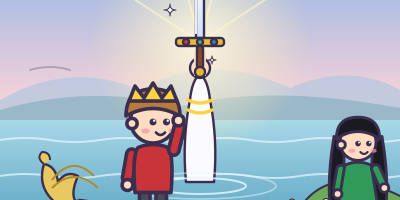
For two days Arthur lay in a hermit's cell, so pale and weak that visitors thought he was dying. When his strength began to return, he sat up and said that he intended to fight again, even if all he could find to fight with was an oak branch. Merlin smiled. In another part of the forest, he said, there was a land of enchantment, and in the middle of it a lake, and in the middle of the lake a woman's arm, dressed in white silk, holding up a sword called Excalibur. Many knights had tried to take it, and many had drowned. But if Arthur wished to try, Merlin would show him the way.
The next noon they followed a white doe through the woods, past a lawn where a table was already laid, and into a country where the air itself seemed made of gold. Flowers crowded the lakeshore, and birds sang in blossoming trees, and there was no village, no road and no person to be seen. In the center of the water, exactly as Merlin had promised, a slim arm rose from the surface, wearing bracelets of gold, and in its hand it held a sword whose jeweled hilt glittered in the sun. As Arthur gazed at it, a lady in a green gown walked toward him through the flowers. Her hair was black and so long that it brushed the grass, and she told him her name was Nymue, the chief of the Ladies of the Lake.
"Nobody can win that sword," she warned him gently, "unless he is without fear and without reproach." Arthur confessed that there were many things he reproached himself for, but he wanted to try anyway. Nymue put an emerald whistle to her lips, and out across the water, shining like a swan, came a boat of carved brass. Arthur stepped aboard, and it carried him swiftly to the sword. He reached out and took hold of the hilt, and the arm sank quietly beneath the surface. In his hand lay Excalibur, with its belt and its scabbard, and it was lovelier than anything he had dared to imagine. The brass boat carried him back to the shore, where he thanked the Lady of the Lake with all his heart.
The next day Arthur rode back to the bridge of shields, ordering Merlin to keep his magic out of the fight. He struck the black shield, and out came Pellinore, rested and fierce, and this time the two kings fought with swords from the beginning. But Excalibur was a different sort of blade. Pellinore fell back, wounded again and again, and Arthur received not a single scratch, and at last Pellinore sank to his knees and asked for mercy. Arthur gave it. He even restored the lands he had once taken, asking only that Pellinore's two eldest sons join him at court. They came, and in time they grew into well-known members of the Round Table, and the shields on the apple tree were taken down and returned to their owners.
As they rode home through the cool green woods, Merlin asked a curious question. "Which would you rather have, the sword or its scabbard?" Arthur answered at once that he would take Excalibur, for a hundred times over. "Then you are wrong," said Merlin, "because whoever wears the scabbard cannot be wounded in battle or lose a drop of blood. Did you not notice that you came out of the fight with Pellinore without a scratch?" Arthur frowned, and was silent for a long time. Then he said it did not seem right to him to win battles by enchantment. He thought he might take the sword back to the lake. Merlin replied that a king's life belongs to his people, and that Arthur had no right to throw it away.
So Arthur kept both, the sword and the scabbard, and the Round Table, the quest for the Holy Grail and all the great deeds of his reign were to come afterward, with Excalibur by his side. He made a chest bound with iron and fastened with three locks to hold it, and he let it shine only on days when he needed it, and when he drew it in battle, it blazed so brightly that his enemies trembled before the blade touched them. But he made one promise to himself that day beneath the leaves: he would never again draw Excalibur in a game, but only when the safety of his people required it. And the old tellers always remember that the scabbard, in the end, was lost to him by a betrayal, and that it cost him dearly.
Questions
- He was hungry
- He felt a king could not allow such an insult to stand
- Merlin told him to
- He cast a sleep spell on Pellinore
- He drew his own sword
- He asked Pellinore to forgive Arthur
- A boat of brass
- To be without fear and without reproach
- A magic word
- He wanted to win fairly, but he also had a duty to his people
- He was afraid of magic
- He did not like gifts
- Reward
- Danger
- Delight
- He was banished
- Arthur forgave him and restored his lands
- He became king
Words to know
- peril: danger
- hermit: person living alone
- scabbard: sword case
- mercy: kindness to enemies
- reproach: blame
Answer key: Excalibur and the Lady of the Lake
- B. He felt a king could not allow such an insult to stand
- A. He cast a sleep spell on Pellinore
- B. To be without fear and without reproach
- A. He wanted to win fairly, but he also had a duty to his people
- B. Danger
- B. Arthur forgave him and restored his lands
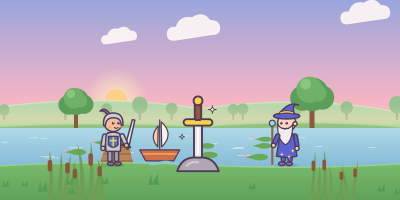
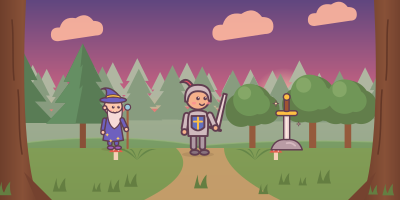
The story in pictures
- Part One · The Bridge of Shields
- Part Two · The Lake
- Part Three · The Sheath
For the teacher: how this passage is levelled
“Excalibur and the Lady of the Lake” is a reading level 13 story. Every Peabody story at this level is written and checked to keep sentences to 62 words or fewer, to aim at an average of 15 words a sentence, and to show 100 to 145 words on a screen. At most 19% of its words may be off the familiar-word list. Readers reach this level by climbing, not by grade.
| This passage | 1425 words, 11 screens, 6 multiple-choice questions with an answer key, and 5 vocabulary words with kid-sized meanings |
|---|---|
| Longest sentence at this level | 62 words |
| Words on a screen | 100 to 145 |
| Skills practised at this level | vocabulary, spelling |
Reading level 13: the limits, a real sample and the free games. Peabody is a learning app, not an assessment: use the questions to talk about the story, not to grade a child.