The Beggar in the Hall
For twenty years, Odysseus's house on the island of Ithaca had been waiting for him, and by now nearly everyone had completely stopped believing that he would ever return. Dozens of young lords from the nearby islands had moved into his halls, consuming his cattle and drinking his wine and demanding that his wife, Penelope, choose one of them for a husband. Their leader was a handsome, arrogant man named Antinous, and Odysseus's son Telemachus, who had been a baby when his father sailed to Troy, was now a young man who was powerless to evict them. Then one morning a ship came quietly into a secluded harbor, and an unfamiliar stranger stepped ashore.
The goddess Athena had completely changed Odysseus's appearance so that nobody would recognize him. His hair had turned gray and thin, his skin was wrinkled and weathered, and he wore filthy rags with a patched bag hanging from his shoulder. He went to the humble hut of Eumaeus, the swineherd, who had once been his own servant and who welcomed the beggar kindly, fed him generously and offered him a bed beside the fire. A day later Odysseus secretly met his son, and they swore to keep the secret between them. Then the old swineherd led the beggar up the rough road toward the city, where the king's house stood on its hill, with its courtyards and battlements, exactly as Odysseus remembered it.
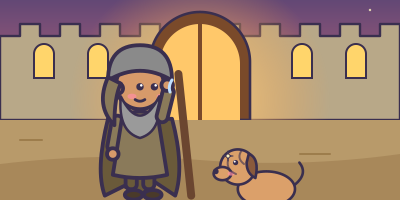
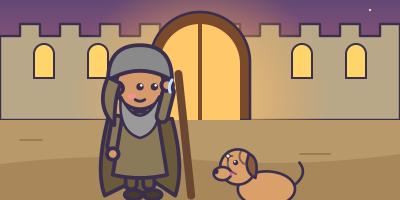
On the way they encountered a goatherd named Melanthius, who sneered contemptuously at them and kicked the beggar hard in the thigh. Odysseus seriously considered knocking the man into the ditch, but decided to wait. At the courtyard gate, they heard a lyre playing in the hall, and there on a heap of dirt lay an old dog, so thin that his ribs were visible, and so neglected that his coat was covered with ticks. He had once been the swiftest hound in the whole of Ithaca, and his name was Argos, and Odysseus himself had raised him from a puppy. The dog lifted his head, looked at the beggar, and recognized him.
Argos could not stand, but his tail moved a little, and he laid his ears back against his skull, the way he used to when his master came home from hunting, and he whined once, softly. Odysseus saw him and quickly looked away, and wiped a tear from his cheek with the edge of his hand, so that Eumaeus, who was walking in front of him, would not notice. "What an extraordinary hound that must have been," he said, as casually as he could manage. "He's a fine dog. A great pity." Then he went on into the hall, and behind him, in the dirt of the yard, Argos laid his head on his paws and died.
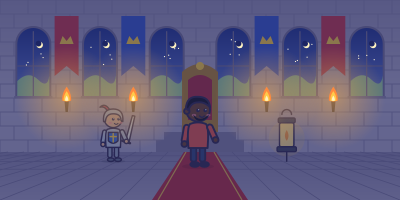
Inside, the great hall was full of laughter and tremendous noise and the smell of roasting meat. Odysseus sat down on the threshold, in the place where beggars customarily sat, and Telemachus, who was at a table with the lords, sent over bread and meat. When he had eaten, the beggar rose and began to move through the room with an open hand, asking each of the lords for a scrap. Some of them gave something, but Antinous looked at him as though he were a stain on the floor. "Who brought this fellow here?" he demanded. "Don't we have enough vagabonds eating our food?" Odysseus remarked mildly that a man with such an abundant table might spare a morsel.
Antinous grabbed a footstool and hurled it, and it struck the beggar hard between the shoulder blades, and the whole hall waited for him to fall, but he did not even stagger. He turned and looked at Antinous for a moment, in silence, then went back to the doorway and sat down. Telemachus gripped the edge of the table, his face burning with fury, and stayed exactly where he was. "There is no shame in a blow taken in battle," Odysseus said, to nobody in particular. "But to be struck for asking for bread is shameful to the man who throws. If there is a god who looks after beggars, may he remember this." Some of the lords looked distinctly uncomfortable, but Antinous only laughed.
Penelope had heard the commotion from her upstairs room, and she sent a servant to bring the stranger to her, because he had traveled widely and might have heard something about her husband. Odysseus sent back an answer: he would gladly speak with the queen, but not while the lords were in the hall, and could he sit by the fire when the hall was empty? That evening, after the lords had finally gone home, Telemachus and his father quietly carried every weapon down from the walls and concealed them in a storeroom, and Penelope came down the stairs with her maids and sat by the hearth. For the first time in twenty years, she was sitting only a few feet from her husband.
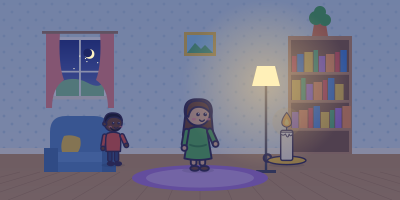
"Tell me who you are," said Penelope. "Nobody worth remembering," said the beggar, "but your name is known in many countries." She told him how she had kept the wooers waiting. "I told them I would choose a husband when I finished weaving a burial cloth for my husband's father. Every day I wove it, and every night I unwove it by torchlight, so it never grew longer. It worked for three years, until one of my maids betrayed me." Odysseus listened, silently admiring her. She asked if he had ever met Odysseus. He described a purple cloak and a gold brooch with a hound and a fawn, and Penelope began to cry, because only a man who had really seen her husband could have known such things.
She ordered the old nurse, Eurycleia, to wash the stranger's feet. The old woman knelt, took one foot in her hands, and suddenly became completely motionless. Along the shin, from the knee to the ankle, ran a long, pale scar, left by a boar that had gored Odysseus when he was a boy. She had washed that leg when he was a child. She let go and the basin tipped, and she looked up into his face and whispered his name. Odysseus laid a hand lightly over her mouth, and put a finger to his lips. "You must say nothing," he breathed. "Not even to Penelope. Not yet." The old nurse nodded, her eyes streaming with tears, and wiped up the spilled water as though nothing extraordinary had happened.
At the end of the evening, Penelope announced that she could not postpone her decision any longer, and that in the morning she would hold a contest. Her husband's great bow still hung in the house, and she would marry whichever of the lords could string it and shoot an arrow through twelve iron axe-heads set in a row, as Odysseus had once done. "That is good advice," said the stranger. "Do not delay. Let it be tomorrow." Penelope looked at him curiously for a moment, thanked him, and went up to bed. Odysseus lay down in the porch among the sleeping dogs and listened to his own house breathing, and waited patiently for the morning, and the bow.
Questions
- Athena had changed his appearance
- He wore a mask
- He had grown a beard
- The old hound Argos
- Antinous
- Telemachus
- He was patient, because revealing himself too early would ruin his plan
- He was afraid
- He had not seen it coming
- By weaving a cloth by day and unweaving it by night
- By hiding in a tower
- By sending them to Troy
- He could control his temper to protect something larger
- He was a coward
- He did not care about his house
- Force someone to leave
- Invite someone in
- Feed someone
Words to know
- battlements: notched wall tops
- arrogant: proudly rude
- evict: force out
- vagabonds: wanderers without homes
- hearth: fireplace
Answer key: The Beggar in the Hall
- A. Athena had changed his appearance
- A. The old hound Argos
- A. He was patient, because revealing himself too early would ruin his plan
- A. By weaving a cloth by day and unweaving it by night
- A. He could control his temper to protect something larger
- A. Force someone to leave
The story in pictures
- Part One · The Old Dog
- Part Two · The Hall
- Part Three · The Web and the Scar
For the teacher: how this passage is levelled
“The Beggar in the Hall” is a reading level 13 story. Every Peabody story at this level is written and checked to keep sentences to 62 words or fewer, to aim at an average of 15 words a sentence, and to show 100 to 145 words on a screen. At most 19% of its words may be off the familiar-word list. Readers reach this level by climbing, not by grade.
| This passage | 1212 words, 10 screens, 6 multiple-choice questions with an answer key, and 5 vocabulary words with kid-sized meanings |
|---|---|
| Longest sentence at this level | 62 words |
| Words on a screen | 100 to 145 |
| Skills practised at this level | vocabulary, spelling |
Reading level 13: the limits, a real sample and the free games. Peabody is a learning app, not an assessment: use the questions to talk about the story, not to grade a child.