Hermes and the Cattle
High on a mountain in Greece, in a shady cave, a nymph named Maia once gave birth to a baby boy. His father was Zeus, the king of the gods, and the baby was called Hermes. He was no ordinary baby. Most babies sleep, and wriggle, and cry for their milk. But this one was awake and thinking almost at once, and he was already full of plans, clever ones and mischievous ones.
He was born at dawn, and by the middle of the morning he was tired of lying in his cradle. While his mother slept, he wriggled out of his blankets and climbed down on his small, strong legs. He toddled to the mouth of the cave and looked out at the bright green mountain. "Today," Hermes said to himself, "I am going to do something grand." And he had no idea how grand it would be.
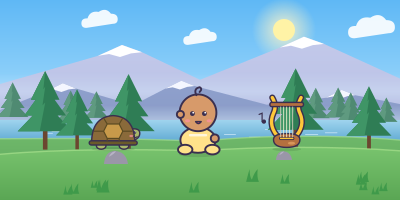
Right outside the cave lay an old tortoise shell. The tortoise that had once lived in it was long gone, and the sun had dried the shell until it was hard and empty. Hermes picked it up, turned it over in his small hands and laughed with delight. "What a lovely shape," he said. "I know just what to make of you!" He sat down on the stone doorstep and went to work, tapping and measuring and humming to himself.
First he cut stalks of reed and fixed them across the hollow shell. Then he stretched a piece of ox hide over the front, as tight as the skin of a drum. He fitted two curved arms on either side, joined them with a crosspiece, and strung it with seven strings made of sheep gut. At last he plucked each string in turn with a little pick, and each one sang out, loud and sweet.
Hermes had made the very first lyre. He picked it up and tried a song, quick and gay, the sort young people sing to tease one another at a festival. He sang about his father, Zeus, and about his mother, Maia, and about the comfortable cave that was their home. The music floated over the mountain. It was wonderful. But even as he sang, Hermes had another idea at the back of his mind, and it was not a quiet one.
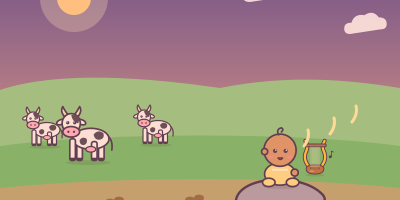
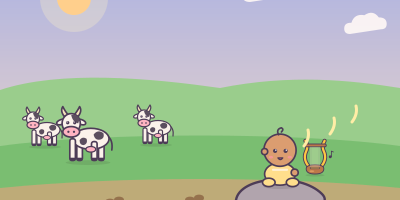
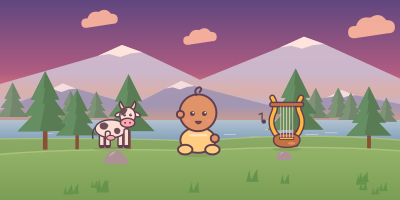
He laid the lyre in his cradle and slipped away down the mountain, for he had decided to go to the meadows where his brother Apollo kept his cattle. Apollo was the god of the sun, and he owned a fine herd of long-horned cows that grazed on the grass of Pieria. As the sun went down, Hermes crept up to the edge of the meadow and counted fifty fat cows. "Very nice," he whispered.
He drove the cows off down the hillside, but a clever thief always remembers that footprints can give him away. So Hermes made the cows walk backward, with their tails first, so that the prints in the dust seemed to point toward the meadow instead of away from it. Then he wove himself a pair of sandals from tamarisk branches and twigs, which left strange marks that no one could read. He walked behind them all, quietly steering.
He hid the cows in a cave far from the meadow and shut them in for the night. Then he hurried home through the dark with his twig sandals tucked under his arm. Hermes slipped back into the cave by the keyhole, as softly as a mist, and he tucked himself into his cradle with the lyre beside him. He pulled his blankets up to his chin and looked as innocent as any baby that ever slept.
But his mother had woken up, and Maia was not fooled. "You rascal," she said, "where have you been? Apollo will be furious, and then what will become of you?" Hermes only yawned. "I am going to be the greatest god of all," he said, "and I do not mean to stay in a dark cave all my life." Maia sighed. She knew he had decided on something, and she knew he was clever.
The very next morning Apollo came striding up the mountain with a frown on his face. A bird had told him a baby had been seen near his cows, and he had followed the trail with his sharp eyes. He came to the cave and looked at the baby in the cradle. "Where are my cows?" he demanded. Hermes opened his eyes as wide as he could, and then, to his own great surprise, he discovered that he did not want to deceive his big brother after all.
"I took them," said Hermes at last. "They are safe, and I will show you where." Apollo had been ready for a long argument, and he blinked. Zeus, who was watching from far above, burst out laughing at his clever little son. He told both of them to go and fetch the cows, and he said that they must settle things fairly, as brothers should. So the two of them set out together down the mountain.
When they reached the cave, Apollo saw all his cows safe and sound, and none of them was hurt. Hermes stood in front of him, with the lyre in his hands, and began to play. Apollo had heard the music of every god and every muse, but he had never heard anything like this. He forgot that he had been angry. "What is that?" he asked. "I must have it!"
"Take it," said Hermes, and he put the lyre into his brother's hands. Apollo plucked the strings, and a sound of pure gold rang through the cave. He was so delighted that he gave Hermes a whip for herding the cows, and he said, "From now on you will be my friend." Hermes took the cows back to their meadow, and he and Apollo walked up the mountain side by side. And from that day on, the Greeks said, the two brothers were friends, and the lyre was played by Apollo.
Questions
- A tortoise shell, reeds and strings
- A wooden bowl and a rope
- A hollow log and a bell
- The cows wanted to go that way
- So the footprints would point the wrong way
- To make them run faster
- Even angrier at Hermes
- Delighted, and he forgot his anger
- Sleepy
- Owning up helped to end the trouble
- Apollo always wins in the end
- Cows are easy to find
- Not guilty of doing anything wrong
- Very hungry
- Fast asleep
Words to know
- lyre: small harp
- mischievous: playfully naughty
- herd: group of cows
- tamarisk: a shrub
- innocent: blameless
Answer key: Hermes and the Cattle
- A. A tortoise shell, reeds and strings
- B. So the footprints would point the wrong way
- B. Delighted, and he forgot his anger
- A. Owning up helped to end the trouble
- A. Not guilty of doing anything wrong
The story in pictures
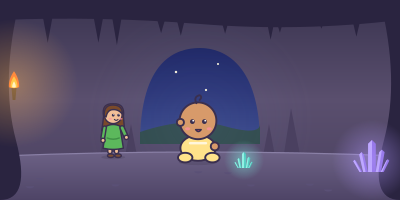
- Part One · The Baby in the Cave
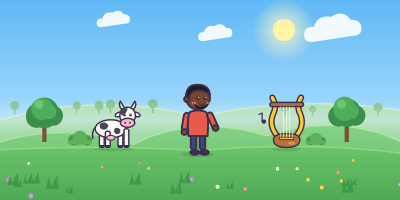
- Part Two · The First Lyre
- Part Three · The Backward Cows
- Part Four · Apollo Comes
- Part Five · The Trade
For the teacher: how this passage is levelled
“Hermes and the Cattle” is a reading level 10 story. Every Peabody story at this level is written and checked to keep sentences to 38 words or fewer, to aim at an average of 12 words a sentence, and to show 70 to 100 words on a screen. At most 13% of its words may be off the familiar-word list. Children in 6th grade start at this level.
| This passage | 1014 words, 13 screens, 5 multiple-choice questions with an answer key, and 5 vocabulary words with kid-sized meanings |
|---|---|
| Longest sentence at this level | 38 words |
| Words on a screen | 70 to 100 |
| Skills practised at this level | vocabulary, spelling |
Reading level 10: the limits, a real sample and the free games. Peabody is a learning app, not an assessment: use the questions to talk about the story, not to grade a child.