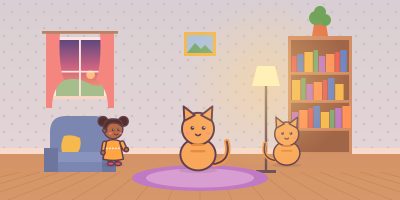
Hum Under My Hand
Rosie sat on the couch with a book, and her cat, Nutmeg, hopped up beside her. He turned around two times and settled down comfortably. Then Rosie felt something strange under her hand, because Nutmeg was humming. It was a low, soft buzz that went on and on and on. "Nutmeg," she said, "why do you do that?"
A cat's hum is called a purr. It sounds a little like a soft, rolled r, so Rosie tried to do it herself, and it tickled her throat. "Rrrrrrr." Nutmeg looked at her carefully and kept on purring. His purr was deeper than hers, and some cat purrs can be even deeper than the lowest notes that most grown-ups can sing.
"When does he purr?" Rosie asked her dad. "Think about it," said Dad. Rosie thought about all the different times. Nutmeg purred when she petted him, when she filled his dinner bowl, and when she scratched his chin. "He purrs when he feels good!" said Rosie. "Often," said Dad. "Not always."
"Cats start to purr when they are babies," said Dad. "A mother cat feeds her kittens, and they purr while they drink." Rosie smiled, because Nutmeg was a kitten once. When he was tiny, he pushed his paws against his mother, in and out, in and out. That pushing helped the milk come.
Just then Nutmeg began to pat the blanket with his front paws, pat, pat, pat. "He is doing the baby thing!" said Rosie. Nutmeg purred louder. Cats call this kneading, the way a baker kneads dough. Many cats purr while they do it, and it may be a kitten habit that stays with them.
But once, Nutmeg purred in a place that was not cozy at all. It was the vet's office, and a stranger was touching his side. His whole body shook while he purred and purred. Was he happy? Not really. Cats also purr when they feel worried or sore, so a purr does not always mean, "I am happy."
"How does he make that sound?" Rosie asked the vet. "That is a very good question," said the vet. "Some scientists think the sound is made in the voice box, up in the throat. But they are still working out exactly how it happens, and nobody knows for sure." Rosie liked that, because a puzzle was still waiting.
That night all the lights were off, but Nutmeg purred in the dark, and his eyes shone like two little lamps. "Your eyes are glowing!" Rosie whispered. At the back of a cat's eye is a layer that works like a mirror. It bounces the light around, so a cat can see in places where Rosie sees only shadows.
In the morning, Nutmeg squeezed underneath the bed to find his ball. It looked like an impossible fit, but he slid right through. A cat can often squeeze through a gap that its head can fit through. His whiskers helped, too. They tell a cat when it is close to a wall or a chair, even if it cannot see well.
After lunch, Rosie dangled a toy mouse on a string. Nutmeg dropped low to the ground, and the tip of his tail twitched from side to side. He crept closer with his claws tucked in, so he made no sound at all. Then his back end began to wiggle. Wiggle, wiggle, wiggle. POUNCE!
Rosie tossed the toy mouse across the floor, and Nutmeg crept after it, slow and low. Then he stopped and sat perfectly still, with his eyes on the mouse. Some cats creep up, and some cats wait for prey to come close. Nutmeg tried both ways, and Rosie laughed, because he was wonderful at catching toys.
At the end of the day, Nutmeg walked across the room with his tail straight up. Rosie looked at him and blinked her eyes very slowly. Nutmeg blinked back, slowly and softly. Scientists have found that cats come closer to people who blink slowly at them.
He climbed into her lap and curled up, and the hum began again, soft and low. Rosie did not know all the reasons for it. Scientists do not know them all, either. She put her hand on his warm side and felt the buzz. Try it with a cat you know. Blink slowly, and see what it does.
Questions
- Nutmeg was humming
- Nutmeg was sneezing
- Nutmeg was asleep
- He was very happy there
- He was worried or sore
- He wanted his dinner
- Pressing in and out with the paws
- Washing his face
- Running fast
- Hear far away
- Feel when it is close to things
- Taste its food
- How a cat makes a purr
- What a cat's name is
- Where cats sleep
Words to know
- purr: low cat hum
- kneading: pressing with paws
- whiskers: feelers on face
- scientists: people who study
- vet: animal doctor
Answer key: Hum Under My Hand
- A. Nutmeg was humming
- B. He was worried or sore
- A. Pressing in and out with the paws
- B. Feel when it is close to things
- A. How a cat makes a purr
Teaching a mixed class? Cats at three reading levels
Three true passages from the same facts, a basic, a middle and an advanced one, so every group reads about the same thing and the class can talk about it together. Print one PDF: a sheet for each group, marked with a shape instead of a level, and a page for you that says which is which.
- ● Hum Under My Hand (this passage)Basic, for about 6 to 8 · reading level 8 · 726 words · Flesch-Kincaid grade 2.9 · 5 questions
- ▲ Why Do Cats Purr?Middle, for about 9 to 12 · reading level 10 · 937 words · Flesch-Kincaid grade 5.2 · 6 questions
- ■ The Problem With a PurrAdvanced, for about 13 to 16 · reading level 14 · 1230 words · Flesch-Kincaid grade 9.3 · 6 questions
The story in pictures
- Part One · The hum
- Part Two · Kittens
- Part Three · The puzzle
- Part Four · Night eyes
- Part Five · The hunter
- Part Six · Hello
For the teacher: how this passage is levelled
“Hum Under My Hand” is a reading level 8 story. Every Peabody story at this level is written and checked to keep sentences to 26 words or fewer, to aim at an average of 10 words a sentence, and to show 40 to 65 words on a screen. At most 9% of its words may be off the familiar-word list. Children in 4th grade start at this level.
| This passage | 726 words, 13 screens, 5 multiple-choice questions with an answer key, and 5 vocabulary words with kid-sized meanings |
|---|---|
| Longest sentence at this level | 26 words |
| Words on a screen | 40 to 65 |
| Skills practised at this level | vocabulary, spelling |
Reading level 8: the limits, a real sample and the free games. Peabody is a learning app, not an assessment: use the questions to talk about the story, not to grade a child.