Why Do Cats Purr?
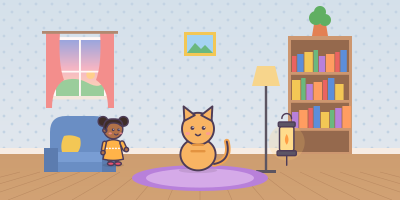
Every morning at six o'clock, Yara's cat, Juniper, climbed onto her chest and started to rumble. She could feel it in her ribs. It was a purr, but not a sweet, sleepy one. It sounded pushy, as if there were a whine hiding inside the hum. Yara had always believed that purring meant a cat was happy. But if Juniper was happy, why did she sound so bossy? And what, exactly, is a purr?
The usual answer is that cats purr when they are content. You hear it most in a nursing mother cat, and when a person strokes or feeds a cat. Kittens start to purr when they are very young, while they are still drinking their mother's milk. So a purr can mean "this is nice," and it can mean "I am here, and I am safe." Yara was pleased with that answer. Then she kept reading.
Cats also purr in places where they are not happy at all. A cat scientist at the University of California, Davis, points out that cats often purr at the vet's. They also purr while they are recovering from an injury. Yara pictured Juniper on the metal table at the vet's, shaking and purring, and she felt sorry for her. A purr, it seemed, could mean something close to the opposite of happy.
Then there is the sound itself. A purr is a low rumble that keeps going while the cat breathes in and while it breathes out. A house cat weighs only about ten pounds. Yet its purr can be lower than the lowest bass notes of an average human voice. That puzzles scientists. Big animals, such as elephants, have long vocal cords and deep voices, and smaller animals usually do not. So how does a small cat make such a big, low sound?
Yara laid her hand on Juniper's side and felt the buzz. Where was it coming from? For a long time, books said the answer was muscles. A cat, they said, squeezes and loosens the muscles in its voice box up to thirty times every second, with the brain sending a signal each time. Then scientists in Vienna tried an experiment. They blew warm air through the voice boxes of cats that had been put to sleep because they were very sick. The voice boxes purred. There was no brain and no muscle moving.
But not everyone is convinced. One scientist pointed out that a voice box on a table cannot tell you what a living, purring cat is doing. Yara pressed her ear against Juniper's side and listened. Then she tried purring herself, a low hum in her throat. It was nothing like Juniper's rumble. Whatever the answer was, it was happening right there under the fur, and nobody could say for sure how. One of the most famous animal sounds still has a secret inside it.
Back in her room, Juniper was still rumbling. Yara found her answer in a study led by Karen McComb, a scientist at the University of Sussex in England. Her team recorded ordinary purrs, and the purrs that cats made when they wanted food. Some hungry purrs had a high whine hiding inside them, about as high as the cry of a human baby. Juniper was not only purring. She was also adding a whine, and the whine was meant for Yara.
Then fifty listeners heard the recordings. People judged the purr with the hidden whine as more urgent and less pleasant, even people with no cat at home. That may explain why cat owners seem to jump up and fill the bowl at all hours. Yara looked at the empty bowl, and then at Juniper, who looked back at her without a flicker of shame. Yara had to admit that the whine had worked on her every single morning.
Lions, tigers, leopards and jaguars roar but do not purr. Cheetahs and cougars purr but do not roar. For years, books blamed a small bone in the throat, the hyoid, for the split. Then scientists noticed that the snow leopard, whose hyoid bends the way a lion's does, purrs anyway. So the throat bone cannot be the whole story. Yara looked at Juniper curled on the blanket and tried to imagine her roaring. She could not.
A few scientists wonder whether a purr helps a cat heal. Sounds in about the same range have been linked to stronger bones and faster healing in other studies. Yara thought of Juniper on the vet's table and wondered if the purr had been doing a job there. But nobody has watched a purr mend a hurt cat. Scientists call an idea like this a hypothesis, a careful guess that still needs testing. The question is still open.
Yara still wanted to know why six o'clock. Cats are most active near dawn and dusk, so Juniper's early alarm may simply be part of being a cat. Yara thought about every morning that Juniper had woken her long before the sun came up. She groaned and pulled the blanket over her head. It did not help, because a cat who wants something has plenty of ways to ask for it.
The next morning, Yara put her hand on Juniper again, and the rumble began at once, soft and low and ordinary, like a small engine. Juniper's eyes were half shut, and her paws kneaded the blanket. Her tail curled slowly around Yara's wrist. Was she happy? Was she soothing herself? Was she asking for breakfast? Nobody knows everything about a purr yet, not even the scientists. What do you think Juniper was saying?
Questions
- A high whine like a baby's cry
- A deep growl
- A tiny click
- Cats never purr when they are happy
- Cats also purr at the vet and when they are hurt
- Cats only purr at night
- Quiet and shy
- Sleepy and slow
- Demanding, as if bossing someone
- Cats must tighten muscles to purr
- A voice box can make a purr without muscles or a brain signal
- Cats cannot purr when they are asleep
- The idea is a careful guess, not a proven fact
- Cats do not need healing
- Purring is too quiet to study
- It sounded calmer than a plain purr
- It sounded more urgent and less pleasant
- They could not hear any difference
Words to know
- purr: low cat rumble
- bossy: ordering others around
- hyoid: throat bone
- pushy: bossy, demanding
- hypothesis: careful guess
Answer key: Why Do Cats Purr?
- A. A high whine like a baby's cry
- B. Cats also purr at the vet and when they are hurt
- C. Demanding, as if bossing someone
- B. A voice box can make a purr without muscles or a brain signal
- A. The idea is a careful guess, not a proven fact
- B. It sounded more urgent and less pleasant
Teaching a mixed class? Cats at three reading levels
Three true passages from the same facts, a basic, a middle and an advanced one, so every group reads about the same thing and the class can talk about it together. Print one PDF: a sheet for each group, marked with a shape instead of a level, and a page for you that says which is which.
- ● Hum Under My HandBasic, for about 6 to 8 · reading level 8 · 726 words · Flesch-Kincaid grade 2.9 · 5 questions
- ▲ Why Do Cats Purr? (this passage)Middle, for about 9 to 12 · reading level 10 · 937 words · Flesch-Kincaid grade 5.2 · 6 questions
- ■ The Problem With a PurrAdvanced, for about 13 to 16 · reading level 14 · 1230 words · Flesch-Kincaid grade 9.3 · 6 questions
The story in pictures
- Part One · The six o'clock purr
- Part Two · The rumble
- Part Three · How
- Part Four · The hidden cry
- Part Five · Roar or purr
- Part Six · Six o'clock again
For the teacher: how this passage is levelled
“Why Do Cats Purr?” is a reading level 10 story. Every Peabody story at this level is written and checked to keep sentences to 38 words or fewer, to aim at an average of 12 words a sentence, and to show 70 to 100 words on a screen. At most 13% of its words may be off the familiar-word list. Children in 6th grade start at this level.
| This passage | 937 words, 12 screens, 6 multiple-choice questions with an answer key, and 5 vocabulary words with kid-sized meanings |
|---|---|
| Longest sentence at this level | 38 words |
| Words on a screen | 70 to 100 |
| Skills practised at this level | vocabulary, spelling |
Reading level 10: the limits, a real sample and the free games. Peabody is a learning app, not an assessment: use the questions to talk about the story, not to grade a child.