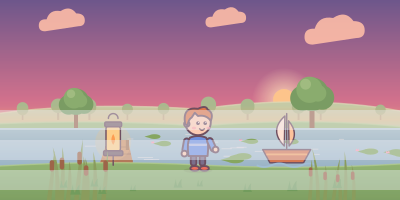
Marsh Light
Every evening at the first blue of dusk, Corwin climbed the ladder to the roof of the Lamphouse and lit the lamps. There were nine of them, set along the ridge like nine small, patient hearts. Each had to be lit in order, from the reed side to the water side, because the fog-wives said that a lamp lit out of turn would lead some boat astray. Nobody ever had to remind him.
The Lamphouse floated on the marsh, tied by a rope as thick as his arm to the stump of a drowned oak. It rose and fell with the tide so gently that you felt it only in your stomach. Corwin was eleven years old, and he had never once set foot on dry land. He had been left on the front step as a baby, in a boat no bigger than a bread trough. The three fog-wives had found him on a morning so thick that you could not see your own hand.
Maud was broad and brisk and made soup out of anything; Nell was thin and quiet and could mend a net in the dark. Old Marl was older than the oak, and she slept through most of the day and woke at dusk to pronounce the weather. They were not women, exactly. Their hair was fog and their hands were cool, and when they were pleased with him the kitchen grew warm.
On bad nights boats came looking for the Lamphouse: a fisherman far from harbor, a peat-cutter lost among the channels. The fog-wives went out across the water with long poles hung with lanterns to lead them home, while Corwin kept the lamps burning on the roof until the last boat was safe. It was the only work he knew, and he had never wanted any other. But this autumn he had begun to notice things.
He could see the kettle through Nell's hand when she poured; Maud's soup was as good as ever, but she sat down more. And on the foggy mornings there was a little less fog than there had been the year before. And every night, from the roof, Corwin could see the other light. It was a single yellow lamp, very small and very far, on the eastern shore, never lit late and never put out early. He had asked about it only once.
"Somebody keeps it," Maud had said, and put another bowl of soup in front of him. Nobody had ever told him that he could not go; the punt hung on its hook beside the door, and the marsh lay open in every direction. He stayed because the marsh was wide and he was small, and because every night there was supper. But he had never, in all those years, stopped looking at the light.
The boy came out of the fog on a Tuesday evening, standing in a leaking punt with a pole in one hand and a lantern in the other, and he was shouting. "Corwin!" he cried, in a high, cracked voice. "Corwin of the Lamphouse! Is anyone there?" Corwin stood still on the roof with a lit taper in his hand. He had watched the village children from a great distance, small figures on the mudflats, but he had never heard anyone say his name who was not one of the three people who loved him.
In the open air it sounded like a name that belonged to somebody else. By the time he had climbed down, the boy had run his punt aground in the reeds, and the three fog-wives stood in a row at the door. He was about Corwin's age, with a wide nose and a great many freckles, and he was wet to the knees. "Abner Gill, from Eastwater," he said, out of breath. "Everybody on the east shore knows you. The boatmen say the Lamphouse boy lights nine lamps at the same minute every night, like a clock."
"My Aunt Hesper keeps the shore lamp, and her eyes have gone. She cannot see to trim the wick, and I am no good at it. She says she would sooner have a lamplighter than a nephew. Will you come?" Nobody spoke. Corwin looked at Maud, who was smiling a little, and at Nell, who was so pale that he could see the lamplight through her sleeve, and at Old Marl, who had opened her eyes before dusk.
"Go on," said Old Marl, and it was the first time in his life that he had heard her speak before dark. "Tell him, Maud, for we have put it off all summer." So Maud told him, slowly, like someone setting down something heavy. The marsh was being drained at the east end, ditch by ditch, for peat, and fog needs wet. The fog-wives were made of fog, and the fog was going thin, and by midwinter, if the ditches reached the reeds, they would be nothing but weather.
"We did not tell you," said Nell, in a whisper, "because you would have stayed." "We have been trying to send you ashore for three years," said Maud, "and you keep finding reasons." Corwin stood very still. There was a roaring in his ears like the sound inside a shell, and a hot, bright anger in his chest. "You want me gone," he said. "We want you kept," said Old Marl. "That is a different thing, and it is a long way across."
He went up the ladder to the roof and sat among the lamps with his arms around his knees, and he looked, for the first time with his whole heart, at the little light on the far shore. It flickered, and Corwin watched it dim and brighten and dim again, and then it went out altogether. "That is the third night," said Abner, who had been given a blanket and a bowl of soup and had refused to leave. "She cannot see the wick."
Out on the marsh, a long way off, something knocked against the reeds, and a man's voice called, thin and cross, the way a man calls who has been lost for hours. Old Marl lifted her head. "Sedge," she said. "The Eastwater warden. He steers by two lights lined up, yours and hers, and two lights make a road through the rocks. One light only tells him where he is not."
Nobody had to say what came next. The fog-wives could lend a road across the water, but they could not go past the reeds, where the fog ended, and the lamp that had gone out stood on land. Corwin took the coat that Nell had been knitting for a year from fog and wool and had never mentioned, and Maud's bundle of bread and dried apples, and he stopped at the door. "I will come back," he said. "I know," said Maud, "and that is the whole idea."
Old Marl stood at the edge of the reeds with her hair streaming sideways in a wind that was not blowing. The three of them breathed out together, and a long white road of mist unrolled itself across the marsh, as firm as a plank, toward the east. He walked it with Abner behind him, and the marsh whispered on both sides. Little lights rose out of the black water, cold and green, the old marsh lights that lead travelers astray, and they drifted close and looked at him and did no harm, because he was wearing the coat.
At the edge of the reeds he looked back once. The three women stood small on the roof among their lamps, and all nine of the lamps were burning, lit in order. He raised one hand to them, and then he stepped out of the reeds onto the land, for the first time in his life, and the ground did not move at all. Eastwater was one lit street and a long stone quay.
The shore lamp stood in a stone hut at the end of the quay. Beside it on a stool sat a very small old woman with trimming scissors in her lap and her face turned toward the window. She did not look up, but she spoke. "You are the lamplighter," she said. "I can hear that you walk like somebody who is used to a floor that moves." She laughed, a little.
"Quick, now. The wick is the left one. Lift it with your thumbnail and cut it square." He cut it square. The flame stood up, steady and yellow, and from the dark water far out came a shout, and then another, nearer. The boat came in along the line of the two lights, with the warden at the oars, a man in a long coat with a face like a closed door.
He stepped onto the quay and looked out at the faint glow of the Lamphouse. The warden was quiet for a good while. "I have sworn at that house for eleven years," he said. "I said the fog took my brother's boat, and would take mine. I notice, however, that the fog has just brought me home." Corwin told him about the ditches. "Those are the peat company's," he said at last.
"I have been meaning to quarrel with them for years, and have not had a good reason." Corwin stayed at Eastwater for three days and learned from Hesper how to trim a wick with his eyes shut. On the fourth evening he borrowed a boat and rowed out through the reeds. He found the Lamphouse waiting, with Maud's soup on the stove and his chair kept and Old Marl awake.
Maud had set out an extra bowl, in case a boy from the east shore should be hungry. Nell, at the door, looked a little less thin, or perhaps he only wanted her to. Old Marl, awake, pronounced the weather: fog by morning, and more by Thursday. He climbed the ladder and lit nine lamps in order. Behind him, across the black water, the lamp on the shore burned low and steady, as if someone were learning to keep it.
Questions
- The fog-wives locked the door
- The marsh was wide, he was small, and he felt safe at home
- He did not know the east shore existed
- They were growing thin, and there was less fog
- They were growing louder
- They were leaving the Lamphouse each night
- They did not know it themselves
- They thought that he would stay to help them
- They were angry with him
- Two lights lined up make a safe road through the rocks
- Two lights are brighter than one
- He liked to read by them
- guards or watches over a place
- sells fish at the quay
- keeps bees
- It was out for good
- Somebody new, probably Abner, was learning to keep it
- Corwin took it back to the Lamphouse
Words to know
- marsh: wet low land
- warden: guard
- reeds: tall water grass
- peat: dug-up fuel
- flickered: shone unsteadily
Answer key: Marsh Light
- B. The marsh was wide, he was small, and he felt safe at home
- A. They were growing thin, and there was less fog
- B. They thought that he would stay to help them
- A. Two lights lined up make a safe road through the rocks
- A. guards or watches over a place
- B. Somebody new, probably Abner, was learning to keep it
The story in pictures
- Part One
- Part Two
- Part Three

For the teacher: how this passage is levelled
“Marsh Light” is a reading level 10 story. Every Peabody story at this level is written and checked to keep sentences to 38 words or fewer, to aim at an average of 12 words a sentence, and to show 70 to 100 words on a screen. At most 13% of its words may be off the familiar-word list. Children in 6th grade start at this level.
| This passage | 1694 words, 21 screens, 6 multiple-choice questions with an answer key, and 5 vocabulary words with kid-sized meanings |
|---|---|
| Longest sentence at this level | 38 words |
| Words on a screen | 70 to 100 |
| Skills practised at this level | vocabulary, spelling |
Reading level 10: the limits, a real sample and the free games. Peabody is a learning app, not an assessment: use the questions to talk about the story, not to grade a child.