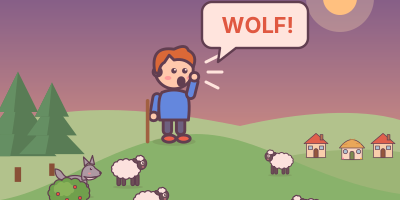
The Boy Who Fibbed
A boy named Tim watched the sheep on a hill.
It was dull. One day he had a bad plan.
He ran down and yelled, "Wolf! A wolf!"
The men ran up the hill. But there was no wolf.
Tim laughed. "I fooled you!" he said. The men went home mad.
The next day he did it again. "Wolf! Wolf!" he yelled.
The men ran up once more. There was still no wolf.
An old man said, "Do not fib, Tim." Tim did not stop.
One night, a real wolf came out of the trees.
"A wolf!" yelled Tim. "It is real!" He ran to town.
But nobody came. "It is a trick," said the men.
The wolf ran at the sheep. They ran off. It went away.
Tim looked all night. At last he found the sheep.
The old man helped him bring them home.
"Nobody believes a fibber," he said. Tim never fibbed again.
Questions
- On a hill
- In a boat
- In a barn
- A wolf
- No wolf
- A fox
- They did not hear him
- They thought it was a trick
- They were asleep
- A fox
- His dad
- An old man
- Sheep can run
- Nobody believes a fibber
- Wolves are big
Words to know
- fibbed: told a made-up tale
- trick: a joke to fool you
- real: not made up
Answer key: The Boy Who Fibbed
- A. On a hill
- B. No wolf
- B. They thought it was a trick
- C. An old man
- B. Nobody believes a fibber
For the teacher: how this passage is levelled
“The Boy Who Fibbed” is a reading level 5 story. Every Peabody story at this level is written and checked to keep sentences to 10 words or fewer, to aim at an average of 5 words a sentence, and to show 1 to 12 words on a screen. At most 6% of its words may be off the familiar-word list. Children in 2nd grade start at this level.
| This passage | 156 words, 15 screens, 5 multiple-choice questions with an answer key, and 3 vocabulary words with kid-sized meanings |
|---|---|
| Longest sentence at this level | 10 words |
| Words on a screen | 1 to 12 |
| Skills practised at this level | phonics (sounding words out), first sounds, sight words |
Reading level 5: the limits, a real sample and the free games. Peabody is a learning app, not an assessment: use the questions to talk about the story, not to grade a child.